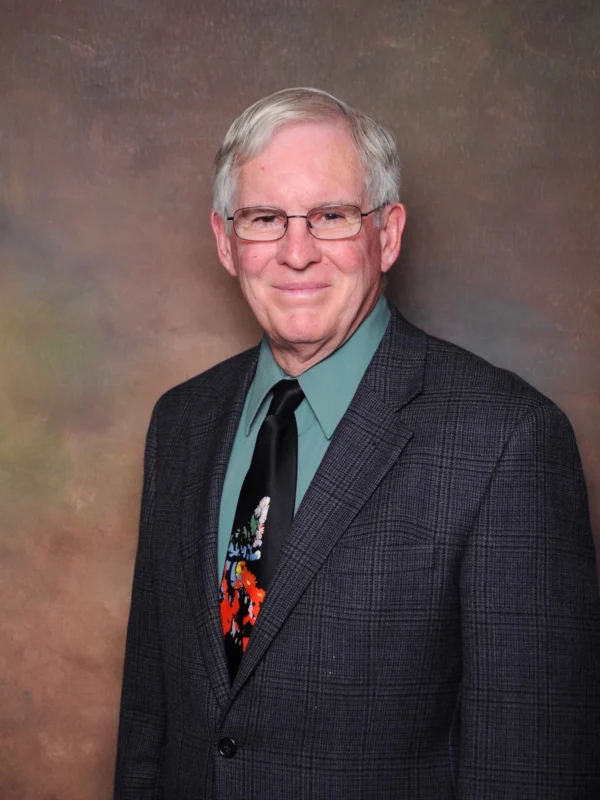
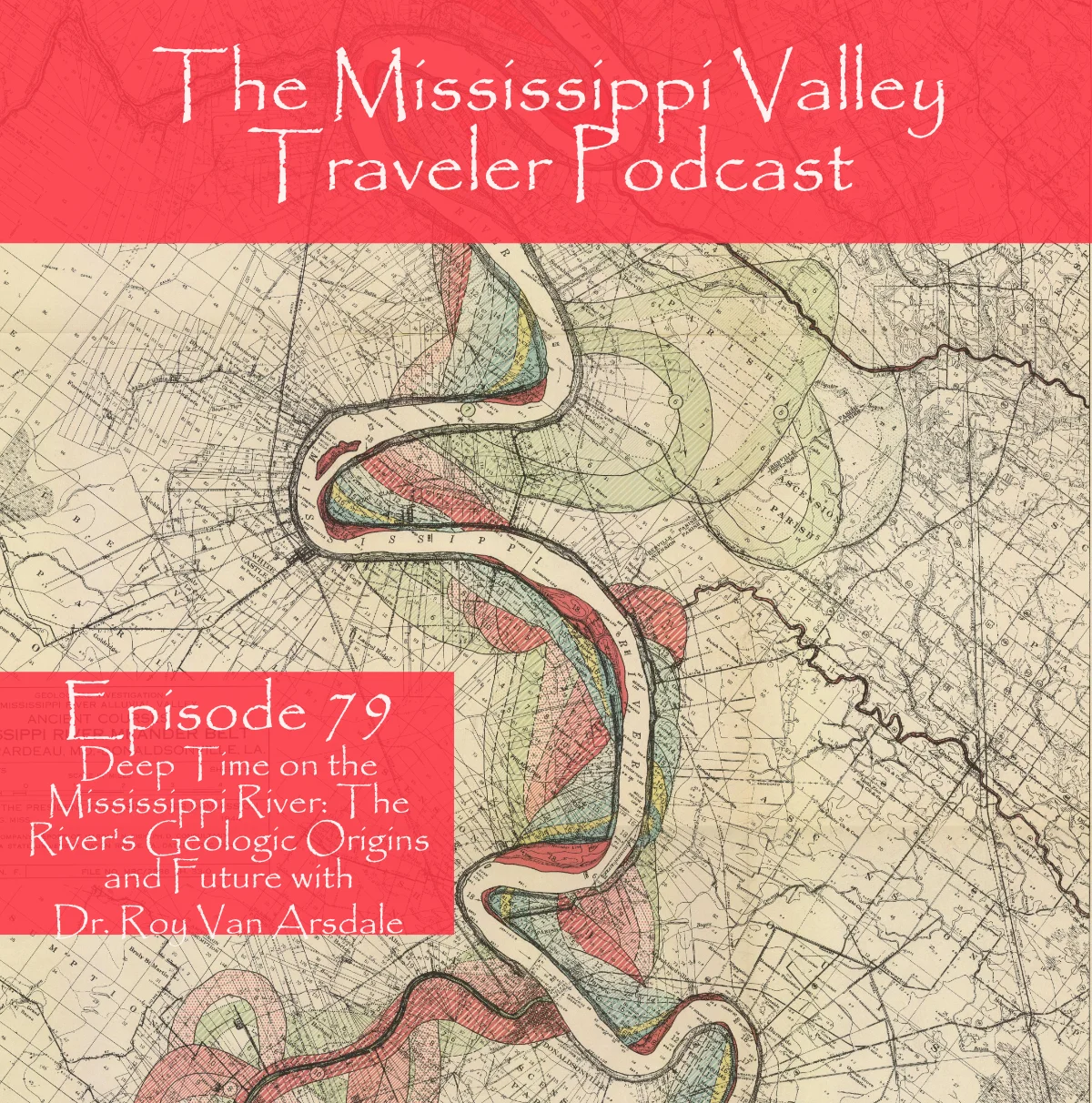
How do you tell the story of a river that’s tens of millions of years in the making? In Episode 79, I sit down with Dr. Roy Van Arsdale, Professor Emeritus at the University of Memphis, to trace the deep geologic history of the Mississippi River—and it’s a more dynamic ride than you might expect.
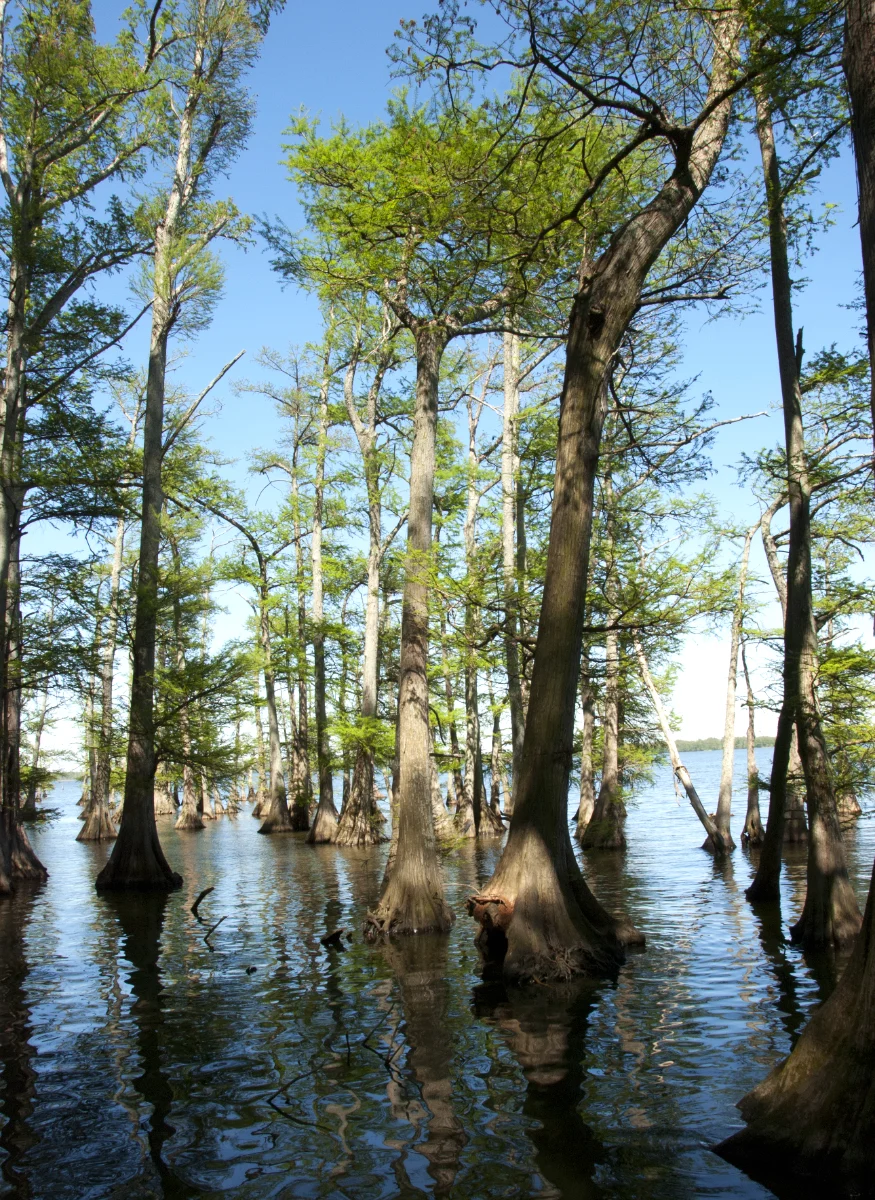
We go back 100 million years, to a time when rivers in North America generally flowed north and west, then follow the dramatic forces that reversed the continent’s plumbing, including a drifting hot spot that lifted part of a mountain range nearly two miles, which then eroded and sank, creating a trough for the river we call the Mississippi. Roy talks about the pre-Ice Age river that was much bigger than today’s Mississippi (and why it carried more water) and explains how glaciers rerouted the river’s course. He also describes one of his first studies where he learned how bald cypress tree rings in Reelfoot Lake still bear witness to the New Madrid earthquakes of 1811–12. We even peer into the river’s future, describing how uplift that is still in progress will likely change the future Mississippi River, as well as ongoing seismic risks.
If you’ve ever wondered how America’s greatest river came to be, this conversation is for you.
Show Notes
Here are the articles and books mentioned in the podcast:
- The Mississippi’s Curious Origins; Roy B. Van Arsdale and Randel T. Cox (2007 Jan); Scientific American, pp. 76-83.
- The New Madrid Earthquakes (2nd edition); James Penick (1981); University of Missouri Press.
- Geology, Archeology, and Earthquakes of the Central Mississippi River Valley; Roy B. Van Arsdale & David H. Dye (2024); Arkansas Archeological Survey, Popular Series 9.
- Van Arsdale, R., Youngsang, K., Cox, R., and Lumsden, D. 2026, The Ancient Mississippi River’s Return. American Scientist, v. 114, p. 170-175.
Support the Show
If you are enjoying the podcast, please consider showing your support by making a one-time contribution or by supporting as a regular contributor through Patreon. Every dollar you contribute makes it possible for me to continue sharing stories about America’s Greatest River.
Don’t want to deal with Patreon? No worries. You can show some love by buying me a coffee (which I drink a lot of!). Just click on the link below.
Transcript
SUMMARY KEYWORDS
Mississippi River, geologic history, erosion, subsidence, Gulf of Mexico, New Madrid seismic zone, glaciers, sediment, Mississippi Embayment, hotspot, drainage basin, ice ages, Crowley’s Ridge, river migration, seismic hazards.
SPEAKERS
Dr. Roy Van Arsdale, Dean Klinkenberg
Dr. Roy Van Arsdale 00:00
If you lift it and strip it, but then drop it to where it was, you essentially have it removed and made a trough, and that’s what the Mississippi Embayment is. It’s a big erosional trough related to that uplift and then subsidence, and with the subsidence, the Gulf of Mexico migrates up into the continent. With the subsidence we now are capturing drainage from the mid continent and directing it to the south because that trough becomes deeper from north to south.
Dean Klinkenberg 00:52
Welcome to the Mississippi Valley Traveler podcast. I’m Dean Klinkenberg, and I’ve been exploring the deep history and rich culture of the people and places along America’s greatest river, the Mississippi, since 2007. Join me as I go deep into the characters and places along the river, and occasionally wander into other stories from the Midwest and other rivers. Read the episode show notes, and get more information on the Mississippi at MississippiValleyTraveler.com Let’s get going.
Dean Klinkenberg 01:24
Welcome to episode 79 of the Mississippi Valley Traveler Podcast. In this episode today, I have a really fascinating conversation with Dr. Roy Van Arsdale, who is Professor Emeritus at the University of Memphis. I had a chance to connect with him a few years ago when I was working on an article for Smithsonian Magazine about the long geologic history of the Mississippi, and Roy was a really good resource to help me understand how the river has changed and changed its form and shape so much over time. So naturally I thought this would be a great topic for the podcast, so I invited Ron to have a wide-ranging conversation about the long and somewhat complicated history of the river we call Mississippi. So, in this episode, we will talk a little bit about what North America looked like about 100 million years ago.
Dean Klinkenberg 02:20
So we begin with a fairly brief overview of what North America looked like about 100 million years ago. We talked a little bit about the rivers at that time, what their directions they tended to flow at that point in time, and then we describe, or he describes some of the changes that began to take place at a geologic level that shifted the flow of water on the North American continent that would eventually give us the Mississippi River.
Dean Klinkenberg 02:53
One of the more fascinating aspects of this is where he describes his, his incredible research that has uncovered essentially the process, the geologic processes that created the area we call the Mississippi Delta, which technically called the Mississippi Embayment. It’s that part of the Mississippi River, south of Cairo, Illinois down to the to the Gulf. There’s a fascinating story behind how that area came to be part of the Mississippi River Basin.
Dean Klinkenberg 03:25
Then we move into a discussion of how the river changed for the 10s of millions of years before the ice age, how big Mississippi got at one point, and what were some of the forces, the geologic forces that created such a large river, and then how the massive sheets of ice, those glaciers changed the direction and flow of the Mississippi River.
Dean Klinkenberg 03:49
And then we kind of wrap it up by talking a little bit about a few of the questions that he thinks are still unanswered about the geologic history of the Mississippi and what the river might look like down the road a piece, at least in geologic terms. It’s not a river any of us alive today are likely to see, but what are some of the forces that are continuing to shape the river today and how might that alter the future Mississippi River?
Dean Klinkenberg 04:17
Well, thanks to all of you who participated in the Kickstarter campaign, that is officially finished now. Happy to say it funded, and it funded above the goal that I had initially set. So, if you supported the Kickstarter campaign in the next couple of weeks, I will be getting the fulfillment stage, so books will be going out pretty soon. I have to order hard copies of the print and of the paperback and the hardcover yet, but I’ll keep you up to date on the process for that. The digital copies will go out much sooner than the print copies, obviously, probably within a couple weeks. So, thank you again. I’m deeply moved by the number of people who contributed to the campaign and helped me reach that funding goal. I’m sure you’ll be hearing more about that book as time goes on, because there’ll be a more widespread release coming up, probably in mid to late August, when the book will become available in the usual online marketplaces.
Dean Klinkenberg 05:11
Until then, I still have the Patreon going, and I’m so grateful for those of you who also are showing some love through Patreon. That support keeps this podcast rolling along. It makes it possible. So for as little as $1 a month, you can join the Patreon community, and for that, you get early access to every episode. If Patreon isn’t your thing, buy me a coffee. You can, I have a fairly substantial caffeine habit. I appreciate every little bit that helps me stay caffeinated and alert, so thanks to those of you who’ve also occasionally dropped some support through the buy me a coffee option. If you want to know how to do either one of those, go to MississippiValleyTraveler.com/podcast and from there you’ll find out how to join the Patreon community or how to buy me a coffee. And at that same place you’ll find a list of every single previous episode, all 78 previous episodes, and you can also get to the show notes for this one. In the in the show notes for this episode, for example, you’ll find links or descriptions of some of the books and articles that Roy mentions during our conversation.
Dean Klinkenberg 06:25
Well, with that, let’s get on with the interview. Dr. Roy Van Arsdale is professor emeritus at the University of Memphis. His research has been primarily in the geology fields of geomorphology and structure. While he’s conducted research in Utah, Oklahoma, Tennessee, Arkansas, Kentucky, Missouri, and Australia, much of his research has been in the Mississippi Valley, studying its evolution and the seismic hazards of the New Madrid seismic zone. He has authored or co-authored approximately 100 geology articles and written two books. Welcome to the podcast, Roy.
Dr. Roy Van Arsdale 07:12
It’s good to be here.
Dean Klinkenberg 07:15
I always like to start off with just a quick question about how you got interested in your field. So, what was your path to studying geology?
Dr. Roy Van Arsdale 07:25
Well, to be totally honest, I was thinking about being a chemist, and then I thought, you know, I really don’t want to be inside all that much, so what’s the closest thing that will get me outside and still involved chemistry and geology, was a natural follow-up, plus the fact that as a child I spent a lot of time hiking in the woods. I lived in Maine for a while, down in Texas, I did a lot of hiking around in the desert, and I thoroughly enjoyed the outdoors.
Dean Klinkenberg 07:57
So, what were some of the earliest projects you got to work on when you were studying geology or training to be a geologist?
Dr. Roy Van Arsdale 08:04
Well, I actually started training to be a micro paleontologist, which is not a small paleontologist, but someone who studies small fossils, and this was I was working with Lamont-Doherty Geological Observatory, while I was a senior at Rutgers University, and, and I decided, after a month or two of staring into a microscope, that I would go insane if I had to do that for vocation, and so the first real research that I got involved with was at the University of Cincinnati, where I flipped the entire script and ended up working in desert geomorphology south of Phoenix, where I was looking at caliche and how that affected the landscape.
Dean Klinkenberg 08:55
Alright, so for folks listening, that probably have a mix of people who have some science background and some who don’t, can you can just explain basically like what a geomorphologist studies, like what geomorphology is?
Dr. Roy Van Arsdale 09:10
Yeah, it’s a study of landforms and how they develop. Such things as rivers and glaciers in the subaerial environment, the wind, erosion, all the things that are involved in sculpting the landscape, and then for those who are doing submarine geomorphology, the processes at work on the sea floor and in the oceans, but all my work has been subaerial, continental type stuff, and so I’ve studied, for example, as I said, caliche, which is a desert soil, it’s actually nature’s concrete that forms in desert soils, and also I’ve worked on the geologic evolution of the Mississippi River Valley and how it came to be, which is largely a geomorphological study. The river’s history and characteristics, and the landforms of the Mississippi Embayment with where the Mississippi River flows through.
Dean Klinkenberg 10:14
So, what led you to studying the Mississippi? That ended up being, as I read your, your resume, your vita, it looks like the Mississippi geomorphology has kind of been the focus of much of your career. How did you get there?
Dr. Roy Van Arsdale 10:30
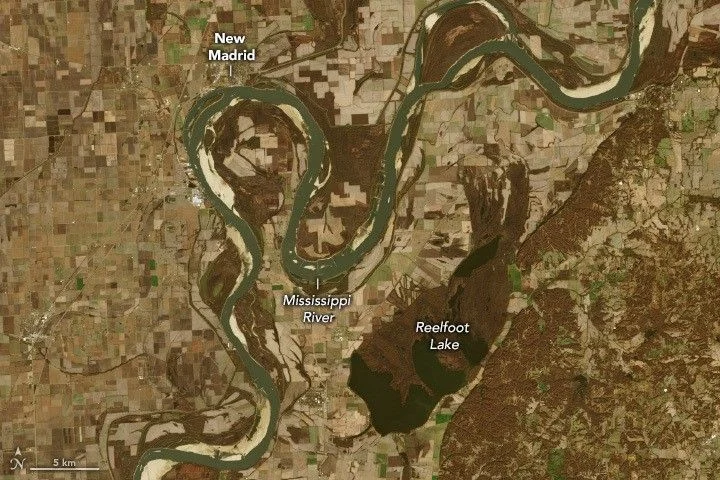
Well, part of it is simple proximity. I like to be able to drive to my research area, as opposed to picking up and going around the world, and then coming back and realizing you forgot to do something. So it’s much easier to do work in your backyard. If you make a mistake or you forgot something, you just turn around and go back and get it, plus the fact that as an academic, when you get students involved, it’s it doesn’t cost as much if you stay local and work in your backyard. Students can afford to do these types of projects on low budgets, and plus I just find the Mississippi River fascinating. It probably started as a graduate student at Cincinnati. We took a field trip from the University of Cincinnati to Reelfoot Lake, which is a lake that formed during the earthquakes of 1811, 1812 specifically February earthquake of 1812. And we were basically standing on a pier overlooking the lake, and I became very interested in the bald cypress trees that were out in the lake, and wondering if they had a story to tell. And many years later, as a faculty at the University of Arkansas, I was able to talk a dendrochronologist, that is a person who studies tree rings, to join me in a research project to look at the tree rings in Reelfoot Lake.
Dean Klinkenberg 12:03
Wow, so what did you find out from that?
Dr. Roy Van Arsdale 12:05
Well, it turned out to be quite a fascinating story. The trees that are out in the lake predate the earthquakes, and so they lived through it, and when we cord into these trees, we extracted the cores and saw that there was dramatic growth increase in 1812, 1813, 1814, about a 10 year period. The ring width increased tenfold, what they had been pre earthquake. We also saw that the wood post earthquake was solid, and pre earthquake the cores, the individual rings were were cracked, so these trees were severely shaken, such that they broke and cracked. They responded to the earthquakes probably because the other trees died. Bald cypress love water, and even though it was inundated by about a meter of water, they survived the flooding, whereas their competition didn’t, and so the bald cypress thrived in this year-around water supply. You could also see, frankly, that there was a difference in the type of wood that was being put down. I think you may be aware that your audience is aware that many trees put down a two rings in the course of a year. There’s a low density light colored spring wood, and then there’s a late summer higher density dark wood, and so when you look at these tree rings, you can actually see the earthquake, because the ring color shifts. It goes from light, dark, light, dark of systematic pattern pre earthquake to almost all light post earthquake, because there was no late summer drought. These trees were in water from first spring to first freeze, and they just gobbled it up and thrived, and for whatever reason they resorted to their original growth pattern after about 10 years, which I don’t understand why that’s the case either, but it did happen.
Dean Klinkenberg 14:23
You know, one of the things I love about this is that there’s so many stories to uncover that cover these almost unimaginable amounts of time. At least with the period we’re talking, with the New Madrid earthquake, and looking at the trees, we can almost get our heads around a couple 100 years, but what we’re about to transition into are much, much larger timescales, but there’s still some incredible stories to tell about how the land changed, how the rivers changed during that time period. So, what I thought maybe we would start with is if we go back in time to, I don’t know, roughly 100 million years or so ago, before there was any trace of the river we call Mississippi today. What was North America like at that time? What rivers existed, and what was the pattern for where they drained?
Dr. Roy Van Arsdale 15:12
Okay, so 100 million years in prior that, the area of what is now the Mississippi River Valley was in the middle of a mega continent called Gondwana. And so it was in the middle of this giant continent with the mountain range that ran right through the middle of it, that mountain range being what we see today as the Appalachians, the Ouachitas, and all the way down to the Marathons in Texas, and in fact, 100 million years ago, and prior to that, drainage off of this mountain range was to the north, off of this mountain range, and so the predecessor to the Mississippi would have been a north flowing river system. Evidence is strong that the rivers flowed north and west, because over in western states at this time period, actually older than 100 million years, but still prior to 100 million years, they find sediments that could only have come from the Appalachians, and I’m talking about sediments that finally came to rest in places like Utah, and so the physical evidence of the depositional history in North America was that prior to our current topography there was a drastically different topography, and that there was this through going mountain range, which divide the drainage, half of which went north up through the United States and on to the western states.
Dean Klinkenberg 16:55
What are there any current rivers that might have followed some of those older pathways or parts or channels of current rivers that might, like, for example, be part of the ancient rivers that flowed north?
Dr. Roy Van Arsdale 17:11
Well, not that I’m aware of. In part because there was a major erosional event that happened after these rivers formed that basically removed the landscape, changed the landscape so dramatically that nothing would have in the immediate area of the central United States, severe erosion would have eliminated any paleo drainage. What we see basically is the remnant being deposits much further to the west, and in places like Utah.
Dean Klinkenberg 17:51
All right, so a few years ago, Dr. Sally Potter McIntyre published a paper where, based on their analysis, they were estimating the river, let’s say that we call Mississippi, or a river that would flow more southerly, at least from in the middle of the continent, probably began flowing some 70 million years or so ago. What changes were happening geologically around that time that might have helped shift the flow of water on the continent.
Dr. Roy Van Arsdale 18:22
Well, the work that Randy Cox and I have conducted indicates that the reversal flow to its contemporary southern flow is related to the movement of North America over a hotspot, specifically what’s called the Bermuda hotspot. Now, a hotspot is a deep-seated volcano, like that which underlies the Hawaiian Islands. A different one underlies Yellowstone. And let’s just reflect on on Hawaii for a moment here. As the Pacific plate moves in a westerly direction, this deep magma source is stationary relative to that western drift, and as it drifts, the volcano becomes active again and pops a hole through the crust to the surface, and so you end up with a dotted line across the sea floor that literally marks the trace of the Pacific plate over top of that hotspot.
Dr. Roy Van Arsdale 19:27
We see the same thing in Yellowstone. If you start at Yellowstone, where the modern hotspot currently lies and is fueling volcanic activity and hot springs and geysers, you can see where it went in the past relative to North America. It’s right down the Snake River Plain all the way to the coast, and that’s why the states of Washington and Oregon are covered by lava flows. Because the Yellowstone hotspot used to be under Washington and Oregon as North America. America drifted westward, and its current position now underneath.
Dr. Roy Van Arsdale 20:04
Okay, so back to the mid continent. So, if we go back, let’s just say 120 million years ago, or thereabouts, the Bermuda hotspot, relatively speaking now, was northwest of the Mississippi Valley. As North America moved westerly. That hot spot stayed in its position, and we just moved right over top. And right around 100 million years ago the hotspots globally became very active. This was not just a unique Mississippi Valley event; this was occurring globally for reasons that aren’t really clear, but they were very active, and so when the hot spot was directly underneath what is now the Mississippi River Valley, it was very active about 100 million years ago, and the magma was ascending, and it was coming up, frankly, along ancient fractures in the crust.
Dr. Roy Van Arsdale 21:02
This goes back much further in time to, to say, 600 million years ago the mid continent was was cracked. In fact, the southeastern corner of the what is now the United States nearly ripped off 600 million years ago, but it didn’t go to completion. So there’s this major crack that runs up through it’s called the Reelfoot Rift. Now we are further in time, and this hotspot happens to sit right under this busted up rock, which allows for the ascent of the magma to come up these fracture planes along the fault planes, and in so doing, it heats the crust, alright. The ascent of the magma heats the crust and makes it swell, right? When you heat something up, it swells up, and in so doing, it lifted the landscape and literally formed a, an arch or a subtle mountain that would have run down the length of the Mississippi River Valley, and it was about three kilometers tall, about two miles high. So, what preceded the Mississippi Embayment trough was actually an arch that was driven by the heat of that plume or hotspot that was pumping heat into the crust and making the crust swell up. Well, okay, so if you lift the landscape three kilometers, erosion just attacks it, and so that three kilometer high welt that was trending northeast southwest under what is now pretty much the Mississippi River underwent erosion, and about three kilometers of sediment was stripped off by erosion. Essentially, that mountain was eroded down to sea level. Now this drift of North America continues through this whole story, and eventually it drifts off the hotspot, so the hotspot is now under what is be the Appalachians, say in the order of 40 million years ago. Well, with the removal of the heat source, the that ancient upwelt now contracts, cools, and sinks, and that which was two kilometers above sea level, which was eroded away, is now two kilometers below sea level.
Dr. Roy Van Arsdale 23:28
I don’t know if you followed that, but if you lift it and strip it, but then drop it to where it was, you essentially have a removed and made a trough, and that’s what the Mississippi Embayment is. It’s a big erosional trough related to that uplift, and then subsidence, and with the subsidence, the Gulf of Mexico migrates up into the continent. With the subsidence, we now are capturing drainage from the mid continent and directing it to the south, because that trough becomes deeper from north to south. The trough, Mississippian Embayment, and the arch that preceded it extended pretty much from southern Illinois all the way down to what is now Louisiana all the way to the Gulf.
Dr. Roy Van Arsdale 24:14
One of the things that some people have argued is that the Mississippian Embayment was related to the opening of the Gulf of Mexico, that is not the case. There is about a 30 million year difference between the opening of the Gulf of Mexico and the subsequent hotspot story and hotspot mechanism. They’re not related events. So the uplift and subsidence is a hotspot event, not a Gulf of Mexico event. Some people want to reactivate that ancient rift and propagate it up to the north, causing subsidence, but that is clearly not the story. They’re just not related events. That hotspot, which is called the Bermuda hotspot, is actually is left of it, not much of anything is east of the island of Bermuda. Now it’s pretty much shut down, but one of the last manifestations of that hotspot is the island of Bermuda, of which, of course, the uppermost part is covered by reefs. You don’t see the volcano until you drill about 200 feet, but it’s there, and it makes up a very large uplift of the sea floor, which is what the Bermuda Island sits on top of.
Dean Klinkenberg 25:34
Wow, I mean, I know you’ve been working on this particular reconstruction of geology for quite some time. It was a 20 some years ago you published an article about this in National Geographic, or one of those publications?
Dr. Roy Van Arsdale 25:48
We first started the really best publication, technically, is the I believe it was in Tectonics, but then we published a Scientific American article, which they did a great job in providing the graphics to illustrate our points, and it’s certainly written in a much more easily accessible manner for people who are not trained in geology to read and and follow, but yes, it’s probably been 20 years. I didn’t realize it had been that long, but yeah, it probably has been.
Dean Klinkenberg 26:27
Yeah, when, when you first presented this idea to your colleagues, how was it received?
Dr. Roy Van Arsdale 26:36
Mixed, some people, you know, thought that that’s crazy and laughed, and then we started to notice that people were referencing, particularly people at Berkeley and Stanford, and some of the, frankly, the powerhouse programs jumped on this. We have since, in fact, there was an article just published within the last couple months where they look very carefully at the chemistry of some of these igneous rocks that are actually exposed. There’s a quarry over in Little Rock where these rocks that came from deep within the earth, from the mantle, are exposed in a quarry, and they did chemical analysis, and came to the conclusion that indeed these rocks are from deep within the earth. It’s related to a hotspot, and so the evidence is coming in from other people who were looking at this and have been looking at this. We had another scientist contact Randy and say, “Thank you for that article. I’ve often wondered what this is that I see over in Mississippi and Alabama that I could never explain.” Apparently, it’s, it’s related to the hotspot track and sits right on what he had found as being anomalous in in his geologic study. So there’s been there’s been mostly positive response to this. Some people still don’t, aren’t on bandwagon, which is normal, right?
Dean Klinkenberg 28:16
That’s normal in science. Yeah, I’m trying to get my head around what things might look like now, too. So, I, so after the hot spot moved away, and the rocks cooled and sank back down, we’re talking a two kilometer trench, essentially, I guess then the sediment and sand and all that began to fill in much of that as the river flow to drop sediment, it began to fill in that gap. Am I on the right track so far?
Dr. Roy Van Arsdale 28:54
That’s correct, and a couple other things I should probably point out. There’s obviously a number of lines of evidence that we presented in our discussion of this, but prior to 100 million years ago, there were just reefs around the Southern Gulf coast, which means there was no big river, because reefs don’t like rivers, and so clearly there was no Mississippi River more than 100 million years ago, because there’s no indication of of a big sand body coming into the northern Gulf of Mexico. That’s that’s certainly one line of evidence. We were also able to get a hold of radiometric dates of igneous rocks that were buried and drilled by oil companies as they were exploring for oil and gas, they bring up rocks from the bottom of the hole and radiometrically date them, and the ages of these igneous rocks diminish in age from northwest to southeast. Indicating that the North American plate was moving from southeast to northwest, and that this, this hot magma source relative to the United States, was moving in a southeasterly direction.
Dr. Roy Van Arsdale 30:17
There were a couple other things that made this argument strong. If we go back 100 million years ago and reflect on the fact that drainage was actually to the north, as we talked about earlier, meaning that there was a mountain range. The Appalachians were a huge mountain range, and as were the Ouachitas and the Marathons, you have to breach a mountain range to make the Mississippi River Valley, how do you do that? Well, the hotspot provides the way of doing this, that literally the hotspot went relative, relatively speaking, again underneath that Appalachian Ouachita mountain chain, and so what was already high was lifted higher and subjected to more severe erosion and deeper erosion, and then when it dropped, it was three kilometers below sea level. The deepest part of the Mississippian Embayment is actually sits on top of what was the Appalachian or Ouachita mountain chain that was one continuous mountain range over 100 million years ago,
Dean Klinkenberg 31:20
And how far down would we have to drill to get to that rock now?
Dr. Roy Van Arsdale 31:23
Three kilometers,
Dean Klinkenberg 31:24
Three kilometers, right? Yeah.
Dr. Roy Van Arsdale 31:26
Yeah, the deepest part is right over top of what would be what is the remnants of the Appalachian Mountains at three kilometers depth that continue across our Alabama, Mississippi, Arkansas, and on to the west.
Dean Klinkenberg 31:45
So how, how wide is the gap now? How much of a, so how much of a gap opened up between in the mountain chains?
Dr. Roy Van Arsdale 31:54
About 100 miles, about the width of the valley. It actually kind of diminishes in width as you, if you follow, look at the valley in a map, it’s a bit wider north of where the Appalachian were, and then it opens up again once you get across the ancient mountain chain area. So there’s somewhat of a manifestation of the effect of that previous mountain chain, and just the width of the valley.
Dean Klinkenberg 32:22
Well, just, just for clarity, too. I know we misuse these terms sometimes, but that the area we’re talking about is what a lot of people call today the Delta, which is, you know, the part of the Mississippi south of Memphis, essentially the Delta, anyway, is that area from Memphis to roughly Vicksburg or so, and then east and west, about 100 miles, but with the area you’re talking about affected by the hotspot is actually much larger than that.
Dr. Roy Van Arsdale 32:49
Much larger. All the way from southern Illinois to off the shelf south of offshore Louisiana.
Dean Klinkenberg 33:01
All right, so we finally get them a route opened for a river to go south to the Gulf, and we’re still talking 10s of millions of years ago. The river was hardly static during that time. So, can you give me a little bit of sense of like what that, when the river began flowing, what do we know about what kind of river it was in the earliest few million years? How long might it have been? Was it comparable in discharge of volume to what we see today> Do we know what? Can we speculate about any of those things?
Dr. Roy Van Arsdale 33:39
I don’t really have, I, I’ve never really pursued that, so I don’t have any, I don’t really have any comments to make to that. Let me think about that for just a moment here, but we could, we could probably back calculate that by looking at the deposits that were were made in the northern Gulf of Mexico, I’m sure if we could go through oil company records, we could come up with an answer for you on that, because they’ve drilled the heck out of it, and they would know the distribution of the sediments and how thick they are and how extensive they are, and then that you could pretty readily back calculate what size river you’d have to have to produce that big package of sediment down there, but that’s not something I’ve done. I’ve actually made some inquiries to see if I could get somebody interested in doing that, and never had any success at that, because it does to be done well, you’d have to open up the records of the oil companies and see what they have, because they would certainly be able to answer that question if they are willing to provide the information.
Dean Klinkenberg 34:51
Sounds like somebody’s future dissertation.
Dr. Roy Van Arsdale 34:53
Absolutely, absolutely make a great dissertation.
Dean Klinkenberg 34:59
Hey, Dean Klinkenberg here interrupting myself. Just wanted to remind you that if you’d like to know more about the Mississippi River, check out my books. I write the Mississippi Valley Traveler guidebooks for people who want to get to know the Mississippi better. I also wrote The Wild Mississippi, a guide that goes deep into the complex ecosystem supported by the Mississippi, the plant and animal life that depends on them, and where you can go to experience it all. If you like fiction, check out my Frank Dodge mystery series. Each book is set in places along the Mississippi River. My newest book is a travel memoir called ‘Better Safe Than Sorry: Slow Boats, Chicken Busses and the Radical Choice to Trust the World.’ The book explores a simple question: What happens when you stop asking what if something goes wrong and start asking what if everything goes right? Find out more at deanklinkenberg.com/bettersafethansorry.
Dean Klinkenberg 36:00
You do have some other papers, though, where you write about characteristics of the river in the pre-glacial time period, where you’ve looked at old meander belts and kind of estimated how much water must have been carried by the river at different points in time. Can you speculate? Can you maybe summarize a little bit about what this pre ice age river, how it sort of grew and changed across time, and the general course.
Dr. Roy Van Arsdale 36:31
Yes, we pick up the story, I say “we”, here in Memphis pick up the story, of the Mississippi River from ancient to relatively recent, about 3.6 million years ago, in studying ancestral Mississippi sediments that are preserved underneath Memphis and Shelby County. These sand and gravel deposits are underneath westernmost Kentucky, southern Illinois, Crowley’s Ridge in Arkansas, and go all the way down into Louisiana. It’s a red-colored sand and gravel deposit that is exploited as the principal aggregate source for construction in this part of the country. What they’re, what they’re digging up is the ancient Mississippi River of 3.6 million years ago. It’s locally called the Upland Complex. It has different names in different areas. It’s called the Mounds Gravel up in Illinois. And it’s not at the surface, it’s varied by windblown silt, what’s called loess, related to the subsequent ice ages, but beneath this loess blanket that covers everything out here, just about, is this very pronounced, approximately 10 to 20 meter thick sand and gravel unit that is the ancestral Mississippi, and it extends from east of Memphis all the way to almost to the easternmost edge of Shelby County to Crowley’s Ridge, and probably all the way over to Little Rock, but it’s been removed by erosion west of Crowley’s Ridge. It’s been removed by erosion between Crowley’s Ridge and Memphis, but it exists today underneath westernmost Kentucky, Tennessee, and down into Mississippi and southern Illinois, as I said, and is the principal aggregate source for gravel in particular.
Dr. Roy Van Arsdale 38:37
This was a very broad floodplain. We estimate that it was probably in the order of over 100 miles wide. Now I’m not saying the river was 100 miles wide by any means. The river migrates back and forth, leaving behind the sand and gravel as it shifts, but it was a very big river, and our estimates are that it was maybe as much as six to eight times bigger than the Mississippi in terms of volume of water flow, and we base that on what we have found in the sand and gravel deposits, what look like ancient meander bends. Meander bends, these are the big curves in the Mississippi River, or any other river, for that matter. One of the bigger bends today is the one up near, well, up in southernmost southeastern Missouri, the New Madrid Bend. That’s what I’m trying to remember. There’s very large meander bend up there, but we have found evidence in these ancient deposits, these 3.6 million year old sand and gravel ancestral Mississippi stuff, that these meander bends were substantially bigger than that, and for those meander bends scaled to today would indicate a six to eight times greater discharge of the 3.6 million year old river.
Dr. Roy Van Arsdale 40:05
Now there’s still lots of contention about the age of these sands and gravels that I’m talking about. We have some very good dates from a quarry north of Memphis, and the people that did the work were at Purdue and at a California school, it may have been Berkeley, I should remember that, but any event, they came to the conclusion that, based on the samples that we collected here in Memphis from a quarry, that these set set-ups were deposited 3.6 million years ago, so that’s where I keep throwing that number around. It could have a wide range of ages. It could be a very old river that extended over millions of years, it’s possible.
Dr. Roy Van Arsdale 40:50
But there’s another PhD dissertation that’s sitting out there, sort of a plum hanging from a tree. Let’s go to all these different quarries, get samples, determine the age of that unit and nail it down. When, when was that ancient Mississippi River flowing? Our best estimate right now is in the order of 3.6 million years ago, but it’s hanging on a thread. We’ve only got one well-defined series of dates.
Dean Klinkenberg 41:21
So, what would the conditions have been like at that point in time, say 3.6 million years ago, that might have fed that much water into the Mississippi?
Dr. Roy Van Arsdale 41:32
Excellent question. Well, you, you could have had 3.6 million years ago much higher rainfall, but there’s no indication of that from paleoclimate studies. Nobody has ever proposed that this was an Amazon environment 3.6 million years ago. So we were forced to consider the possibility that the drainage basin was substantially bigger than what it is today, as you know, the Mississippi River, the eastern edge of the drainage basin is the Appalachians, the western is the Rockies, and the northern border is pretty much the Canadian American border, and that that is the footprint of Mississippi River. Well, you can’t really extend the drainage basin further to the east, you’ve got a mountain range, you can’t extend it to the west, you’ve got a mountain range, but there’s no such mountain range to the north.
Dr. Roy Van Arsdale 42:26
So we looked at the possibility that the Mississippi River drainage actually started well up into Canada. Not at the Canadian American border, but well up into Canada, so that we can enlarge the drainage basin by including southern Canada, southern central Canada as being part of that 3.6 million year old drainage basin. Well, as we are doing this and formulating these ideas and coming up with a number of lines of evidence, we came across a paper by some Canadian earth scientists, where they had mapped river systems in south and central Canada that flowed across southern Canada to the Red River area. Now, the Red River, I’m talking about the Northern Red River, the one that flows today from the northernmost part of South Dakota, let’s just say from North Dakota north to ultimately Hudson Bay. Well, these guys were saying that no, it looks like the drainage was to the east, and what if you projected it would have gone into the Mississippi River and, and south, or at least we interpreted, we interpreted as a southern flow that would have contributed the water that we were looking for. So these guys provided us with one of the strongest lines of evidence at 3.6 million years ago, southern Canada was actually draining to the Mississippi River and ultimately to the Gulf of Mexico. We had other rungs of evidence, but that was that’s the best
Dean Klinkenberg 44:17
Yeah, so just a much larger drainage basin.
Dr. Roy Van Arsdale 44:24
50% bigger, thereabouts.
Dean Klinkenberg 44:25
Yeah, so then I’m going to go out on a limb, and I’m going to guess the glaciers changed all that.
Dr. Roy Van Arsdale 44:32
Oh yeah, it just did a number on everything. As you know, the ice accumulated initially in Canada, in this part of the world, and as the ice piles up, it spreads kind of like pouring honey onto a table, you pour it at a point, but it spreads all over the table, and so that’s what was happening during what we call the Pleistocene, so you have a big ice sheet advancing from Canada, from the Hudson Bay area, so that any kind of drainage would have been, would have been destroyed, and that is to say, the original south flowing drainage would have been destroyed, because the area would have been covered by ice. The Canadian part of the story was totally changed and covered by ice. The advance of the glaciers had another profound effect. It lowered sea level, that’s where all the water came from, that made the ice, and so as sea level went down, the major rivers of the world draining into the oceans would incise, and the Mississippi Valley, being made up of relatively soft rocks, would have been been like cutting hot knife through butter, and so the Mississippi Valley underwent dramatic erosion when sea level was as much as 400 feet lower than it is today. And so in so doing, a lot of sediment of the Mississippi River Valley was removed, and that ancient river deposit of 3.6 million years ago, most of it, or yeah, most of it was eroded away, and we have the carving of what is now the Eastern Lowlands and the Western Lowlands on either side of Crowley’s Ridge, which is located in Eastern Arkansas.
Dr. Roy Van Arsdale 46:39
So the modern landscape is a consequence, in large part of incision during sea level decline and erosion, and and then superimposed upon that, as the ice sheets melted all the sediment that was trapped in the ice, a large part of it would have entered the river system and was deposited in the Mississippi River Valley, so we have a lot of ice age sediments in the Mississippi River, and this, when I say, when the ice melted, there were actually as perhaps as many as 18 glacial advances and melt backs, so we’re talking about over two and a half million years, dramatic changes in sea level and ice, the freezing and thawing, and freezing and thawing, and with each cycle you get erosion and deposition, and it makes for a very complicated picture.
Dean Klinkenberg 47:36
Right, Right. And then all of that sediment being incised out of the valley gets carried down to the Gulf of Mexico, right? And
Dr. Roy Van Arsdale 47:45
Correct.
Dean Klinkenberg 47:45
And it kind of, that must have helped build that continental shelf that we see today.
Dr. Roy Van Arsdale 47:51
That’s right. It certainly deposited the large part of the sediment pile that the oil companies are exploiting for oil and gas. And the delta that we see today, which is most people think of, at least geographically, the delta being Louisiana, you know, that was, that was, that’s all very young sentiment within the last 20,000 years, most that deposited that, so there’s been this seaward growth of North America as sediments being stripped off of the continent and comes down the Mississippi. So in this process, though the, where was I going with this? We think that this southern flow again had to be reversed, had to be reversed, and so why is it that the northern part of the United States, in particular Red River, now, which apparently used to flow south prior to the ice ages, why is it flowing north? Well, the ice sheet not only expands and contracts by growing and shrinking, I say shrinking by melting. It also has the effect of making the crust of the earth sink. It’s kind of like stepping on on a trampoline, and the trampoline surface drops because of the weight of you standing on it. Well, the same thing happens with this giant ice sheet on Canada. It made the crust sink. Well the melt, the ice melts back faster than the rebound occurs. The analogy, the trampoline goes out the window now, because the minute you get off the trampoline, it jumps back. But in this case, now with the very slow, the encroachment of the ice and the build up and the thickening, it makes the more liquid deep part of the earth, meaning the mantle flow out from underneath that ice cap. Okay, so the crust flexes and bends down and pushes the more liquidy stuff out of the way. Now, when the ice melts, that liquid stuff flows back in to where it was, but it comes in at a much slower rate, much slower rate than what the ice retreats incredibly quickly when they, when you go out of a out of a glacial event, it takes about 90,000 years for the ice to go to full maximum and reach southern Illinois. It only takes about 10,000 years for the whole thing to melt away. So you know it took 90,000 years to depress the crust, but it only took 10,000 years to take the weight off, and so the crust is still depressed, which means that the landscape slopes towards the north, towards Hudson Bay, and that’s why the Red River is flowing towards Hudson Bay today, and why the drainage of southern Alaska goes up to Hudson Bay. That area was the deep part when the ice first melted. Alright, now you still with me on that?
Dean Klinkenberg 51:25
Oh yeah, I’m following.
Dr. Roy Van Arsdale 51:26
Okay, well, we know that the water flows from North Carolina, North Carolina, North Dakota up the Red River, as do the other rivers of southern Canada, and they flow ultimately up into Hudson Bay, but we also know that Hudson Bay is coming up, as is all of southern Canada. It’s still rebounding from that massive ice sheet. We know this from a number of reasons. First of all, it can be measured. It has been measured. Hudson Bay is coming up at 10 millimeters a year, which doesn’t sound like about a lot, but when you start dealing with geologic time, that’s an incredibly fast rate, and in so doing it is tilting the landscape back to the condition it was prior to the ice ages. Okay. So if you’re doing that, the north flowing Red River is starting to tilt back, and so that it’s no longer sloping to the north. Eventually, it’s going to slope to the south. The Red River is notorious for its flooding events. All right, there’s been tremendous floods up along the Red River and up into Canada.
Dean Klinkenberg 52:46
Just ask anyone in Fargo.
Dr. Roy Van Arsdale 52:48
Yes, yes, there’s some spectacular photography of these towns up there that are barricaded by sandbags with water all around them. Well, that there’s a number of reasons for that. One, of course, is that with Red River flowing north to the Nelson River into Hudson Bay, those areas up north stay frozen longer, and so the water gets blocked by the ice to the north. It can’t flow to the north readily because of the ice, but the contributing factor is that the slope is shifting and reversing such that we anticipate not that I’m going to be around to see this but within 10,000 years, assuming no glaciers come back, we’re going to have southern Canada draining back into the Mississippi River when that full isostatic rebound of Hudson Bay takes hold, the whole landscape is going to return to what it was prior to the ice ages, which is a southern slope.
Dr. Roy Van Arsdale 53:50
Now, there’s another element to this that we didn’t really focus on very much, we just mentioned it. This rebound, which most people are modeling, is due to the ice melting, right, very clear. If you take a mile ice off of off of a landscape, it’s going to come back up. Okay, it’s going to come back up. Well, what’s not often, if it is at all taken into account, is that there was a tremendous amount of erosion that took place by these glaciers, so they are removing rock as they are moving south, they are braiding off rock, which ultimately enters the rivers and flows to the Gulf. Well, if you remove a couple 100 feet of rock, that is going to the response by the crust is going to be rebound from that removal as well, so not only do you, this is compounded, it’s not just ice removal by melting, you also, the glaciers have removed surface rock, which is going to promote rebound and make it even perhaps greater than what it was in terms of its original slope to the south.
Dr. Roy Van Arsdale 55:03
That was a mouthful, and I totally overwhelmed your audience.
Dean Klinkenberg 55:09
No, it’s really that is really intriguing to think about. I don’t know how many people have had a chance to do this, but I’ve been to that area around the Minnesota, South Dakota, South Dakota, North Dakota border area, where about 20 or so miles apart, Brown’s Gap, I forget exactly what the name of the spot is. On one side you have the Red River, the beginning of the Red River, the north flowing north. On the other side of that, you have the beginning of the Minnesota River heading south. So it’s very easy, having been there, to imagine at some future state, you know that the flow changes just enough that that unites again. It’s like a single river, and all that water from what’s now the Red River, the North, would then just be captured and go down the Minnesota River Valley.
Dr. Roy Van Arsdale 55:54
Well, there’s another potential. I’m really going out on a limb here, but I hope your audience will forgive me, but if this goes to as we think it will, you see the Red River flows north to a big lake, north halfway up to the Hudson Bay area, and then that lake drains into the Nelson River, into Hudson Bay. Okay, and the drainage is all to the north, and I’m saying that nope, that’s going to reverse. What we don’t know, we think we know that the actual point of reversal is going to be in the Nelson River area. So we have a pretty good idea where the original drainage divide was where the northern limit of the Mississippi River was, and where it will be in the future.
Dean Klinkenberg 56:47
None of this is going to happen while we’re alive. At what point in human history should we be making preparations for an increased much larger Mississippi? Do you think, few 1000 years?
Dr. Roy Van Arsdale 57:04
We’re talking thousands of years. Yes, yes, I’m not going to be, I’m not going to be a witness to this, nor will you, even though you’re a younger man, you will not be a witness to this either.
Dean Klinkenberg 57:15
Yeah, not gonna be around for that.
Dr. Roy Van Arsdale 57:17
Well, and we’re also presuming there will be no more ice ages, because if the ice comes back, the whole cycle starts over again.
Dean Klinkenberg 57:25
Right. Yep, you know, one of the things that I really like about, about your work, and talking about this is, I just, again, how it, it reminds us how much the planet is continually changing, like the geographic features of the planet are not static. You know, we see a rock, you know, and it seems so, you know, eternal in a sense, but none of this is. All of these things are continually changing and be affected by a variety of forces. Even the Mississippi River, relatively speaking, is pretty young when you think about the age of the planet.
Dr. Roy Van Arsdale 58:01
Absolutely.
Dean Klinkenberg 58:02
And and even during that time period, it’s been through some very significant changes, and I was just thinking again about I think you did some work where you were estimating different time periods for when the Ohio and Mississippi River confluence changed, or different periods of time where those two rivers met.
Dr. Roy Van Arsdale 58:23
Yes.
Dean Klinkenberg 58:23
So can you just kind of summarize that for us fairly quickly too?
Dr. Roy Van Arsdale 58:28
Well, okay. We today, of course, the Mississippi River in Ohio joined at Thebes Gap area in Cairo, Illinois. Okay, but if we go back several 1000s of years ago, the point of junction, and this isn’t my work, this was done by, by, by someone else, the confluence was actually south of Helena, Arkansas, south of Crowley’s Ridge, and then it jumped up about midway, little bit more than midway on Crawley’s Ridge, and then it jumped again a little bit further north, and then finally moved up to its present position, and so the Ohio River has pretty much captured the present Mississippi River at Cairo, where they joined today. In fact, I was having a similar conversation with some people from from Ohio some years ago and pointed out that most of the landscape of the Mississippi Valley is actually ancestral Ohio River, and that the Mississippi River used to flow down the west side of Crowley’s Ridge through what’s called today the Western Lowlands, and the Ohio River flows down through the Eastern Lowlands, which is what is today the modern Mississippi. Mississippi River, and that the Ohio has sequentially captured the Mississippi River in steps further and further to the north to where it is today, and the person’s response was, well, then it shouldn’t be called the Mississippi River Valley, it should be the Ohio River Valley, and I had to say, “Yes, you’re right.”
Dean Klinkenberg 1:00:19
Yeah, well, we won’t even get into the debate about the Missouri versus the Mississippi name, because in my part of the woods up here, my part of the river, there’s a lot of fun, fun arguments over happy hours, where we don’t have that discussion. So.
Dr. Roy Van Arsdale 1:00:21
I’m sure there are.
Dean Klinkenberg 1:00:22
So we’ve hit it at this a little bit, but I’m going to, what are some of the bigger questions in your mind yet about that we don’t know about the geologic history of the Mississippi?
Dr. Roy Van Arsdale 1:00:51
In my mind, see, my principal focus of getting really diving into the history of the Mississippi was to try to better understand the earthquake threat. That’s where most of my funding has come. That’s where I’ve done most of my publishing is the New Madrid Seismic Zone. And it’s still quite the enigma as to why we have big earthquakes in the central United States, and I think it’s related to the erosional history of the Mississippi and Ohio rivers. As I mentioned before, there has been dramatic erosion events that have occurred in the valley during the ice ages. Now, if you have an area that’s under compression, which North America is, because it’s drifting westerly, it’s being, if you will, pushed by the Mid-Atlantic Ridge, and it’s drifting westerly. The every all the area east of the Rocky Mountains is under horizontal compression, right? It’s just a fact. And it appears to be related to continental drift in this, this drifting of North America, pushing from the Mid-Atlantic Ridge.
Dr. Roy Van Arsdale 1:02:02
If you have a fault system that’s being squeezed, and you remove the cap off the top, if you remove sediment, hundreds of feet of sediment off the top, it seems to me that that is a way that you could activate these ancient faults, so I’m thinking that the erosional history is very important to better understanding the seismic hazards and the cause of earthquakes, and what causes earthquakes, of course, is fault, right, bedrock movement. And if you can come up with a mechanism to make the earth move, then you have made an earthquake. And one of the ways to do that is by removing a lot of sediment off the top of these faults and releasing the vertical pressure on them, I mean, we see similar things going on related to reservoirs, they fill up a reservoir with water and they start earthquakes, they’ve changed the local pressure. Or that earthquakes occur in parts of Scandinavia and Canada where the ice has recently melted. They remove the weight of the ice, and that ambient compression is being now released. So it seems to me that looking at the geomorphology and the geomorphic history, specifically the erosional depositional history, the valley. There may be a link to why these faults have become reactivated. You see, these are ancient faults that have turned on and turned off through deep time, but they apparently have turned on quite recently. All right, within the last 5,000 years, something like that. Well, that sits right in the framework of these big erosional events that have have occurred. So that’s what I’ve been thinking about and proposing.
Dean Klinkenberg 1:04:16
So yeah, basically, if I’m following you right on this one, then the melt water is coming down from the glaciers, and that range of 5,000 plus years ago probably removed an awful lot of sediment as those major flows, those massive flows of water came down. Is that kind of what you’re thinking?
Dr. Roy Van Arsdale 1:04:41
That is certainly part of it. Yes, you see another aspect of the Mississippi River. If you look at the map of the Mississippi River, it pretty much sits against the bluffs. Okay, you have a, you have a 50 mile or more wide eastern lowlands, but the river is over on the eastern side of the valley, except at New Madrid, where it takes this big loop. Right, you may be familiar with that big loop. The reason it has a big, big loop is it goes around an uplift area. That area is literally coming up. That’s the focus of a large part of the New Madrid seismic zone under that loop.
Dr. Roy Van Arsdale 1:05:22
But if you look at the river further south, it lays up against the bluffs all the way to south of Memphis, and then it heads off to the west. I think, and I’ve argued that the Mississippi River over the last 20,000 years has shifted from its position just east of Crowley’s Ridge, and migrated in an easterly direction, eroding the bluff line to its current Memphis position. So that if we go back 20,000 years ago, Memphis would have been 50 miles from the river. All right, so this stripping of about 70 meters of sediment, because that’s the height of the bluffs, about 70 meters, something like that, I may be overstating that, but about 70 meters, I believe. You have essentially, if indeed that eastern migration story is correct, you have stripped 70 meters of sediment off of the eastern part of the eastern lowlands. The significance of that is that’s where all the, not all, where most of the young faults lie, and where the seismicity occurs.
Dr. Roy Van Arsdale 1:06:34
So, I think that this most recent stripping event, it may be that which is responsible for the onset of seismicity in the Mississippi River Valley relatively recently, within 1000s of years ago, let’s say 10,000 years ago to present. It’s related to this eastward migration. Now you didn’t ask this question, but you’re probably going to ask, “Why is the Mississippi River migrating?” Well, I think it’s related to the original erosion of the valley, and that it is coming up all right. It is coming up. The center of the valley is Crowley’s Ridge. The highest part of the valley is actually in the center of the valley, Crowley’s Ridge, and there’s evidence that Crowley’s Ridge has and continues to come up, and that the Mississippi River has shifted eastward, and that the rivers on the west side of Crowley’s Ridge have shifted westward, indicating that the center of the uplift is Crowley’s Ridge, and I think that that uplift of Crowley’s Ridge is still a manifestation of the severe erosion that took place when sea level dropped 400 feet. It just basically removed so much sediment that the valley is still responding to that, and coming up.
Dean Klinkenberg 1:08:09
That’s really interesting. I hadn’t, I didn’t know Crowley’s Ridge of that area that we still have some uplift going on.
Dr. Roy Van Arsdale 1:08:16
Well, it’s nothing obvious, that’s for sure. But there’s a paper just recently published about young faults along the margins of Crowley’s Ridge, and there may be more information coming out on that subject in the near future. Some colleagues and I are working on that right now.
Dean Klinkenberg 1:08:36
Excellent.
Dr. Roy Van Arsdale 1:08:37
We haven’t got anything to report quite yet.
Dean Klinkenberg 1:08:40
So I don’t know if there’s a single good resource for this, but if folks are interested in going a little deeper into understanding the geology and the geomorphology of the Mississippi Valley, are there one or two books or articles that you would recommend to do so?
Dr. Roy Van Arsdale 1:08:56
Well, if you’re interested in the history early American history, Penick’s book. He’s a historian, and was a historian at University of Missouri. Now there are two editions. The later edition is the one you should read, and the history part is good, the science is not. But then again, he’s a historian, so, and at the end, when he wrote the book, most of the things I’m talking about today were not published when he wrote that book, so anyway, so that if people are really interested in what people saw or witnessed, experienced, Penick’s book on the on the history of the New Madrid seismic zone and the earthquakes of 1811, 1812 is a great read.
Dr. Roy Van Arsdale 1:09:46
I have written a book on the geologic history of the Mississippi Valley, and in conjunction with an archeologist, and the book is half geology, half archeology, that might interest people, but it is a written for general audience. In any event, I’m certainly available if people want to send me an email and have a request. I will respond to their requests as best I can, and you can go from there.
Dean Klinkenberg 1:10:20
Well, Roy, that was fantastic. Thank you for having this conversation with me today. I really appreciate you sharing your expertise, and you did a great job of explaining things in a way that I can understand. So, I’m sure that’s good enough for you. That’ll work for all the listeners to this podcast as well. So, thanks so much for your time.
Dr. Roy Van Arsdale 1:10:38
You’re welcome. Bye, bye.
Dean Klinkenberg 1:10:41
Thanks for listening. If you enjoyed this episode, subscribe to the series on your favorite podcast app, so you don’t miss out on future episodes. I offer the podcast for free, but when you support the show with a few bucks through Patreon to help keep the program going, just go to patreon.com/deanklinkenberg. If you want to know more about the Mississippi River, check out my books. I write the Mississippi Valley Traveler guidebooks for people who want to get to know the Mississippi better. I also write the Frank Dodge mystery series that’s set in places along the river. Find them wherever books are sold. The Mississippi Valley Traveler podcast is written and produced by me, Dean Klinkenberg. Original music by Noah Fence. See you next time.