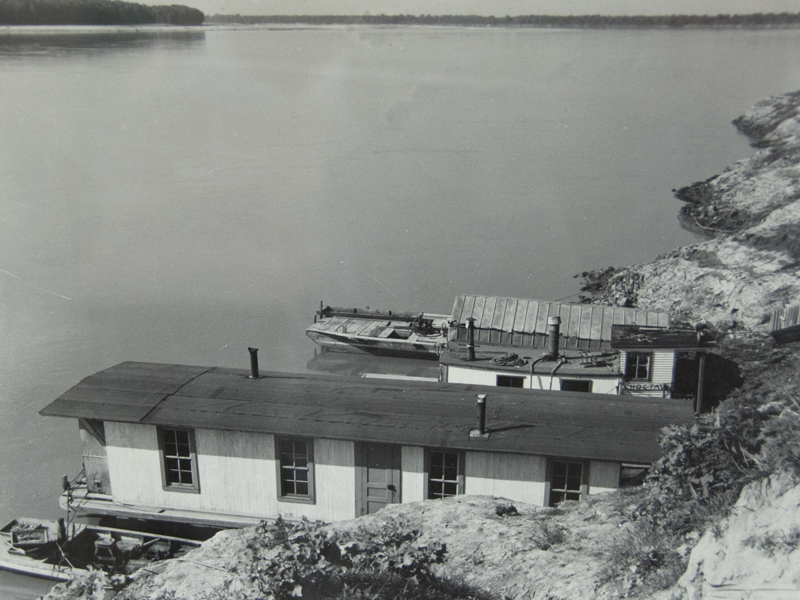
A hundred years ago, shantyboat communities could be found along many rivers in the US. Historian Gregg Andrews went in-depth to research these communities, inspired in part by the discovery of a personal connection to them, which resulted in a book called “Shantyboats and Roustabouts: The River Poor of St. Louis, 1875 to 1930.” In this episode, I talk with Gregg about those shantyboat communities. After Gregg describes how he got interested in shantyboat communities, he describes what a shantyboat was and who lived in them, what it was like to live in one of these communities and their frontier-like culture, some of the characters he came across, including Louis Seibt and Rose Mosenthein, the legal basis shantyboaters used to defend their communities (often successfully), and their eventual dissolution.
Show Notes
Shantyboats and Roustabouts by Gregg Andrews
Gregg Andrews’ river-themed blog
Wes Modes’ A Secret History of American River People



Support the Show
If you are enjoying the podcast, please consider showing your support by making a one-time contribution or by supporting as a regular contributor through Patreon. Every dollar you contribute makes it possible for me to continue sharing stories about America’s Greatest River.
Don’t want to join the Patreon community? No worries. You can show some love by buying me a coffee (which I drink a lot of!). Just click on the link below.
Transcript
Mon, Sep 08, 2025 6:43PM • 1:20:33
SPEAKERS
Gregg Andrews, Dean Klinkenberg
Gregg Andrews 00:00
We were looking at just starting the research. And Vikki was on the census, looking at the 1900s census. And while I’m researching other stuff, she said, Hey, Gregg, come here. She was on a microfilm reader. And she said, look here, these are your people here. And she says they live on boats on the south side of the of Hannibal, and my jaw dropped. And so that’s where it all began. My interest in in shantyboats.
Dean Klinkenberg 00:54
Welcome to the Mississippi Valley Traveler podcast. I’m Dean Klinkenberg, and I’ve been exploring the deep history and rich culture of the people and places along America’s greatest river, the Mississippi, since 2007. Join me as I go deep into the characters and places along the river, and occasionally wander into other stories from the Midwest and other rivers. Read the episode show notes and get more information on the Mississippi at MississippiValleyTraveler.com Let’s get going.
Dean Klinkenberg 01:25
Welcome to Episode 67 of the Mississippi Valley Traveler podcast. Well, I’m just back from spending much of the summer touring Southern Africa, a lifelong dream. I can’t believe we actually had a chance to do this, but we spent six weeks touring six different countries in the southern part of the continent, including Madagascar and South Africa. And if you follow me on social media, you’ve seen some of the pictures, and you’re going to see more. I’m still in the process of sorting through those 2000 or so photos and trying to figure out how to post them in a way that’s interesting but not overwhelming. So if you’re not following me on social media, I suggest you go to Instagram in particular. I’m Dean.Klink on Instagram. You can find me very easily there, and there are going to be a whole bunch of posts coming up on that trip. I might at some point do an episode kind of reflecting on that trip and and what it was like to be in some of these places that I’ve only seen on nature shows and seen so often on nature shows, and to see some of these incredible animals in person. Not going to do that in this episode, but maybe at some point down the road.
Dean Klinkenberg 02:37
Today, though, I’m really excited to bring you an episode where I got to talk with Gregg Andrews again. Gregg is a historian. He was on a previous episode all the way back in episode four, he talked about his memoir, My Daddy’s Blues, which focuses on his childhood growing up south of Hannibal, Missouri, in the floodplain. Go back and listen to that one if you get a chance. There’s some great stories in there. Gregg has spent a lot of his career, and especially in these later years, writing about the Mississippi and in this episode, we focus on a book that he published two years ago called ‘Shantyboats and Roustabouts,’ and we focus just on the shantyboat communities in this particular episode.
Dean Klinkenberg 03:19
So we will cover how he got interested in shantyboats in particular, which was sparked in part by a surprise in his own family history. We talk about what a shantyboat is and and who actually lived on them, what those communities were like, and some of the different sort of professions represented on those in those communities. We talked about some of the characters he came across who lived in those communities, including one whose name is going to be familiar to St Louis folks. And we talk a little bit about the legal claims that shantyboaters made to living where they did and how those stood up when they were challenged, the sense that some of these communities that had a bit of a frontier culture to them, a little bit outside the law in some ways, and outside the cultural norms of the day. And then we talk about what happened to eventually break them up. In spite of multiple attempts to force these people out, they always seem to come back until they couldn’t anymore. So we talk about what sort of led to the eventual demise of these shantyville communities.
Dean Klinkenberg 04:25
Well, thanks to all of you who continue to show me some love through Patreon, I deeply appreciate your ongoing support and to the new folks who have recently signed up. Thank you very much. You can join this community at patreon.com/DeanKlinkenberg, and for as little as $1 a month, you get early access to the episodes, plus you get my eternal gratitude. If Patreon isn’t your thing, you can buy me a coffee. Go to MississippiValleyTraveler.com/podcast, and from there, you can find out how to join the Patreon community or how to buy me a coffee. You can also from that same URL, you’ll get access to all 66 previous episodes, as well as the show notes for all of those and the show notes for this one. And now let’s get on with the interview with Gregg.
Dean Klinkenberg 05:17
Gregg Andrews is a distinguished history professor emeritus at Texas State University, a former National Endowment for the Humanities Fellow, and a prize winning author of eight books. His research focuses on the cultural history of working class people on the Mississippi River. Born in Hannibal, Missouri. He grew up in the river hamlet known as “Monkey Run,” just south of the nearby Mark Twain Cave. He’s also a memoirist and singer songwriter who fronts the swampy blues band, Doctor G and the Mudcats. He and his wife Victoria Bynum live in Seguin, Texas. Welcome to the podcast again. Gregg, great to have you back.
Gregg Andrews 05:40
Well, good afternoon, Dean. It’s great to see you again and be back with you to discuss the shantyboats book and how that how that came about.
Dean Klinkenberg 06:14
Yeah, so let’s talk. Let’s just get right into it. So you you’ve written multiple books, and I’m a little slow getting around to talking with you about the shantyboat book, because I’ve had a pile of things to get through. But your book, ‘Shantboats and Roustabouts: The River Poor of St Louis, 1875 to 1930.” It was published almost two years ago now. Tell us how you got interested in this topic.
Gregg Andrews 06:36
Well, my interest is, first of all, I began as a personal interest of mine, because in 1992 while working on another book, City of Dust, I discovered that my grandmother and her family, her mother and her mother all lived on shantyboats on the south side of Hannibal, and I thought, Wow, I you know, I mean, I knew we didn’t come from royalty, and I had no idea that we, that we, that we came from, you know, people who lived on the shantyboats in the river. And I had written a little bit about shantyboats, but really didn’t know much at all about them. But I filed that away back in 1992 and gradually over the years, when I had some spare time, I would dig just a little bit deeper into the shanty boat world. And I think when I wrote, I wrote a childhood memoir back in published in 2019, I made a commitment to myself at that time to dig deeper into the through the waterways and other Mississippi River and what life might have been like for my grandmother. Now, she was a child when she lived on the boat. But what amazed me was that, why didn’t I know that. My mother, who passed on every bit of gossip and anything, she knew everything about the family line, but interestingly, she missed that. She never she told me that, that her mother told her there were people who lived on the river like that, but she never said we’re one of them, and so for and for that, and maybe there was this. There was a stigma attached to people who lived on shantyboats at the time, maybe for that reason. But the point is, I never knew it until 1992.
Dean Klinkenberg 08:37
How is it saying you figured out? How is that you figured it out that that they lived on a shantyboat. What were the clues that you found?
Gregg Andrews 08:44
Actually my wife, my wife Vikki, was with me in Hannibal, and we were, we were just starting, both of us starting new books, and I was writing on the history of lIasco, which is just south of Hannibal. Monkey Run you mentioned was a, was a, you might call a suburb of Ilasco. Monkey Run had about 100 people and but we were looking at just starting the research, and Vicki was on the census, looking at the 1900s census. And while I’m researching other stuff, she said, Hey, Greg, come here. She was on a microfilm reader. And she said, look here, these are your people here. And she says they live on boats on the south side of the of Hannibal. And my jaw dropped. And so that’s where it all began. My interest in in shantyboats.
Gregg Andrews 09:40
Of course, I grew up on the river there, south of Hannibal, and I’ve loved the river from the time I was a child. It was my playground, you might say. Then in academic, in a world of academia, as I in my doctoral work, I focused heavily on the. A period of industrialization in the United States, roughly from 1875 to about 1945. And so I was especially interested in, well what was called Mark Twain and Dudley Warner called the Gilded Age, where there was just a phenomenal rise in wealth in cities like St Louis. You can see it there in Chicago, any city at the time this rapid industrialization. So I was interested in looking at the underside of the Industrial Revolution, consistent with my my interest in studying working class people across racial lines, and so that that kind of helped stoke the fire too for the period. And of course, growing up in the Hannibal area, you know, Mark Twain presence was there. And I was especially interested, you know, as you know, his observations on the river, like in Life on the Mississippi, and in other other publications. I was particularly interested in what he had to say. He didn’t take a very he had a pretty dim view of shantyboat people, because he was looking at it from the standpoint of a steamboat pilot, you know. And on dark nights, the shanty boat, shanty boats were supposed to have lights by law. But of course, in reality, that often didn’t happen. And so Mark Twain had an experience when he was a copilot, where they almost hit this Indiana shantyboat on a dark side of an island, and all of a sudden, Twain said they heard all this, people cussing up a blue streak, and the steamboat came there, almost, almost hit him, but they could hear music playing down, you know, in within the shanty boat and everything. And soon they were all drinking heavily and enjoying having a good time. And so he wasn’t particularly fond of the shanty boat people, from that, from that, you know, perspective, right?
Gregg Andrews 12:24
So all in all, I think that that my interest in that area, and the subject of shantyboats, you know, derived from my family primarily, but then it also dovetailed into my own scholarly interest, so that there wasn’t much work done on shantyboat people. I found that out as a historian, and I was kind of surprised by that, but, but anyway, that’s when I really dug in and started working on the book.
Dean Klinkenberg 12:55
What? Why did you select that period of 1875 to 1930 as the focus? That seems very specific.
Gregg Andrews 13:02
Well, because of the things that I mentioned before my grandmother that it was 1900 when they were on the census in in Hannibal. And, you know, my scholarly interest, research interests, were the strongest in in that area. And I think I cut it off in 1930 mainly because it’s there are changes going on, rapid changes on the river, including a network of dams that changes, that changes the lifestyle, and in some ways, it puts almost a total end to it. But because of the Great Depression, you have people flocking to the waterfronts, poor people. I touched on a little bit I did. I was afraid it would overextend me, so I stopped it pretty much in 1930 but by then, for all practical purposes, that world of shantyboat living is over, except in, except in, I think in the ’50s you might you still had it in St Louis in the 1950s and in some cases, and parts of Kentucky and more rural areas, especially, you could find them into the ’50s. And actually today in different places, although the composition of those shanty boat communities are very different than today, than they were back then.
Dean Klinkenberg 14:30
What exactly do we mean by a shantyboat? Can you? Can you tell us a little bit about what that means, what it might look like?
Gregg Andrews 14:36
Louis Seibt, well, he was the king of Little Oklahoma, you know, or the he was like the mayor each of these colonies had their own informal government. You know, they chose kings or mayors, whatever it was like, you know, urban areas, you know, the king of 52nd street, or whatever that that that title. The point is, they were the they were, they were the bosses. And if you had issues, complaints, neighborly, neighboring complaints, any kind of complaint you went to see Captain Seibt, as it turned out, he was, as he was, a steamboat by himself at one time. And he built him a nice little, little boat. He, you know, for years, had operated the liquor set had provided liquor, and sometimes inside the law and sometimes outside the law. You know, he bedeviled St Louis authorities because he he got, he got a boat that had some speed to it, and so they would revoke his license. But he’d go out in the middle of Mississippi, and then people would in the shantyboats would come out in their skiffs, you know, all every shanty boat had some kind of a skiff, you know. So that helps them move around, give makes them more mobile. And they would paddle out and buy, buy booze from, from, from him out in the river. But he finally they, you know, he finally got his license and everything and but he had an ongoing battle with with St Louis authorities over that liquor license. But he was, he was, he was a real character. And I really came to, I really came to enjoy the research that, you know, the that I did on him. But he was an example, someone who had, he was had more, not wealth, but he had more money at his disposal. And he set up a beer garden there where it was sandy, you know, and everything he eventually, he’s set up a grocery store and a beer garden there. He had live music coming in there. You know, ragtime blues. He was, I mean, it was a hopping place. If you lived on the north wharf and close to little Oklahoma, if you don’t fear for your life, you’re probably going to go down there and enjoy life down there. And, you know, and there it was rough. I mean, there’s no hiding that, as in, you know, there were many fights down there. Of course, there are many fights in any in any bar.
Gregg Andrews 14:36
Yeah,a shantyboat, it, of course, it varied according to the wealth of the owner. I mean,the term shanty boat was used, generally by the newspapers of that period as a way of denigrating the people who lived on those boats. They were, you know, by and large, they were poor people. Um , and some lived on the riverfront without pursuing a an I, you know, an itinerant lifestyle. They lived on the, for example, someone like in St Louis, they might rent a shantyboat from a another shantyboat owner. There were, I found, you know people on the St Louis levee, especially, who built boats for poor people like that, and so they would sell them. And you could, you could probably put yourself together a shantyboat using logs out of the river, using a variety of things that that you you were able to get from the river and build a boat, probably for about $20 at that time. Now, some of them had one window, some had two windows, some had three and some of them were really well to do boats. I mean, we’d say today, maybe middle class, upper middle class, maybe, who had those boats and their lives centered around the river for a number of reasons. You could have business merchants who operated on the river, who traveled about, selling their goods, pulling into the waterfronts of the different towns and selling, you know, everything that they could could, thought they could sell in that boat. And so they stayed. You know, they would be temporary people there, but there are also permanent people who lived there. Some of them built lean-tos, and some were called wig bombs, anything, any kind of crude sheltered, you know, that that they could build to live in cheaply they would. But then you had the boats some more, you know, expensive boats in in that north in the community of Little Oklahoma, which is one of the ones that fascinated me the most about, about this project on shantyboats.
Dean Klinkenberg 19:49
It happened in bars far away from the river too.
Gregg Andrews 19:56
But, but there were distinctions in the in between the boats. Based on, I think, based on your based on how much money you had.
Dean Klinkenberg 20:03
You mentioned it was primarily poor people, but they were from what the description your book, it sounds like it was the working poor for the most part, right?
Dean Klinkenberg 20:13
So describe a little bit about the range of occupations you discovered for people who were working, who were living down in some of these shady boat communities?
Gregg Andrews 20:13
Yes.
Gregg Andrews 20:21
Well, that’s a great question. Some of them worked on the railroad. Some of them worked in the lumber yards, you know, nearby lumber yards. Lot of them were fishermen, you know, and they had their fish flagged up, you know. And they were well advertised and well known in the area. You know where people would come and buy and buy their fish from them. But I also found which really interested me. You found a sprinkling of doctors, medical students, actors and actresses, photographers and artists who took to the river, you know, and were part of these communities at various times. Now, again, they would come and go, but, but there was always a core there of people who had been there a while, and they were the ones who, who, you know, who made improvements to their land. They they fixed up their boats. And some of them looked like they were, like a regular house in some places, you know, flowers outside and everything and and unless you knew the river was nearby, you would, you would not say this house, this houseboat or shantyboat, and people use those terms, I think a little differently. I use the term shanty boat as a way of rejecting the pejorative treatment of use of that term by critics of the people who live that lifestyle on the river, some preferred to calling, you know, houseboats. And of course, later, if you think about a wealthy person traveling down the Mississippi River on a boat, you wouldn’t call it a shantyboat. You’d call it a houseboat or a luxury liner or something.
Dean Klinkenberg 22:20
Right.
Gregg Andrews 22:22
But you wouldn’t call it a shantyboat that I from what I could tell, and a lot of times, the people who were called shantyboat people preferred the term river people. They thought it was more respectful, and more respectful and more reflective, I think, of their life.
Dean Klinkenberg 22:43
What’s interesting about that distinction there, too, for me, in just thinking about this. Probably the term shanty certainly had a connotation with poverty, and maybe you ended up there because you couldn’t afford any place else. But the way you’re kind of describing the variety of people who live there too. It sounds like there was more than one path to living in these communities on the river. It wasn’t just because you had no place else to go.
Gregg Andrews 23:12
No, no. They made. They made. It was personal choice. And so, I mean, I remember many cases where they were. They were interviewed by newspaper reporters or travel writers or whatever the case. But they did not like in St Louis, they did not want to live in the tenements where the rat infested, you know, horrible conditions, outdoor toilets that used by everybody on the block, you know that sort of thing, and they preferred to be on the river. Of course, there was a a prevailing view at the time in the medical community that the fresh air cure was good for you. Living out if you had an illness, go live out. Live out on the river. It’ll make you heartier and sturdier. In fact, the the head of the health agency there in St Louis. He himself had a, course, it wasn’t a shantyboat. It was a much, much nicer boat, you know, but he endorsed that to the public. So there’s that feeling that I can, I can be healthier if I live here. I don’t have to have, I don’t have a landlord coming around, bothering me all the time. And I think, you know, then people just who like, who like, who love, the river. I found so many you know, quotes from people who were interviewed, talking about they wouldn’t trade it for a mansion on a hill, and that they felt safe there. And of course, it was dangerous. It was a dangerous life, even looking at it from a standpoint of nature, with you know, storms and tornadoes coming through St Louis and other places along the river. So, you know, it’s of course, ice gorge is one of the main, one of the most destructive things, not just for the shantyboat people, but, you know, steamboats. Anybody along the river who’s, you know. So, you know, there were a lot of dangers there, but I think that, but in many ways, it was a you do have a lot of people who go there as a last resort. It’s, as I say, is, it’s the only safety net when it was available to them at that time.
Dean Klinkenberg 25:42
If you’re a person of limited means in 1900 and your choices are like the crowded tenements, where you maybe you’re sharing bathrooms with 100 people or more, versus having a shanty on the river, where at the very least, you have your own room to yourself on a floating.
Gregg Andrews 26:00
Exactly.
Dean Klinkenberg 26:01
It seems like like the the choices were, if you could, if you could make that choice, to go live on a shanty on the river, that would probably be preferable to many of the tenements of the time.
Gregg Andrews 26:11
Well, I I suspect that that if I had to make that choice, I would have been on a river. And I kind of know, I kind of think you would too.
Dean Klinkenberg 26:19
Absolutely, we’d be neighbors.
Gregg Andrews 26:20
But one of the things Dean and I found fascinating is that when, when the when the wealth began to imitate the lifestyle of the poorer shantyboat folks, they the terms of the game change the term that that I mean the they, in effect, imitate the lifestyles of the shantyboat people, but they do it with, you know, a beautiful, luxurious steamboat with an automobile board, you know, so they can roll off in downtown, stopping anywhere they want, Memphis or New Orleans and go see the sites and, you know, go out on the town a little bit. They did it. And when they did it, it was all praised. And so what had been condemned before by many people was this lifestyle on the Mississippi River suddenly become chic.
Dean Klinkenberg 27:17
Right. I remember, I think, like during that same basic period of time, like the Mayo brothers, who founded the Mayo Clinic in Minnesota, had a yacht on the Mississippi as well during that same era. So.
Gregg Andrews 27:29
Yeah, and some of them had made their wealth off the river, you know. Some of them were lumber barons, you know, up in Wisconsin and in Minnesota and in Iowa, you know. And so they built these lavish boats, even as as the lumber boom was basically had gone bust. It was, it was played out by the by the 1890s and but they built these luxury boats to enjoy the river from that perspective. And one of them, I included the quote in there, but he was, he described himself as a jon boat man, you know, on a jon boat, on a jonny boat plan. And then he linked himself to the shantyboat people, of course, tongue in cheek, but you know, in in cities and other towns along the way. What happens here during, oh, I’d say by 1910 anyway, it’s very much underway, is that the commercial development of the riverfront is changing things, changing the rules of the game, and limiting the lifestyles of the shantyboat communities on the riverfront. For one thing, they it’s commercial development, and they want to you so you have conflicts, a lot of conflicts between the commercial developers in the who were interested in waterfront real estate, which became, of course, quite expensive.
Dean Klinkenberg 29:03
Hold that thought, because we’ll come back to like the what happened when we get a little further along. But I want to go a little deeper into what these communities themselves were like. I mean, there were several clusters of, let’s say, river people communities, or shantyboat communities, even in St Louis, you describe at least three or four different communities, let’s say like, if we had a time machine and we could go back to like, the peak of Little Oklahoma, one of those communities, and we were able to visit that community. What might be we see? What would it what would it be like? What would we see in that community?
Gregg Andrews 29:42
Well, I think you would see, for one thing, if you were in northern if you were in Little Oklahoma on the north wharf, if you went there on a weekend, you’re going to see a lot of a lot of music and a lot of dancing. And there was a culture that I came across there I had never heard of before, called a ragger culture. And of course, these were the days of ragtime. So ragtime explodes in St Louis, but there’s also this other culture made of white working class. It originated on the north wharf in St Louis, or what today we call the near north but it was a dance craze. What was where in which these young people would had an outfit to wear. I mean, they had certain ways of styling, you know, and and they learned dance routines. And so they became very popular in St Louis. Some of them were parts of gangs, you know. And they were, you know, like, I don’t know if you’re familiar with zoot suit, you know, the look of the of Mexican Americans in the, you know, in the ’30s and, and how you would dress. It was very hip. But there were rival groups of these. You know, you’re always there. They were always competing for the who’s going to be the king and the queen of the raggers. And so this dance craze originated right there, near the the Louis Seibt’s saloon in Little Oklahoma. And suddenly, I mean it, it boomed so much that they’re in demand everywhere in St Louis, out in the wealthy suburbs on the West End, people are I remember the Republican Party invited them to come and perform at at at political meetings. And wealthy people out, you know, on the West End would invite these young people to come and put on a show for them, and they were performing in the ballrooms and everything there. And the St Louis Post Dispatch noted that for the first time, they brought it to the attention of the public in 1898 and for a few years that ragger culture was was was still all the rage, you might say, in in St Louis and and it spread to other places. And so you might be one of the bartenders for Louis Seibt was the king of the raggers. I can’t recall his name. I think it was John Oliver, I believe. But anyway, he and his brother also worked there, and so every Sunday, this was a hangout place for raggers. So if you went there on a Sunday afternoon, you you’d be rubbing in elbows, or, you know, drinking beer alongside these groups. And there generally was an edge to the competition, you know, in terms of, you know, there, I remember in one case that at Louis Seibt’s saloon there and in Little Oklahoma, a rival gang came in and started the the the trash talk, we’d say today, the banter and offended the bartender at Louis Seibt’s place, and so he pulled out his pistol and threw him out. And so of course, they came back and retaliated. He had he shot up Louis Seibt’s saloon, and one injury, one wounded, and that sort of thing. So you had to be light on your feet, you know, yeah, if you’re going to go there and enjoy because you’re just a one little bit of edginess away from maybe somebody taking offense to the way you look, or the what the way you talk, or whatever. And so anyway that that you would, you would find that certainly on a Sunday.
Gregg Andrews 33:41
I think mainly it’s a it’s a life, you know, in terms of the shantyboat life. Let’s to be realistic, a lot of is spent time. Your time is spent looking for wood in planning for winter, unless you are one of the long trippers as a writer, travel writer, call them at that time, unless you are part of this migration that takes place from the north to the south in the in the fall, and then it comes back in spring, unless you’re part of that. If you’re going to stay in places in a cold what cold weather was? You know, Minnesota, especially Minnesota, Wisconsin, Iowa, but St Louis, even St Louis, you better have a pretty good wood supply. And you better have, you know, a good food supply stocked up. You do a lot of fishing, you know, out on a river and but you did, I think, you know, it became very difficult. There were often people who died in the wintertime. They just couldn’t get through, didn’t have inadequate heat. People frozen to death in some cases, you know, but there was a sense of in all those communities, and by the way, some of these were racially integrated waterfront communities, and that sort of surprised me when I first started doing this project.
Gregg Andrews 35:16
I know in some areas you had all white shantyboat communities and others. You had a mixture with maybe black residents in majority, like on Dock Street at the foot of Dock Street in St Louis and then other ones were whites would be in the dot would be the dominant group. But you also had black people living in there. And this doesn’t mean that there weren’t racial tensions or anything like that. I don’t want to suggest that, but it happened enough to where it got the attention of newspapers who blasted it. They condemned the shanty. They wanted the authorities to go in there and break it up because they were racially integrated. And I found, I think that was one of the more surprising things that you know, this is the 1890s and nine, early 1900s and if you look around the country, I mean, this is the era of legal segregation and violence against against African Americans. And yet, in these communities, you find kind of an alternative that might be too you know I found later on, I think it was around 1930 these two uh, roustabouts, black roustabouts were interviewed. This is coming, of course, at the tail end of the period that I look at, and just at the beginning of the Great Depression. And I thought it was really interesting when one of them named, well, one of them was named, was Mule, and that each, each roustabout, you know, had a nickname of some sort. And so they were getting they were older. And so they look back and told the story about how the how the St Louis waterfront got started, and there, to make it a very long story short, they, they said, in the beginning, a black man and a white man came down here and set up some kind of a living shanty and lived together. And then it got to be so popular that it grew and then the authorities came in, basically, is what he said, and put that to an end. And, and I thought that was an interesting way of expressing a kind of a class identity across racial terms. There, you know, in St Louis, of course, by the time they were interviewed, the waterfront was looked deserted. You know, it was just a few steamboats coming and no steady work for the roustabouts. Pool halls have been shut down. The places small, black, middle class establishments that you know, serve food everything, they’re disappearing because that lifestyle is, is, you know, is disappearing. And of course, later we know, you know, in the 30s, St Louis turns on its own history, and blast literally blasted up that part of its history, that area.
Dean Klinkenberg 38:36
Talk about erasing history.
Gregg Andrews 38:37
Right, right, right. That’s the way they did it. Yeah, it got rid of all those waterfront apartment houses and everything, you know, where poor people lived and enjoyed their life there culturally as best they could, you know, in a limited way.
Dean Klinkenberg 38:57
Hey, Dean Klinkenberg here, interrupting myself. Just wanted to remind you that if you’d like to know more about the Mississippi River, check out my books. I write the Mississippi Valley Traveler guide books for people who want to get to know the Mississippi better. I also write the Frank Dodge mystery series that is set in places along the Mississippi. My newest book, The Wild Mississippi, goes deep into the world of Old Man River. Learn about the varied and complex ecosystem supported by the Mississippi, the plant and animal life that depends on them. And where you can go to experience it all. Find any of these wherever books are sold.
Dean Klinkenberg 39:37
So from what you’re what you’ve been describing to me too. I can’t help but think, like a lot of what you’re describing about the life of the communities, the people living the shantyboat communities, it has a real frontier. Feel to me, like kind of outside the normal laws and conventions people, the people in the city in particular, kind of left them alone for long periods of time until it became inconvenient for them or for a developer. But is that accurate? Was it kind of a frontier kind of place, in a way, in a sense?
Gregg Andrews 40:10
I think so. And in fact, I think I make the case in the in the book, that many of the people here in the 19th century, especially, they clung to frontier customs and frontier ways, frontier folklore, in terms of of of their own status, their own right to to live along the waterfronts here in, you know, no matter the town or the city or the rural area. Yeah, I think they, I think that that, that feeling the presence of the frontier was, you know, was was strong there with them. And I think they kind of represent, in effect, I mean, you know, in the early 1890s the the frontier was announced that it was formally closed by the United States government, that we had settled every part of the country within the continental boundaries, and that it was closed. And I think, but, but it certainly didn’t close in terms of the culture and customs of of people you know, who pursued, who pursued this lifestyle, riparian rights. I mean, they, they, they.
Gregg Andrews 41:30
I mean, it’s such a fascinating legal thing. You know, when you, when I began to dig into these cases, you had a three cornered legal fight. Fights going on in many cases you have a private owner. Let’s say you had to use St Louis, but you could use any town, a private owner who owns waterfront land but lives in Louisville, Kentucky or somewhere else, absentee landlords. But what happens to that piece of land over the years is the river changes course. You get land accretions. If, and this happened dramatically in East St Louis, the river because of dikes, the new dikes, it changes its course. And so a person who was on a riverfront one day might be, there might be a half mile now between him and the shoreline. You see what I mean, and then, yeah, so now he owns land there. That land is now there. That wasn’t there when he when he set up shop. And so these legal battles go on. You have landowners, private owners, trying to they’ll invoke, you know, riparian rights, to try to lay claim to that to that property. But in other cases, they oppose it when the shantyboat people claim riparian rights to occupy even a small part of a of a little island that just popped up. You know, over the last year or so and so then you have the municipal authorities trying to sort all this out, and along the St Louis waterfront that the ownership of the waterfront was like a patch. Was like a patchwork quilt. You’d have for a mile and a half, maybe coming down from the north shore you’d have a private owner owning that, and then the next mile and a half, you’ve got this municipal authorities only owning it, but you also have shanty boat people in there, and so there’s these complicated legal issues that have to be sorted out.
Dean Klinkenberg 43:50
Right. And you describe that in the book quite a bit too. It seemed a lot of the shantyboaters believed they had a legal right to live where they lived, right?
Gregg Andrews 43:58
That That’s right, they did. And many cases they did. And when they went to court, they won. You know, again, depends on the cases. There was one case, Dean, and I remember they wanted them out of the city, St Louis, wanted them out of that area. And half the boat was on half the boat was on land that belonged to the city, but the other half did not belong to the city. And in frustration, I think the engineers at St Louis threw up their hands and said, Well, go saw the boat in half if they don’t get out. You know. And but so they endorsed violence against them too. That’s it.
Gregg Andrews 44:44
Little Oklahoma went through that. It was a it was an awful, awful scene that I described in my book. And the St Louis reporter who went down there was horrified at what he saw, but they the police used waterfront gangs to go in and. And force these people out and and they came through there with the vengeance, tearing, taking food and throwing, you know, whatever they could do to destroy. That’s what they did. And there was a case of an old woman there who all they, they destroyed everything she had. And they the reporter at the last of the story, reported seeing her walking off crying with her dog. The only possession she had in her entire life now was that little dog,
Dean Klinkenberg 45:32
Right.
Gregg Andrews 45:33
And it was, it was brutal, you know, St Louis police, that’s the way they did things back then, you know? And they they stood by and watched, and the waterfront gangs went through there and destroyed it for them.
Dean Klinkenberg 45:47
So they basically found a way to encourage those gangs to go and ransack the houses so the police themselves wouldn’t get their hands dirty. But they didn’t do anything to stop them, either, after they’d encouraged them to go ransack.
Gregg Andrews 45:59
That’s right, and although, you know, I couldn’t prove it, but there’s no doubt a quid pro quo there somewhere. Yeah, the police are going to do something nice for the you’re going to let the gang carry on this activities, you know, not hassle them, whatever the case. But yeah, that the people believe they had a right to it. In some cases, they claimed they had paid for it, bought it from a previous owner who was a shyster and stiffed them. You know, many of these people were illiterate and they but they claimed they had title to it and they could prove it, but they didn’t have a written copy prove it. So it didn’t matter how many people they brought in for to, you know, to do, to act as they were, on their behalf, as witnesses. They don’t have the, they don’t have the legal paper, you know, to prove it. The, one of the things that I, you know, the Mount Pleasant Baptist Church. I found a church on the waterfront in St Louis that was predominantly it consisted predominantly of black members, but it was racially integrated. Several white people that I was able to confirm you know, went to church there, but a lumber company wanted them out of there. They piled up in a deal they worked out with the city, obviously, they piled up garbage all around the church and and finally, the an attorney, an attorney, took the case and they forced it into that harassment by by it turned out the lumber, the owner of the lumber company, did not have the legal right to that particular stretch of strip of land, so he could not, he could not pursue it legally any further. So you can imagine the the antagonisms and the frustrations, you know.
Dean Klinkenberg 47:59
Right. What do you. You mentioned that the term shantyboater was kind of was an insult, basically, you know, the way it was used initially, and there was clearly some deep hostility directed at people who were living in these communities. So what’s behind that? Why were they the subject of so much harassment and negative feelings?
Gregg Andrews 48:24
Yeah, that’s a great that’s a great question, and one that I’m not sure I can give a definitive answer to, but I can suggest some things I believe. You know, first of all, they were poor people, and you know, you it’s facing every society, there is contempt for a portion of its population that’s impoverished. Now, there’s often a association with crime, you know, in the in the in with with these groups, with poor people in general. And while certainly there’s crime, you can, you can look in these riverfront communities and find plenty examples of crime, but I think around 1907 it was a St Louis police officer admitted publicly that there wasn’t any more dangerous, any more criminal element, any more criminal elements there than there was in other parts of the city. But it just that it gets sensationalized. And you know, people who lived along the river, farmers, for example, the people would come down the river, you know, in their boats float and later some of them put in motorboats. You know, with their shantyboat homes, install those boats, install those motors. But for the most part, they floated by and they had to tie up and stay wherever they tied up, they stayed for the night. And some people complained that they were stealing their chickens. And no doubt, somebody did once, you know, grabbed a chicken or or few ears of corn or something, you know, they lived, in other words, in many cases, it was a subsistence kind of survival for the shantyboat people, not, not always so. And then that gets blown out of proportion, and then newspapers began to advertise it. And so people, in their minds, start associating, associating crime with shantyboat people. And I think that, you know, that has a lot to do with it, but it’s also a very, you know, it’s a culture or a subculture, you might say it’s very much at odds with gilded age society. I mean, you know, this is a time when people are their lives are becoming much more highly regimented because of the Industrial Revolution, it’s that those sound of the whistle that you know the at the workplace, the factory, whistles and where you go in and you you report to work at a certain time, and you stay there until a certain time. shantyboat life was very different from that. You did things on your own time when you wanted to do them and where you wanted to do it. And it was a pre industrial I associated with the pre industrial work rhythms. I think, you know, many people associated them with just being lazy, shiftless, same kind of stereotypes that were applied to African Americans at the time, that you can find the same kind of stereotypes in terms being hurled at shantyboat people as pejorative terms. So that, I think that you know, for those you know people, some people would you know, if you have to work eight to five, you might resent somebody who seems to you know, have your have your moonshine with you, and fish a little bit fish, it looks like recreation, to a person who’s an eight to fiver.
Dean Klinkenberg 52:03
Right.
Gregg Andrews 52:05
And, you know, growing up on the river, I there’s nothing I’d rather do than fish. And but, but to someone looking on who’s resentful that they have to do work, you know, for 12 hours a day, let’s say, well, people are fancy foot and, you know, foot loose and fancy free I mean, so there’s, you know, that kind of resentment that, just in a way, is jealousy. But I one of the things that I found about newspaper coverage is there’s also a grudging admiration for the people who lived on the river. I’ve seen it many cases there and doing research. While they condemn it, there’s still a kind of a lurid fascination. You know. What? What’s it like down there on particularly in the areas of where that you have black roustabouts of black, black shantyboat dwellers, and you go, what’s it like to go down there, you know, as a white person, and go in there and enjoy some ragtime music or blues, have a few drinks and be a part of that world. What’s it like down there? And so I think for that reason too, there’s, there’s a kind of a fascination with the lifestyle, a pre modern, we might call it a pre modern lifestyle.
Dean Klinkenberg 53:36
It does kind of seem like, yeah, that has to be part of what was driving the attitudes is, in some ways, it’s a fundamental rejection of the mainstream culture, you know, the that, like you said, the long day routines, you know, the even like the racial hierarchy, is broken down to a large degree on the in these riverfront communities. So it’s, it a pretty broad rejection of mainstream culture of the day.
Gregg Andrews 54:06
And keep in mind also, Dean, you know, at this point in time, the industrialists need they need labor and for the factories. And of course, we turn overseas to get that labor. Southern and Eastern European immigrants in particular, in that period.
Gregg Andrews 54:25
But the note, there’s a preventing notion that these people need to be at work somewhere, you know, that the shanty boat people, they should be working, you know, and not spending their idle time, you know, drifting around, you know, on the river and fishing and drinking and all that, all that kind of stuff. So there that, there’s that that factor as well, I think, the need for the need for labor, and I think, you know, it’s important to point out, because I don’t want to leave the impression of like that. Many of them have held jobs. In Pittsburgh, for example, many steel workers and others in the factories of Pittsburgh lived on the waterfront, and that because it was cheaper and because they enjoyed the river. And so you find that where wherever you go, it’s but many of them travel. They were workers, but they were itinerant workers. So you could have someone who, let’s say, lived in any anywhere up north or even St Louis, but who travels south in the winter, maybe to Tennessee or maybe to Arkansas, where you holed up and fish and hunt. You know, for the winter, you take your shotguns and everything and go, you know, you live on, on on on meat and other things to eat, but you do it in a warmer climate, so you avoid some of the pitfalls that that, I think that, that factor, you know, is, is there, and they, they would go, you know…what do you call them? Well, smokestack painters, highly specialized job.
Dean Klinkenberg 56:17
Yeah.
Gregg Andrews 56:19
You know, and a very dangerous one. You could find smokestack painters in Minneapolis traveling all the way down to New Orleans and working at every town and city where there where there was a need for them. And then they go back and return in the spring and do it all over again the next year. The lumber, the lumber industry in cypress swamps of Louisiana, Red River Valley, that they drew labor from, from from the north. They came down on shantyboats sometimes, and spent the winter down there working in the cypress camps. And then go back to Aberdeen, Ohio, or wherever it was, and then go back and work on the farms in the spring. So you have that itinerant working class that that I was, I was, I was not aware of, I never thought about it in that way. But that’s what they’re doing. They’re providing labor at different places, usually lumber camps somewhere, you know, somewhere along the line, and lumber camps in the south, and then they go back. So I found that particularly fascinating.
Dean Klinkenberg 57:33
Yeah, there’s so many stories there. It makes I’m kind of mindful the time here a little bit too. And I want to ask you one other sort of question about this, you mentioned Sebit, Mayor Seibt, the informal mayor of Little Oklahoma. Are there other were there? Is there one other character or so from the shantyboat communities whose story really struck you or stood out to you in any particular way?
Gregg Andrews 57:59
Oh, yes, many of them. But I’ll just say one. I came across the I think you especially appreciate this that you’ve written on regattas and racing contests on the Mississippi. But I found a young woman who was the sculling champion of America. And in fact, she became the sculling champion of the world in St Louis, living in Little Oklahoma. And I was just, I did an article for her and Gateway, Gateway Heritage, I just so appreciated her story, and to make it, to shorten it, you know, her family, her mother, came to the area as a single woman with several children who had she was divorced or her husband had died, and she came to the north shore of St Louis and set up there. She had her mother had been married to a physician, a surgeon, an army surgeon in Kansas. I believe it was after the end of their their marriage. I think he actually deserted the family, I think. And the last was last seen in California in a Veterans Home years later, but, but she takes her children and goes ends up in St Louis on the waterfront. She begins to use her knowledge of medicine, which she gained from observing. She was from Switzerland originally, and she began to apply what she knew and treat to treat people in these shantyboat communities where she lived. And of course, the medical authorities found out about it and they shut her down. But she went to, are you familiar with Mosenthein Island today?
Dean Klinkenberg 59:59
Oh yeah, I’m very familiar with that. Yeah, I’ve been there.
Gregg Andrews 1:00:02
Well, well, I knew you had, well, that’s, that’s where she set up shop. And she went to that island and set up. They built a farmhouse there and everything. And she with her, with the help of her family, several children, they planted crops on there, and did quite well. Now, of course, when floods came, it was rough, and she said that later said that, I think that one of her daughters said that she had to, was pregnant there at the time, and had to they were stranded on top of that house for like three days before the water water levels receded, but that became very valuable piece of real estate and and you can imagine what happens.
Dean Klinkenberg 1:00:52
Yeah.
Gregg Andrews 1:00:54
Real estate developers from St Louis and the steel interest over across this river in Granite City, they are eyeing that island and they want her off. And so it goes to court battle. It’s a long story, but it goes to court and there’s a legal battle that goes on. But eventually the the Mary Mosentheim was her name. She moved off the off the island they are, made a deal with her finally, and arranged for her to have a house over near the Chain of Rocks on the Missouri side. And she she gave in. But her daughter, Rose, was the one who was just fascinating. She lived in that Little Oklahoma. She became known as a great rower, and just from rowboats on the Mississippi and back then, of course, all the rowing clubs were male dominated. You could not join a rowing club if you were a woman, but one of the male rowers took her under his wings and taught her, this, the skill of sculling, you know, which I would never make it in a sculling boat. I tip that over so fast, but you know, the feathered oars and everything. They trained her, and somehow, through context, they set up a match between her and and someone from New England, Connecticut, I think they said. They billed this as the championship, you know, the sculling championship of America. And Mosenthein won, beat her out on one of the one of the lakes there, I forget now which one, but she she in a preliminary match. She beat her out there, but her opponent blamed it on to certain conditions and this and that. And so when it came down to the main race from up around the I believe it was around the Merchants Bridge, all the way down to the Eads bridge, somewhere down there. She won. In fact, the other one gave up halfway along the way. She was she was already beaten. And so then they had a match in Austin, Texas, on Lake Austin, and she won that. And they tried to, they the opposing and they had a rematch there. And in the opposing the opposing corner, they sent someone to try to bribe Rose Mosenthein into throwing that match, and she, she, she refused it and later exposed it. But she won that match too and became the international skilling champ, women’s sculling champion. I just, and sadly, she died of tuberculosis before she turned 40, I think. But she hung out afterward, and, you know, gave tips to the people who wanted to learn to row or skull or swim.
Gregg Andrews 1:04:09
She was a great athlete, and whatever it was, there’s a picture of her in my my book that I found in Frank Leslie’s Weekly magazine, 1895 and Vikki, my wife, did an amazing likeness of her that that I was able to include in the book, because the original photo was not up to speed for including in a publication. But thanks to Vikki, who is not only a historian, but she’s also a great artist, she did that drawing for me based on the picture that she saw in Frank Leslie’s magazine. And so I think that that that was probably one of the most important characters that grabbed my attention, and I was always interested in I never found out an answer to this question. I mean, I was able to make contact with someone, a distant relative, of the family, the Mosenthein family, and I had communications with with one of them, and she was very helpful and very interested in everything. And then her dad still had some papers, she said that showed his claim through that to the riverfront, that they were able to hang on to that piece of property in Little Oklahoma. And I always wonder how that, where that got flipped, how it got went from in the hands of the Mosenthein family out of the hands and I contacted him. Heard him through his I believe it was through his granddaughter, but I never heard from him anymore at some point. I don’t know if they had cold feet about being for whatever reason, but I felt bad about that because I wasn’t able to complete that story about what happened to their property, but it was a, it was a, you know, the family story was a compelling one, and it caught my attention right away.
Dean Klinkenberg 1:06:11
Well, in that that island has such an important spot at the for the paddling community around St Louis now too. There are a lot of people who would love to go deeper into that story of the Mosenthein family.
Gregg Andrews 1:06:23
Weren’t they considering at one time putting an airport in over there?
Dean Klinkenberg 1:06:26
Yeah, but it was more around Columbia Bottoms, where the Columbia Bottoms it was that area, yeah.
Gregg Andrews 1:06:33
It’s a fascinating story. I mean, you know, I think especially for people in St Louis, you know who, who use the river for recreation and sport?
Dean Klinkenberg 1:06:45
Absolutely.
Gregg Andrews 1:06:46
Yeah.
Dean Klinkenberg 1:06:47
So these, these communities, had amazing resilience over time, and there were multiple attempts to break them up, and it seemed like people always found a way to come back and reestablish them, until they didn’t, until, like, around that 1930ish time point. So what changed? What happened that finally got rid of these communities altogether?
Gregg Andrews 1:07:08
Well, several things, I think, and I’ve alluded to a few of them, I think, earlier in our conversation today. But I think the the dramatic commercialization of the St Louis riverfront and other riverfronts there. There were, because you could look in Davenport, Iowa, Hannibal, my hometown, any other place in the cities, there are attempts as groups like boat boating clubs and others they want to give they think it’s an eyesore to where they’re trying to set up on the marina and everything, and they want these people thrown out of there. And so they tried different ways, legally. They tried, you know, they tried using force extra legally. But I think that that that had a lot to do with it, along with the rapid development of real estate that owned by private hands along the waterfront, and at the same time, you know that The river, the river the river is changing. The use of the river is changing. You find more recreational boats, you know, motorboats, speedboats, regattas growing on a river, but, but they’re crowding out these shantyboat communities to a certain extent. And then, I think in the ’30s, the the establishment of dams on network of dams on the Mississippi really, really helped curtail that kind of river traffic. You know, it’s really sad to me today. You look, we would look out the river today. I mean, hey, I take my hometown of Hannibal. There’s not a whole lot going on out there on the river. You know, it’s hard to believe that, at one time, that that river was a busy, busy, busy place. And now, I don’t know if you’ve have are familiar with Rinker Buck the he’s a travel writer,
Dean Klinkenberg 1:09:24
Yeah.
Gregg Andrews 1:09:26
Have you read his book on on what’s it called? I reviewed it about three years ago.
Dean Klinkenberg 1:09:34
Is that “Life on the Mississippi?”
Gregg Andrews 1:09:36
Life on the Mississippi. Yeah, yeah. Same title as Mark Twain’s. Same title but different subtitle. Have you read that by chance?
Dean Klinkenberg 1:09:44
I have not. It’s in my stack.
Gregg Andrews 1:09:47
It’s, it’s a very good book. It’s not, you know, it calls it epic something, but you know how that’s marketing material. But it’s, you know, he built his, he built the shantyboat, and he went back. He studied a lot of the early accounts about about the era, you know, between, let’s say, 1800 and 1860 and but he, it’s an interesting story. He assembles his own crew, and that’s part of the funny story, you know. But he gradually works his way down to New Orleans, and he has a lot to say about contemporary with the contemporary changes on the river, you know? And this was in the year of Donald Trump, course, and he didn’t have a lot that’s good to say, but a lot about the pollution, the pollution of the river, and the commercial development over over commercialization of the river, and what that’s led to and, you know, but it’s, I think that looking back today, you know, of course, we use, we use the river for fishing and motorboats and everything, but, but it’s not nearly as busy a place as it was. I don’t think it was nearly as busy now is now, than it was when I was a child, and we would use the river for water skiing and duck hunting and fishing and just drinking beer, you know, and being out on the river, I don’t, I don’t really see that today. Maybe I’m missing. I don’t live, you know, on the river anymore. So maybe it’s there and I don’t see it. But it seems to me that eventually, the commercial development of the of the waterfront all along Mississippi, have, you know, they contributed to putting an end to that kind of lifestyle of shantyboat people, although you find, you know, you can still find shantyboat there. Well, they don’t call that, but San Francisco, usually these are maybe some old hippies, you know, who just rejected the whole life of what we call bourgeois lifestyle and live out there. And, you know. Or in some cases, there are very wealthy communities who have, you know, you know, up in Minnesota, and places where it’s like, you know, they work things out with the authorities somehow, but they don’t, they don’t bother them, but they have to comply with certain regulations, you know. So you can still find people who live, who prefer to live on the river, you know, and you’ve lived on it, in a sense, for, for many years, not in that same capacity, but, but, but, you know, there’s, they’re still there.
Dean Klinkenberg 1:12:35
Yeah. Well, you know, certainly the boathouse community at Winona, Minnesota, Latsch Island. That’s, you know, a small number of people who live there year round. They’re kind of the descendants of the shantyboat community. Well, spiritually, the way they live too. So there, but it is much harder, and I do think probably you’re right to the assertive control of the federal government of the Mississippi as a shipping corridor, beginning of the with the lock and dam system. It goes it was earlier than that too for flood control as well. But as the federal government took more and more assertive control over managing the river, building levees, managing a navigation channel, I think it became they they actively worked to discourage people from actually living on the river too, in those kinds of boats. So,.
Gregg Andrews 1:13:21
Right. I don’t know Dean, if you’re familiar with, do you know who Wes Modes is?
Dean Klinkenberg 1:13:25
I do know Wes, yes.
Gregg Andrews 1:13:27
Okay, you know, you know, personally,
Dean Klinkenberg 1:13:28
Yeah.
Gregg Andrews 1:13:29
You know what he’s, what his project’s all about. I’m just gonna mention that in case, yeah, I find his project, you know, particularly fascinating. I don’t know he’s he’s made a lot of, he’s drawn a lot of publicity this, this, this summer, again, you know, down in Louisiana and different places. And I know you know what his objective is, as you as you do. And I don’t know if he ever intends to put out a book on it, but he’s just, he’ll, he’ll get you, if he does, it’ll give us some interesting glimpses into contemporary life along the river, and people’s perspectives. And I think he was particularly interested in, you know, in in alternative communities and and and people from indigenous backgrounds, you know, in particular. But anyway, I thought I mentioned him in case, because I look forward to seeing what results of this are going to be.
Dean Klinkenberg 1:14:22
So we’ll just prod him and shame him publicly. Now, he’s got to produce a book or something based on all that he’s created, right?
Gregg Andrews 1:14:29
Well, I know in the beginning he said, he said he was going to produce a book. So I, you know, I but that was about probably 11 years ago, when I first made contact with I’ve never met him. Actually, we were supposed to meet up in Hannibal that summer, but he, I think he had some problems with the boat or something, and he never made it down that far south. He might have gotten to the Quad Cities, maybe.
Dean Klinkenberg 1:14:57
Yeah, I think I got to hang out with him on his boat too. Uh, on that first trip. I think it was, I’d hate to think how many years ago it was. Maybe it was 11 years ago. It was around Brownsville, Minnesota.
Gregg Andrews 1:15:08
I think I didn’t realize that. That’s great. Yeah, that was 2014 I’m pretty sure that date is right, because we were living in Hannibal at the time.
Dean Klinkenberg 1:15:17
All right.
Gregg Andrews 1:15:18
We were still there, yeah.
Dean Klinkenberg 1:15:21
Well, Gregg, thank you so much for your time and sharing the stories again. The book is “Shantyboats and Roustabouts: The River Poor of St Louis, 1875 to 1930” by Gregg Andrews. Gregg, if people want to follow your work, know more about you. Where would you direct them to go?
Gregg Andrews 1:15:39
Well, I have a I have a WordPress blog. It’s all one word, LostRiverStories.com. and so if I’m in between books, sometimes I’ll post news stories on there that I didn’t include in my books and but it’s a good way to catch up with me. I think my all my personal contact information is, is on that site. I’m also on Facebook, under my under, Gregg Andrews. So those, those two places would be probably the best place to get a hold of me.
Dean Klinkenberg 1:16:16
All right, I will post a link in the show notes to that blog and that you want to just quickly mention the new book you have coming out.
Gregg Andrews 1:16:24
Yes, thanks, Dean. I’ve gone back to my hometown, and you know, my hometown has been good to me, especially a little strip of land from about from Hannibal down to Monkey Run, about three mile strip, that’s been my cultural muse, you might say. And I, as a songwriter, so much of my material comes from those river roots.
Gregg Andrews 1:16:54
But I’ve decided to go back and write a history of the it’s called “Shoe Workers in Hannibal, Missouri, the Rise and Fall of Manufacturing in America’s Hometown from 1890 to 1970” and my mother worked in a shoe factory. About every every working class person in Hannibal did at some point in time. The International Shoe Company, which was centered in St Louis and I’m writing a history of the shoe workers and their fate in the 20th century, and their struggles and struggles in a lot of different ways, but the river was a part of the culture. So it was it wasn’t uncommon to see unions chartering boats for dances. And, you know, Moonlight cruises on the Mississippi for the for the shoe workers. And anyway, it’s taken me home. The book has taken me home. It will be out in in the spring with LSU Press in Baton Rouge, and I’m really looking forward to it. It may be the last book that I write in terms of research. It’s getting harder physically for me to do that kind of work, and I might turn to something that’s more personal and in the way of a memoir. I’ve been a diabetic for 56 years, and I’ve been I’ve been writing some on that. You know, in case other people, old school diabetics, might be out there listening and wanting to read. So something that puts together my my private, my personal development and then with diabetes.
Dean Klinkenberg 1:18:47
Well, great. I’m sure it’ll be a great read. I mean, I really enjoyed reading the Shantyboats book and My Daddy’s Blues. Your your memoir from your childhood growing up in Monkey Run. You write well, you tell good stories. The books are well researched, so I look forward to seeing what what you put out there next. Unfortunately, my stack is so big, it might take me two years, but. Gregg, thanks again.
Gregg Andrews 1:19:11
You have your own research and you’ve always got a lot of irons in the fire too. I know you.
Dean Klinkenberg 1:19:18
It’s a big fire. So. Well. Thanks so much for talking with us today, Gregg. I really appreciate it, and good luck with your work.
Gregg Andrews 1:19:27
Thank you very much, Dean, it was good to see you and talk to you again. Bye bye.
Dean Klinkenberg 1:19:33
Thanks for listening. If you enjoyed this episode, subscribe to the series on your favorite podcast app so you don’t miss out on future episodes, I offer the podcast for free, but when you support the show with a few bucks through Patreon to help keep the program going, just go to patreon.com/deanklinkenberg. If you want to know more about the Mississippi River, check out my books. I write the Mississippi Valley Traveler guide books for people who want to get to know the Mississippi better. I also write the Frank Dodge mystery series that’s set in places along the river. Find them wherever books are sold. The Mississippi Valley Traveler podcast is written and produced by me Dean Klinkenberg. Original Music by Noah Fence.