Deep into the night on April 27, 1865, the boilers on the steamboat Sultana exploded, triggering the worst maritime disaster in US history. More than a thousand people died, either from the explosion itself or trying to survive in the freezing cold Mississippi River afterward. The disaster was tragic well beyond the number of casualties as most of the dead were Union soldiers returning home from Confederate prison camps at the end of the Civil War. In this episode, Jeff Kollath, the executive director of the Sultana Disaster Museum, gives a detailed recounting of the events that led to the Sultana’s demise, from the corrupted boarding process at Vicksburg, to the conditions on the boat before the boilers exploded, to the immediate impact of the explosion, and how people scrambled to survive. We finish the episode with a discussion about the Sultana Disaster Museum’s plans to expand their ability to tell the story of the disaster and its victims.
Show Notes
Sultana Disaster Museum Research Database
Donate to help the new Sultana Disaster Museum
Gene Salecker’s book mentioned in the episode: Destruction of the Steamboat Sultana
Support the Show
If you are enjoying the podcast, please consider showing your support by making a one-time contribution or by supporting as a regular contributor through Patreon. Every dollar you contribute makes it possible for me to continue sharing stories about America’s Greatest River.
Don’t want to deal with Patreon? No worries. You can show some love by buying me a coffee (which I drink a lot of!). Just click on the link below.
Transcript
74. Sultana Disaster with Jeff Kollath
Mon, Apr 13, 2026 8:22AM • 1:19:37
SUMMARY KEYWORDS
Sultana Disaster, Mississippi River, steamboat explosion, Union Army, Civil War, maritime disaster, Sultana Disaster Museum, Jeff Kolath, overloaded boat, boiler explosion, rescue efforts, survivor stories, historical preservation, fundraising, museum expansion.
SPEAKERS
Jeff Kollath, Dean Klinkenberg
Jeff Kollath 00:00
While they had agreed to 1,000 there’s a sense, there’s some miscommunication, and some other people that are involved on the federal government side, and eventually over 2,000 soldiers are put on to the boat. There are two other steamboats that are at the landing at the same time, and the second one gets only a few and the third one leaves empty. So there was room for these other boats to have on there. But obviously, Hatch did not have the deal with those captains, he had the deal with Mason, and so the boat is supremely overloaded at that time. But it’s also important to remember that that wasn’t the cause of the eventual disaster.
Dean Klinkenberg 00:28
Welcome to the Mississippi Valley Traveler podcast. I’m Dean Klinkenberg, and I’ve been exploring the deep history and rich culture of the people and places along America’s greatest river, the Mississippi, since 2007. Join me as I go deep into the characters and places along the river, and occasionally wander into other stories from the Midwest and other rivers. Read the episode show notes and get more information on the Mississippi at mississippivalleytraveler.com.
Dean Klinkenberg 01:26
Let’s get going. Welcome to Episode 74 of the Mississippi Valley Traveler podcast. Deep into the night on April 27, 1865 the boilers on the steamboat Sultana exploded, triggering the worst maritime disaster in US history. All disasters are tragic, of course, but the Sultana disaster is the worst, not just because of the number of people who died, which was well over 1,000 but also because of the circumstances. Most of the dead were soldiers of the Union Army heading home at the end of the Civil War after being released from Confederate prison camps.
Dean Klinkenberg 02:07
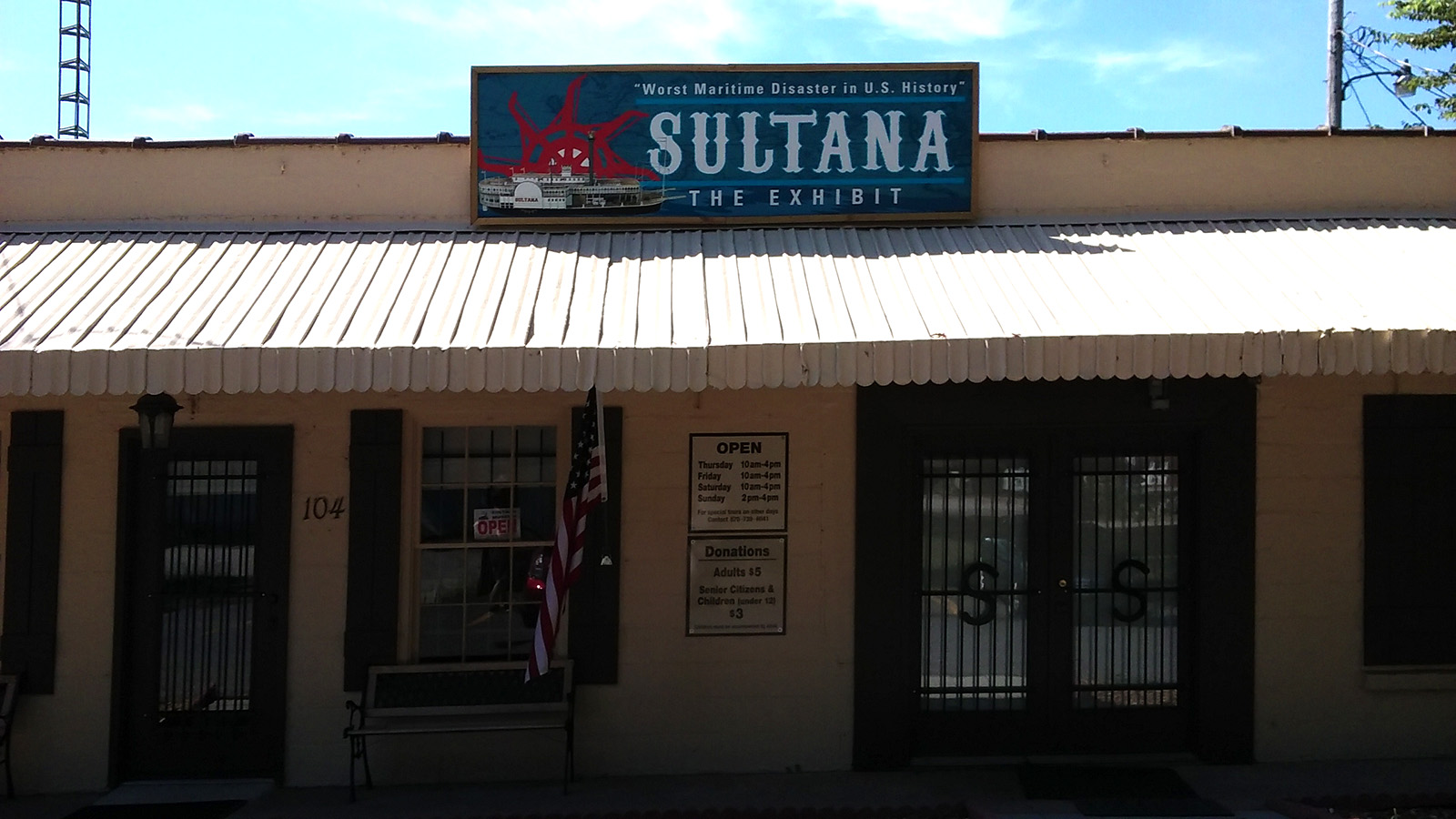
In this episode, I talked with Jeff Kollath, Executive Director of the Sultana Disaster Museum, which is the only museum dedicated to preserving the memory of that fateful night. Since the museum was founded, it’s been housed in a small storefront in Marion, Arkansas, but they are now in the process of moving to a much bigger space that will allow them to tell the story of the Sultana more completely. Fundraising for this ambitious move is still in progress, so please consider supporting them with a donation so they can preserve the stories of those affected by this disaster.
Dean Klinkenberg 02:44
So in this episode, Jeff briefly describes the history of the boat, the Sultana. Then we go through a detailed sequence describing the boat’s fateful last journey. As part of this discussion, Jeff talks about some recent scholarship that has more completely and accurately documented the number of people who boarded the boat and who died. In fact, they have a website. On their website, they have a database you can search, looking up the names of people who boarded the boat and finding out their fate.
Dean Klinkenberg 03:16
I suspect many of you already know something about the Sultana. If you listen to this podcast regularly. You probably know something about Mississippi River history. I think you’ll find there’s still some details that Jeff covers that may be new to you. And still it also amazes me that so many people have still never heard this story. So let’s help get that out.
Dean Klinkenberg 03:41
Thanks to those of you who continue to support me through Patreon. Your support makes me smile, makes me feel good, and keeps this podcast going. If you want to join the Patreon community for as little as $1 a month, you can do so go to patreon.com/DeanKlinkenberg. You can join for as little as $1 a month. If Patreon isn’t your thing, then you can buy me a coffee. Go to MississippiValleyTraveler.com/podcast, and there you can help support my caffeine habit with, you know, buy me one coffee, two coffees, whatever, whatever you’re in the mood for. The show notes and all previous episodes you can also find at that same address, MississippiValleyTraveler.com/podcast. You can binge all previous 73 episodes, or you can go through and and pick and choose the ones whose content strikes you as the most interesting. And now let’s get on with the interview.
Dean Klinkenberg 04:51
Jeff Kollath is a historian and Executive Director of the Sultana Disaster Museum in Marion, Arkansas, and we are here to talk about this infamous and probably not as well known disaster as it should be. Just on the anniversary of its demise. Jeff, welcome to the podcast.
Jeff Kollath 05:12
Thanks for having me. Great to be here.
Dean Klinkenberg 05:15
I thought we would just kind of have a general discussion and trace the timeline of this boat and give sense, give folks a sense of what the sequence of events were. Why don’t we just start by talking about the boat itself, the Sultana had been operating on the rivers for a little while. Give us a sense about what kind of boat it was and what it what it transported, what its role was on the on the river at that time.
Jeff Kollath 05:37
Sure. Well, it was the Sultana. It was actually the fifth boat named the Sultana that was on the river went back, you know, 10, 15 years or so, give or take, was built in Cincinnati, Litherbury Boatyards on the Ohio River. And there’s, you know, other boats built a similar design at the same time. It’s pretty remarkable how these things were built at that time, considering their size. The Sultana was 280 feet long, and you know, like was it almost four stories tall, 60 feet wide. So it’s not a tiny boat by any stretch of the imagination. So seeing all of those things built before modern conveniences is pretty remarkable. And in the boat itself, you know, I mean, really, no expense was spared for how it was outfitted. I mean, yes, it was, was meant to, you know, transport people and goods and animals and various things up and down the river. So they, you, you bought tickets. So there were rooms to stay in. There was, you know, dining hall, saloon. There was a piano in the ladies lounge. You know, the deck work and the railings and things were very ornate. And so it, mean, really, it was, it was quite, quite a boat. I would think when, especially when it went into the water for the first time in 1863 to see it as such. And you know, really, the steamboat industry in the in the on the Mississippi changed dramatically during the war, most notably with the military. United States military, being able to essentially tell a private a private concern, that, hey, it’s cool that you’re carrying people, but now you got to carry some of our stuff, and some of our people too. And so, you know, really, when the river was not in the hands of the Union Army, which didn’t, you know, really the Anaconda Plan, and you know, kind of the taking of the waterways around the Confederacy with Farragut coming in in New Orleans, and then obviously grant taking Vicksburg, Memphis had fallen in, you know, 1862 and then Vicksburg falling around Fourth of July, 1863 when the Union Army is in control of everything on the river. So steamboats then are now opened up beyond Vicksburg, all the way down to New Orleans. So that New Orleans to St Louis run became pretty common, and that’s what the Sultana did. And so I think the boat was, you know, Preston Lodwick was the first captain and co owner, and then the infamous James Cass Mason, who was the captain of the boat when the disaster occurred. You know, how he the how each person managed the boat was certainly different. And with Mason, who was a younger guy, pretty brash, known as being pretty reckless on the river, you know, he had married well, and he was father in law, I think his last father’s law, his last name was Dozier had given him or Mason, had bought into a boat named after his wife, the Rowena, and had basically run the Rowen aground, and then was given the command of the bell Memphis, which actually drag race style. It’s not drag racing, but I love calling it drag racing. Drag raced the Sultana in the city of Alton, you know, in 1863 before he got took command of it, and then he took command of it in early 1864. And even though he sort of kept moving up and had bought into the boat and had a 25% ownership stake, he didn’t really change his behavior. And I think that’s really indicative of how this disaster came to be was, you know, Mason got himself in the hole. You know, he was somebody that, again, was aggressive with how he, time was money, so if he could push the boat, he pushed it. When the river is at flood stage, and you see a wide expanse of two or three mile wide river. He’s driving in straight lines. He’s not following the channel, even if he might know where it is. So he’s hitting snags. He’s running in the debris. He’s running the boat in period of time of the year when there’s still ice on the river, and ice can damage the hull of your boat too, and knock holes in it. So he was behind and had, you know, sold off, he was at 25% sold off, half of that sold off, half of that again, by the time he pulls into Vicksburg in 1865 and it’s because he needed money to keep it on the river. And so it’s, it’s sort of when all of these things sort of coalesce and come together it makes for a terrible story, obviously, with how it comes out. But it’s really interesting to kind of learn about the economics of riverboat travel and river commerce at that time, communication, how, especially during the war, when the telegraph lines are cut in the south and and how people are finding out that live along the river, are finding out what’s going on in the world, and it’s through steamboats. It’s through steamboats pulling in along shore and landings and selling newspapers or just Shouting, shouting news from the boat to farmers alongside the river, whomever it might be, which is really what the Sultana was doing to share the news of President Lincoln’s assassination so.
Dean Klinkenberg 11:01
Right. I was gonna say like that that was a lot of river folks learned of Lincoln’s assassination from the Sultana, right?
Jeff Kollath 11:08
I mean, it’s got the nickname “The messenger of death” for doing that, and it had black bunting draped on the on the boat as it went down the river, leaving Cairo on the 14th of or, yeah, around the 14th of April, 1865. So it’s, it’s one of those things where you know the river today. You know being here. You know our museums in Marion. I’m currently in Memphis. I live in Memphis. You see the river, you know, all the time. And you know, we’ve been at pretty we’ve had very low water the last few years where, you know, two to three feet, and sometimes as little as two to three feet in the chain the main channel. And the amount of, you know, draw that’s necessary for these modern barges and boats and things is pretty incredible. But then to see the river at full flood stage, like we see, you know, every spring, which is the way it was when the Sultana was on the river in 1865, this channel is in a different place, but, but seeing it at its full majesty, it just is one of those things where you see it, and it’s like when you know, DeSoto shows up and then, but people see it for the first time, it is really, I don’t know how I’m gonna get across that.
Dean Klinkenberg 12:26
Yeah, that’s how i feel sometimes today.
Jeff Kollath 12:29
And you know, in St Louis, and we have something in common. We both went to school at UW La Crosse, and we both know the Upper Mississippi is a is a child is giving candy land compared to the lower Mississippi, just in terms of how it’s controlled and the water itself. And you know, silt runs downhill. Not as silty up north as it is down here.
Dean Klinkenberg 12:53
Silt and nitrate and phosphorus run downhill. So, all right, so the boat that ends up in Vicksburg. Tell me a little bit about how it ended up there and what was going on. What was it there for?
Jeff Kollath 13:11
So the boat leaves and goes from Cairo down to New Orleans as part of its you know, usual, or St Louis to New Orleans as part of its usual run. It stops in Vicksburg on the way down to New Orleans. That’s where Mason, there’s some Gene Salecker, who’s sort of the dean of Sultana historians, and has written really, sort of the definitive book, along with Jerry Potter, a local lawyer here in the Memphis area. Jerry wrote the first book about it in the ’80s, and then Gene has written about it several times and and really, you know what the story begins on the way down when, when Mason pulls into Vicksburg and sort of reacquaints himself with this guy named Reuben Hatch, who is the quartermaster at at Camp Fisk, which is where the prisoner exchanges is happening. And so the Union prisoners of war from Andersonville and Cahaba have made their way west, some by rail, some by boat, then most mostly by rail, and then having to walk the rest of the way from Jackson, Mississippi to to Vicksburg, which is not a short walk, mind you. And these are guys that had been in POW camps, in some businesses for years, and injured, or poor health, malnourished and so on. And then, obviously, they when they get to Fisk, they’re given fresh clothes. They’re eating better than they have in a long time. They have clean drinking water, better facilities. And you know, Hatch and Mason are really kind of a match made in heaven in a lot of ways, in terms of how they approach this situation, which was the federal government hiring private steamboats to take men home after the war. This is after the war, after Appomattox, after hostilities had ended in the east.
Jeff Kollath 15:01
Obviously, Johnston and folks in North Carolina had a little bit more to say about it, and didn’t wap up until, I think, what the 24th of April, something like that. But by and large, everybody was figuring out a way to get home. And, you know, the federal government paying, I believe it’s eight with $8 for an officer and three and a quarter for an enlisted men to take them up the river. You know, Mason is knows that this is a way for him to get some money in his pocket. But Hatch is also looking for somebody that he can work with to put a little money in his pocket too. And Hatch is a real is as as much of a scoundrel as Mason might be for participating in this scheme. Hatch is really the bad, the baddest of the actors in this and this is somebody that has, you know, failed upwards, really, in every position he had had in the military, through patronage, through connections with President Lincoln, his brother being in part of President Lincoln’s fundraising and brain trust when he was in Illinois. And every time he would get in trouble, he would always find a way to get out of it. And now he’s quartermaster at Camp Fisk and and it’s looking for somebody that he can say, I’ll give you as many of these guys going home as I can, if you give me x as part of that. And he was looking for somebody that would agree to that, and then Hatch promises, and, you know, I’ll give you 1,000 men. Of course, obviously, the boat is, you know, as we all know, not built to hold that even though it is 260 feet long, but the capacity is only 376 and so. But they may, you know, have a, you know, handshake deal, whatever, and agree to it. And then Mason completes the journey, goes to New Orleans, picks up some civilian passengers, horses and mules and sugar and pigs, or hogs and various things, and then starts steaming back towards Vicksburg, and pulls into the landing at Vicksburg, where they start, eventually they start to load the boat. And Gene, both Gene and Jerry go into it in detail, especially Gene. Gene’s book of the loading is so is so detailed in the research and work that he’s done to tell that story. So I really recommend they go. It’s his book, ‘Destruction of the Steamboat Sultana’ is the name of, it’s the most recent one. And essentially, you know, there’s some while they had agreed to 1000 there’s a sense, there’s some miscommunication, and some other people that are involved on the federal government side, and eventually over 2000 soldiers are put on to the boat. There are two other steamboats that are at the landing at the same time, and the second one gets only a few and the third one leaves empty, so there was room for these other boats to have on there. But obviously, Hatch did not have the deal with those captains. He had the deal with Mason, and so the boat is supremely overloaded at that time. But it’s also important to remember that that wasn’t the cause of the eventual disaster, the overload.
Dean Klinkenberg 18:11
And it wasn’t terribly unusual during wartime for the army to overload boats past their capacity anyway, right?
Jeff Kollath 18:18
Correct. Yeah. And so again, the 376 is, you know, I don’t know anybody that would turn down more people if they thought of what was within the limit. But I think what we see here is the overloading just makes the disaster.
Dean Klinkenberg 18:34
And you mentioned Camp Fisk. So, like, this was a sprawling temporary camp just outside of the city of Vicksburg, home to thousands of men who are just recently released prisoners of war, for the most part, whose health is terrible as you said. Some of them have lost 40% or more of their body weight. There are probably a lot of them that were anxious to get on a boat and start making their way home as well. I don’t know if we have any oral histories or anything about people, soldiers who are boarding that boat, who didn’t really want to get on at that point. I think probably a lot of people just were anxious to empty out that camp and get back to whatever normal existed after.
Jeff Kollath 19:16
Sure, and yeah, absolutely. Chester Berry, you know who was on the Sultana is really the dean of collecting these stories, and publishes his book in the 1880s around the same time that the Sultana Survivors Association chapters are sort of affixing themselves to G.A.R. posts and things throughout the North and able to collect these stories and publish them, really, for the first time. And so yes, there’s a lot of enthusiasm to get home, but there’s also a lot of skepticism about the quality and condition of the boat. And so the way I always, you know, there’s some great lines. And I worked in military history at the Wisconsin Veterans Museum in Madison for a number of years, and worked extensively with Vietnam veterans. And you know that we talk about going home and catching the freedom bird back and, you know, obviously, for most of the men and women that came home, they went over by themselves, and they came home by themselves. They were in a fixed part of a unit. But there was this notion of seeing that, seeing that airplane on the tarmac and getting on and feeling a sense of “ha” maybe, you know, we made it. And then obviously, the the airlines and the service providing those comforts of home on the plane to get them home, back to San Francisco or Seattle or wherever it might be. And then, obviously the homecoming was a whole for some, was a whole other story. But for these men, you’re you after you’ve suffered in a POW camp for an extensive period of time. You’re given some time at Fisk, clean clothes. Like I said, clean clothes, food, water. Conditions are better. You know, some of them, you know, still nursing some wounds and things and some illnesses. But mostly, you know, the able bodied are on this boat. They’re not the infirmed by any stretch. But then you get on a boat and you have to struggle to find a place to sleep or struggle to find a place to sit, and bathroom usage and latrines and short notice and food and supplies and clean drinking water and all that stuff is are in short supply. And then you still have to remember, there’s still civilians on the boat too, who paid money to have a room. And, you know, again, Gene and Jerry both do a good job of talking about the people that were on the boat, but it always kills me that there’s, you know, a honeymooning couple from New Orleans that’s on the boat. There’s a minstrel troop that’s headed north to Memphis. There’s, you know, officers and soldiers who had been convalescing after being wounded in New Orleans, taking the boat back home and with their families too. So there are women and children on the boat as well. And so once they get everybody on, you know, they start steaming north. And I think a lot of that, you know, a lot of that hesitancy, begins to go away, and then it’s just, we just got to make it through this. Obviously, what many of the men and or most of the men and most of the passengers did not know was the work that was done on the boiler there in Vicksburg, as one of the boilers had developed a leak. There are four boilers on the boat and required a patch. It was recommended that the boat not leave. The patch was not recommended, but Mason didn’t want that, it was time to go and money to be earned. And so, of course, the irony of that is that the patch boiler is not the one that exploded, so.
Dean Klinkenberg 22:43
Right. And, yeah, yeah. We’ll get into the cause and all that a bit later, too. But I’m curious to at the so when this, when the boat is out of the port, when it’s on the way to Vicksburg, what’s our best estimate right now about the number of people who are on board?
Jeff Kollath 22:58
2,130.
Dean Klinkenberg 23:01
That’s pretty specific.
Jeff Kollath 23:02
Yeah.
Dean Klinkenberg 23:03
And I remember reading that, I don’t know if this is true or not, but there were, there was a story that the was that the hurricane deck sagged so much they had to reinforce, or one of the decks sagged so much from all the people they had to reinforce the deck.
Jeff Kollath 23:16
Yeah, it was, I mean, one of the struggles that they had was distributing the weight, you know, evenly. And as far as the numbers and the people that were on the boat. If you go to our website, SultanaDisasterMuseum.com, we have a complete database of the passengers, known passengers, that were on the boat. And again, kudos to Gene for doing all that work. And it’s not just a list of names, it’s names you know, where they mustered in, units served with, if we know what happened to them after the war, photos of their gravestones and cemeteries are there, and pictures if available. So it’s a really incredible resource, but keeping the weight distributed was was certainly a challenge throughout the entire journey, and especially, you know, steaming up from Vicksburg to Memphis, which is where, you know, at Memphis is where they’re offloading the hogs. They’re offloading the hogsheads of sugar. So the cargo area underneath the the boat is, you know, is empty at that point in time. So they’re always worried about keeping the weight evenly balanced, keeping the weight balanced and keeping it level in the water and not listing to one side or the other. And part of that is related to just, you know, the boat wasn’t in danger of tipping over, certainly, but it’s maintaining a level water level that’s level in the boilers, and making sure that those those tubes, the tubular boiler, those tubes are covered by the water. You know the analogy, the analogy I always think of when I was reading about this, because, again, this is something I didn’t know anything about really when I started was the technology behind it, you know, is akin to, I like, when I talk to people about it’s like, it’s like a nuclear meltdown in a reactor core. It’s like, everything’s great as long as there’s water on top of those fuel rods, but as soon as there’s not water on those fuel rods, it’s going to get real dicey, and obviously to a much more extreme level than to the to the Sultana. But it’s a similar principle. You know, it’s like making with space in those boilers, but also exposing those, those the hot flues within the boilers themselves. And then when that cold river water comes back on it, there’s it really and especially if you have some issues with your boiler, it really increase or the the boiler itself, it really increases the opportunity for something bad to happen.
Dean Klinkenberg 25:42
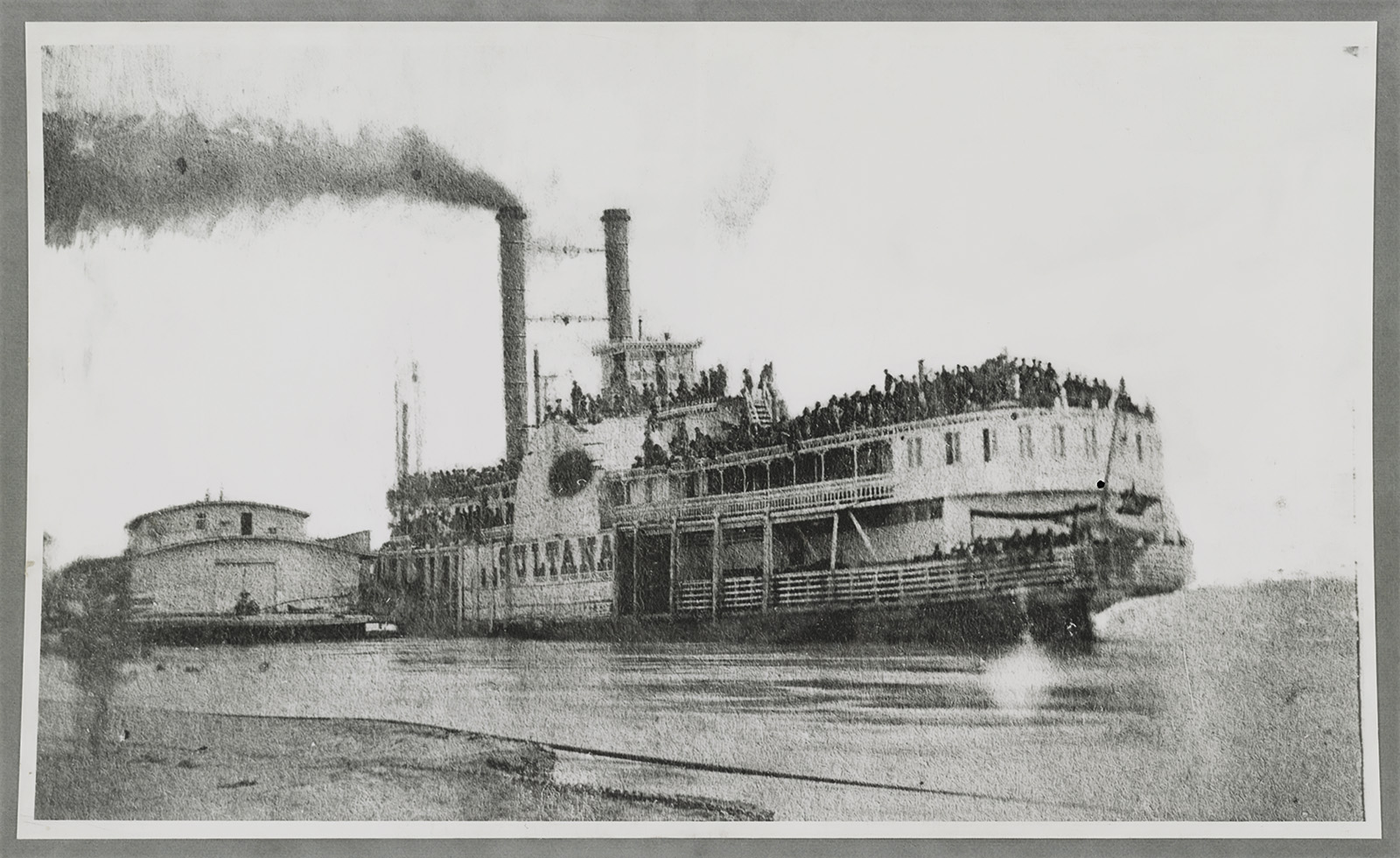
So we have a drastically overloaded boat carrying a lot more weight than probably the engines were designed to push typically. And on top of that, the river is running high. It’s spring, so it’s flood stage. There’s going to be debris in the river. It’s moving quick. So, and on top of that, we have just, you know, that corruption that involved in the boarding process in the first place. So they’re all kinds of like bad omens at the beginning of this trip. So they get to Helena and a photographer is on shore and takes a picture of the boat and the people on board that time. What are you when you see that picture? What do you see?
Jeff Kollath 26:33
Well, so it’s we should explain. It’s one of two photos of the boat that exist. So that’s by far and away, the best and the most famous. There was another photo taken of distance of the boat in St Louis as well, which you can see in the museum. And it’s around too. But it’s really, it’s more of just to see the boat sort of at full and just full profile. The Helena photo. So it’s incredible for so many reasons, taken by a guy named Thomas W Banks, who had a photography business. Who did some interior design, painting, various things in Helena. And he had been documenting this the again, the river at flood stage had been documenting the flood in Helena, and he so he was on a high on the bluff, really, at a high, high point outside the city, and had been taking photos of what the city looked like with the streets flooded. The Union Army was an army of occupation. So there was a number of interesting things there, and really documenting what had been going on, what had been going on in Helena, and then he sees this overloaded boat churning up the river and coming into the landing at Helena and is able to capture this incredible photograph. And so, but when you see the photo, there’s always a few things that pop out immediately, and then there’s two things that, with a fine eye that you look at, look at a photo very closely. You can see so the first thing is obviously the condition of the boat. The condition of the boat, despite the age of the photo and the lack of clarity, it becomes abundantly clear that the boat is in not good shape, and that is evident by the and has been misused, not not used it’s intended to be when it pulls into Helena, and you can see that on the paddle wheel housing, two things stand out there are holes cut. Theyr’e knocked in the top of the paddle wheel housing and then staining on the paddle wheel itself. And that is because the men had been using that area as a latrine, because there was not access to the latrine as it was intended to have on the river. And so that sticks out. There are people everywhere, stuck in places where humans were not intended to be on that boat. And so it’s just a it’s a mass of humanity that’s there. There’s also sort of this ode to, I always think of what the boat could have been, which is the antlers between on the cables between the smoke stacks. And the antlers was a trophy, a unofficial trophy on the Mississippi River, given to the boat that had could make the run from New Orleans to St Louis in the fastest amount of time, or quick least amount of time. So we’re not talking hours here, obviously we’re talking days. And so we’re, you know, roughly three days and change. And the Sultana had that record at the time when it got to St Louis, it was going to eventually have to turn those antlers over because another boat had had taken the crown. But it also was a reminder of always, to me, it’s everybody has become a reminder of what the boat could have been had it been managed better. The detail thing that has become a favorite thing of mine is on the hurricane deck, there is a stairway, and there’s men that are out there, and you notice every. So the boat is listing ever slow slightly, the men see the photographer and run to the starboard side to get their picture made, which is, of course, the most human human nature, especially in 1865 for a lot of these men might not have ever seen a camera before, but you’re going home after your military service, and you want your this is a document. This is going to document that you were on this boat at this particular time in Helena, Arkansas. So anybody that could was rushing over to that side of the boat. And so the boat is listing. It’s not level in the water, which we just talked about it. And the captain, I think, was very concerned about that. And some of the officers on the boat were concerned about it, too. But on the hurricane deck, there’s a stairwell, and there’s two guys, and one guy, he’s actually caught in the moment, running up the stairwell, and he’s almost in midair as he gets up there is which is incredible. And then there’s another one whose arm is extended way above his head and he’s waving, and it’s the most he’s not the only one waving, but he’s the one whose arm is the most visible when he’s waving. And so that, that, to me is it’s just kind of this joy, right? Of wanting to get again, have this event documented, getting your picture made.
Jeff Kollath 31:22
And certainly, the Civil War is the first war in the United States where photography played a significant role, both, you know, certainly you know, the photos of the battlefield at Gettysburg and in other battles, you know, and the cost and bodies laying in the field and so on, you know, really brought home the consequences of war to the entire country at that time, which is something they hadn’t seen before. And then obviously the ability to get your picture taken when you go to one of the larger cities and go into a photo studio and Banks was taking photos of the occupying army, portraits of officers in the occupying army in Helena, which the Central Arkansas Library System has, and other people did you, but they have them in their collection, and they’re really incredible. And so documenting your military service, but in getting your picture made, is such a becomes in such an intrinsic part of service that you start to see that really throughout and again, talking about, I always, I was always a joke, and with my wife about everything, I always bring everything back to Vietnam. But a lot of it is, you know, you in Vietnam, soldiers that were in country were given or, you know, you could get your film processed for free. And so when you see photos that men and women took in in Vietnam, so many of them, this is the first time, not just the first time out of the country, it’s a lot of what’s the first time out of the state that hold their home state, or even their home county, in some ways.
Dean Klinkenberg 32:56
Right.
Jeff Kollath 32:57
First time on an airplane. And so you’re documenting, you’re you’re documenting things. You document, of course, when you’re on vacation, the landscape, the people, the rivers, everything. But they’re also taking pictures of their friends, and they’re having people take pictures of themselves, of them, and their dog, and dogs that they meet, and various other things, which are these kind of pieces of home. And it’s like just grounded in this sense of humanity that I’ve always loved about seeing photos that that soldiers, men and women take during wartime and what they think is important, because that’s what they’re doing. They’re documenting what’s important to them at any given point in time. And so that’s a long way of saying that’s what that photo with those, the guy waving and the guy jumping, that’s what that reminds me of.
Dean Klinkenberg 33:44
It’s a, I find it an especially haunting picture. Maybe it’s just knowing what what comes not long after that, but it’s, it’s a public domain photo. I will post a picture of that on the website, and I’ll probably put it out in social media too when this episode is out so folks can see it for themselves. But yeah, that that’s a very vivid description. Thank you. I was curious how professional a historian, especially, would see something like that.
Jeff Kollath 34:10
Well, and you said it right. It’s sort of like they don’t know what’s coming. It’s like it’s the same thing that I always think about when you see footage of the Challenger astronauts getting on or when they walk out of the walk onto the van, they leave their their quarter, crew quarters, and they get onto the transit van, and they’re all they’re waving and smiling. I mean, of course, you know they’re anybody would be nervous to get on top of a rocket ship, but it’s like, that’s the last view we have of them, right? And they have no idea what’s coming and happening and like so I agree with you. It is haunting because, you know, obviously, with with hindsight, and we do know they don’t, and so it’s just a weird thing to see people in this case, not just hours before they go, Well, this case, yeah, I mean, this was on the 26th this was, you know, less than 24 hours later, these, many of these guys aren’t around anymore.
Dean Klinkenberg 35:04
So I forgot to ask this part. But so the ultimate destination was Cairo, Illinois. Is that right?
Jeff Kollath 35:10
Ultimate destination was actually they were going to head up to the head up the Mississippi to Cairo hanger, right, and go up the Ohio. And then the men were to muster out at Camp chase in Columbus.
Dean Klinkenberg 35:26
So after Helena then, the boat continues on to Memphis. Stops in Memphis, as you’d mentioned, there’s some unloading. I think a few soldiers were able to get off the boat for a little bit and search around town for a bite to eat and some supplies. Do you have any stories about that?
Jeff Kollath 35:45
I’m doing air quotes, supply. Well, I think you know, part of it is, you know, some of the men were paid to help unload the boat, which they did. I mean, these giant hogsheads of sugar and things get off the boat. A lot of civilian passengers get off the boat. But then, yes, you do have some of the men who are like town, restaurants, bars, what have you. I want to get into some of that, which is, again, human nature and soldiers, soldiers, by and large, like a good time.
Dean Klinkenberg 36:16
They just got out of a prison camp.
Jeff Kollath 36:19
Exactly.
Jeff Kollath 36:20
And so there is certainly some of that. And you know some of these stories of near misses. You know, guys that didn’t get back on the boat, guys that missed the boat. You know one of the most famous stories, and one of the most famous survivors of the story is this guy, Eppenetus McIntos, who was an Illinois infantryman who was at Andersonville and withered to about 65 pounds or so. And then was actually got on, was on another boat, steaming north, missed went into town, missed his boat, and then got on the Sultana. And then, you know, all those things. You know, obviously the explosion happens. And then he makes his living after the war as sort of this itinerant musician. You know, he’s written these, you know, taking songs that tunes that were tunes that were popular of the day, or hymns, and making up these lyrics, some of them silly, some of them serious. And he travels the, you know, the country, selling song books and sheet music, or not, cheap music and lyric sheets and photos of himself at Andersonville artist rendering. And so that’s one story. You know, there’s stories of, you know, guys that went into town. The tall Tennessean is somebody that Gene writes about, and is in Chester Berry’s book, and somebody that’s close to seven feet tall. So very much, the tall Tennessean. And his story is certainly really interesting part of the after the boat explodes, and sort of his role and in that too. So the what happens in Memphis is they, you know, some guys leave, some get back on. Other people leave. But the when they removed all that weight from the lower part of the boat, the stick crew in charge did not redistribute the weight. And so that becomes a key part of what potentially could have caused the explosion just up river. Gene talks about that and in his book, again, going back to that idea of exposing those hot flues and then slamming them with ice cold water from the river. Now this is the end of April. The river’s at flood stage. It’s rivers only about 50, no more than 50 degrees temperature wise. So it’s pretty still pretty cold, especially when you have, you know, boiling hot flues in there.
Dean Klinkenberg 38:49
Yeah. So all right, so take us through what happens after that. They get back underway after Memphis, and then all hell breaks loose.
Jeff Kollath 38:55
And add some more firewood and coal and stuff. And that’s really where the, you know, the idea of sabotage comes into play with Confederate sympathizers, or whomever that had a coal torpedo, which is a chunk of coal, or an object made to look like a chunk of coal, but it’s actually a charred explosive charge that would be thrown into the firebox. And those, Gene thoroughly debunks those, and has debunked those over the years. And there’s some great conspiracy theories, but
Dean Klinkenberg 39:26
There always are.
Jeff Kollath 39:29
And so as they start to churn up river, they get a few more miles north, and then one of the boilers, one of the four boilers, explodes, not the patched one. And so it’s a steam explosion. This isn’t a kaboom explosion. This is a steam explosion which blows a hole in the boiler and then blows straight up and blows a hole in the structure and the decks above it. When the explosion happens, it exposes the fire boxes below, which is where, you know where the coal is, that’s that’s boiling the water when the debris goes up and comes back down and then falls onto those fire boxes. That’s what starts the fire that eventually engulfs the boat. So you have sort of this, men that are killed instantly, men that are thrown up in the air and then back down onto the debris and onto the fire. There are some that are thrown off board right away, but some of the men that are in other parts of the boat don’t really know what’s going on. They hear they’re asleep. This is a, you know, 1:30 in the morning, they heard a disturbance of some kind, and then wake up to find out what is actually going on. So you really have two phases of evacuation. One is sort of the initial one where the explosion happens. The first fire is burning, and you have hundreds and hundreds of people jumping into the water, searching for debris to grab on to, taking pieces of the boat and throwing it in the water and jumping in. But you also have this massive humanity in the water. It’s completely dark except for the burning boat. The water is ice cold. It’s in the middle of the night. You’re in the Mississippi River. Many of them are still nursing their way back to 100% and many of them just don’t know how to swim. And you’re fighting the current, but you’re also fighting the people around you. And I think the one of the most harrowing, the most harrowing part of it for me, is just putting yourself in the position of being tossed into the water and having belief in your ability to like, how am I going to get through this? And having a plan, and then somebody grabs you that can’t swim, and pulls you down. And so you have a lot of people, once they’re in the water, start to realize, if I’m going to survive this, I can’t I can’t have my clothes on. And so they start to strip down, so there’s nothing to grab onto. And then some of the men that are on the boat start to see that and do it as well, before they’re jumping into the water well as the fire starts to spread again, it’s fighting the current. The boat is still pushing upstream, but eventually it loses it loses steam, pun intended, and starts to as the river starts to push it back, the fire reaches the paddlewheel housing so once those first paddle that starts to come off the boat starts to turn, and then that fire that’s in the front part of the boat jumps to the back part of the boat. So then now the back half of the boat is also engulfed. So you have sort of the second mass exodus that’s that’s happening. And the more people you have in the water, it just becomes more of an issue. But there’s debris. Mason, the captain, is last time people see him as he’s pulling pieces and finding pieces and throwing into the water. He does go down with the boat, and it’s this, these harrowing tales of survival, some of the women and the children that are on the boat, again, Gene goes into really great detail and telling those stories about, you know, the one female survivor, Ann Annis, who’s actually from Wisconsin, and you know, the just the the terror and the heart wrenching decisions that have to be made for self preservation versus saving your brother or your sister, whoever’s next to you.
Jeff Kollath 43:23
And you know, some of the men are able to swim sort of away and back down, and some are able to find pieces and drift. Obviously, if this is happening at two in the morning and it’s a large explosion and it’s a fireball, you’re going to hear it. If you didn’t hear it, you’re going to see it. And so eventually the people of Memphis, you know, realize what’s going on and sound out, you know, essentially an alarm. And then all these skiffs and canoes and up some other federal boats that are nearby. But then also steamboats that are in the river already going north or south, start to pull people out of the water. And so you have sort of these rescue efforts, you know, people just seeing what they needed to do. But as they’re doing this, they’re pulling bodies out, pulling them in, taking them back to the landing, going out, that eventually you just have this mass of humanity, you know, laying on the landing in Memphis, you know, some living, some dead. It’s just, I mean that it’s a harrowing visual. So the boat, you know, continues to burn, and then eventually burns down to the water line. Some men stayed on it the entire time. Some men actually got back on it when they realized it was safer, potentially, to be on the boat as the fire had dropped down, as opposed to being in the water, and the boat drifts over to the Arkansas side of the river. Again, the river is at flood stage, and so it is a lot wider than where it’s used to, than where it usually is. And so the shore is further west, near present day Mound City, Arkansas. And, you know, runs up alongside the property of the Bartons and the Fogelmans, and both of whom are still quite prevalent names in the in the in the Marion and Crittenden County area. And both are farmers and are able to they had their boats. There had been guerrilla activity on that side of the river, so the federal army had confiscated boats and but they’re they’ve lashed together logs and made, made make makeshift rafts and used, you know, potentially, floats that they had concealed from the from the from the federals to go out into the river and start pulling some of these people out and taking them back to their homes and putting them next. I mean, the traditional story of pull you into the house and give you a blanket and put you next to a fire and hear some whiskey and and so on. And the Barton, the Franklin Barton, who is the the one of the rescuers, had just returned from service in the Confederate Army, and was wearing his uniform when he’s pulling these people out. And so.
Dean Klinkenberg 46:08
Union soldiers, mostly?
Jeff Kollath 46:10
Mostly Union soldiers, right? And so what you have, I think that’s what that puts sort of a, I wouldn’t say it puts a pin in the story, but it brings it full circle for a lot, I think a lot of us, is this complete loss of humanity that occurs at Vicksburg, which is thinking of human beings as a commodity, as a thing that can be sold or bought, in terms of the military, obviously, in thinking of it as a way to make a buck, and not thinking about the human toll of what you’re doing in terms of overcrowding this boat and losing the sense of right and wrong, and then coming full circle to the rescue and people risking their lives to pull these men and women out of the water. But then, sort of like at the end of this war, we’re back. We’re back to where we should have been, which is not blue, not gray. We’re just, we’re just people helping each other out. And so I think that’s always kind of the to me, the full circle moment and the that really closes out the disaster in a way that’s very powerful.
Dean Klinkenberg 47:21
Hey, Dean Klinkenberg here, interrupting myself. I just wanted to remind you that if you’d like to know more about the Mississippi River, check out my books. I write the Mississippi Valley Traveler guide books for people who want to get to know the Mississippi better. I also write the Frank Dodge mystery series that is set in places along the Mississippi. My newest book ‘The Wild Mississippi,’ goes deep into the world of Old Man River. Learn about the varied and complex ecosystems supported by the Mississippi, the plant and animal life that depends on them. And where you can go to experience it all. Find any of these wherever books are sold.
Dean Klinkenberg 47:59
Yeah, it really was remarkable. Reading the stories of people who lived along the river, who risked their own lives go out there and rescue folks who stuck in the water. Yeah, there’s just so many tragic and hopeful stories contained in this one incident that, so do you do? Is there, like, any one or two particular stories of unique ways people, like the victims, survived?
Jeff Kollath 48:36
Yeah, Samuel Pickens is really the, you know, the the story, I think that gets told a lot in his famous quote, is the best trade I ever made was the best. ‘”The best trade I ever made was trading a live mule for a dead one.” And essentially, you know, their mules and their horses that were on this on this boat, and some lived, and some died, and whatever you can find to keep you, keep you afloat. And so obviously a kicking horse or a kicking mule is not going to be as amenable to you grabbing a hold as a dead one might be. So that’s sort of a famous quote that I think gets passed around, and is an interesting one. The kind of the main one of the main stories is William Legenbeal from Ohio, who was aboard the boat, and the crew on the Sultana had a pet alligator, was about a six foot long alligator, had it, kept it in a box, had it out on the deck during the day, and then they kind of put it in a those room or a closet under the grand staircase. And Luganville knew that was in there, and so he thought that would be a great thing to potentially grab a hold of and float to safety on. And so when I before I started, or when I started, I heard about the alligator, and I saw the artifacts in the museum, I was like, Oh, here’s, this is. The story, the mascot of the boat, and blah, blah, blah. Then you read it, and then, oh, but he to get the box. He had to kill the alligator. And it’s just like, man, he even had to kill the alligator. But anyway, he kills the alligator, and then takes the box, throws it into the river, and then jumps on the box and floats to safety. And then his throughout the rest of his life in veterans organizations or Sultana Survivors Association. He is the alligator man like that is his claim to fame. And so we have a number of objects over the years, a pipe, excuse me, a pipe, scrimshaw, cane scarbox, all with the alligator on it, that that, that he owned. So he really leaned into that part of his identity. I’ve been telling everybody that I think the alligator survived and lived a happy life further on down the Delta. Had a full family, with a dagger in his back.
Dean Klinkenberg 50:59
We’ll ignore the water temperature.
Jeff Kollath 51:01
You know exactly.
Dean Klinkenberg 51:03
It’s irrelevant.
Jeff Kollath 51:04
I think you know the what Chester Berry’s book does is, and I can’t recommend it enough. I don’t recommend you read it all the way through bits and read a few at a time, I think mostly just so that you can really understand and don’t lose the impact of what of what you’re reading. Because I think if you read too many of them in a row, I wouldn’t say it desensitizes it, but it just sort of read five or six at a time. Put it down. Come back. Do five or six more.
Dean Klinkenberg 51:36
It’s basically an oral history, right?
Jeff Kollath 51:36
It is, yes.
Dean Klinkenberg 51:37
He contacted survivors and let them tell their stories, whatever they can remember about the sequence of events. It’s, it’s hard to put down, but it’s a good idea to set it aside after a couple stories like you said.
Jeff Kollath 51:50
There are some men that are very much, you know, very tight lipped and don’t share much, but the ones that do, their language and how they write about it is, really pretty incredible. And, you know, again, these are, this is, you know, after the fact, 20 or so years that these are collected and published, but the way that they’re writing about it, and the way that they’re describing how it still affects them. Again, it’s like you’re reading this in the 1880s and like this. These guys had PTSD, these guys had shell shock, whatever you want to call it. And of course, there was that wasn’t a thing then, and certainly wasn’t understood in the way that it was until the late 20th century and so but you’re reading these and understanding what these men had gone through as part of it. But then again, how it affect their life, not necessarily their war wounds, but the injuries that they suffered in the water or as a result of the explosion. Some certainly with burns. And some of the descriptions of the burns are pretty horrific, but being in the cold water for four to six hours and the effect in eventually developing rheumatoid arthritis and other maladies that made it again. This is the we were in agrarian society in the 19th century. So men who were farmers, as older men or younger men or sons of farmers, or whatever that when they got back home, expected to take back over to pick up where they left off or unable to. And so I think you’re also then dealing with the effects of the not just the war, taking away what you had planned for your life or what you were doing with your life, but now you have this as well. And so I think that’s really one of the points that becomes, I think especially for lack of a better word, heavy or weighty, is that in going back to the Sultana photo or the Helena photo and some of these other things, it’s like, you think you got it beat at this point. You think you’re out, you’re done, we’re going to then have this happen. And another thing, 1,000% not even a quatrillion percent, not your fault happens. And so I think that you see the weight of that, the way that these men are dealing with this, in having to adjust their lives. Again, talking about Eppenetus McIntosh is a good example of that, and he’s just one of the many. And I think that’s something that I don’t think it doesn’t, certainly doesn’t get lost. But because I think talking about the Civil War, talking about Civil War, World War I and World War II, but especially the Civil War in World War I, I think we get what one of the best things that has happened in the interpretation of these of these conflicts and of these wars, is in where museums can do a better job. And World War II Museum in New Orleans is a great example of this. And the museum in Kansas City, my old museum in Madison, you know, has evolved too. Is any of you? Studying these conflicts from 30,000 feet is one thing, but the true impact and the to truly understand what happened and the true impact of them, you got to get down on the ground, and you have to understand these as human beings. Military History is social history is the story of ordinary Americans doing extraordinary things, people that were drafted or constricted, conscript, conscripted, some enlisted, whatever it might be, but it’s, it’s everyday, average Americans doing these, doing these tasks, and their point, their lives moving in a linear fashion, and then it goes a different direction, and then coming back again. And sometimes those lives are long, and sometimes those lives are short. But I think it really helps us hearing these individual stories helps us understand this, the impact of this, and I think the the weight of having your life changed irreparably, in some ways, more than once, is a is a concept that’s pretty foreign, I think. And I think that’s something that I haven’t really said. I haven’t talked about this part of it before, until actually right now. Then it’s starting to affect me a little bit too, just because it is kind of like the notion of thinking that you’re going going home is such a powerful thing, I mean, and again, I’m not, did not serve in the military. I don’t come from a military family at all. But the concept of being able to go home and see your parents or your wife or your girlfriend, your kids, whatever brothers and sisters, whatever it might be, and having it pulled away, is.
Dean Klinkenberg 56:42
Right. Well, and it’s, it’s trauma on top of trauma. Because, again, these were mostly men who were just released from prisoner of war camps. So they’d been suffering in prison camps. They had been in battles. You know, they had multiple years away from home, probably for many of them. And like you said, that feeling of it had to at least be a sense of relief, a deep sense of relief that it was over and I’m going to get to go home, and then the steamboat.
Jeff Kollath 57:10
And I think what Chester Berry’s book actually does a good job of, since these guys are writing in the 1880s is talking about they survived the explosion, and then they still got to get home. Some are like, I’m not getting on a boat. I don’t get home. I mean, there’s all, there’s a number of stories about how, you know, these guys got home after that. And so I think that’s, it’s just, it’s part of it, and it, it’s, I think it’s just also the reminder of the importance of veterans organizations and the role that they did, could and should play, and as peer to peer groups and helping folks deal with this thing I know certainly is the 19th century is a little bit different than the 21st Century, and talking about trauma, but I’ll not just talking about but understanding it. And I think the the G.A.R. and and Survivors Association at least provided some modicum of of of togetherness and closeness and a sense of like, Okay, you guys get this that maybe some, some that weren’t involved in those organizations never experienced.
Dean Klinkenberg 58:28
So based on the more recent scholarship then and the determining the number of people who are on the boat, what’s the estimate of the number of people who died?
Jeff Kollath 58:37
1,130.
Dean Klinkenberg 58:40
Yeah, which still makes it the worst maritime disaster in US history?
Jeff Kollath 58:44
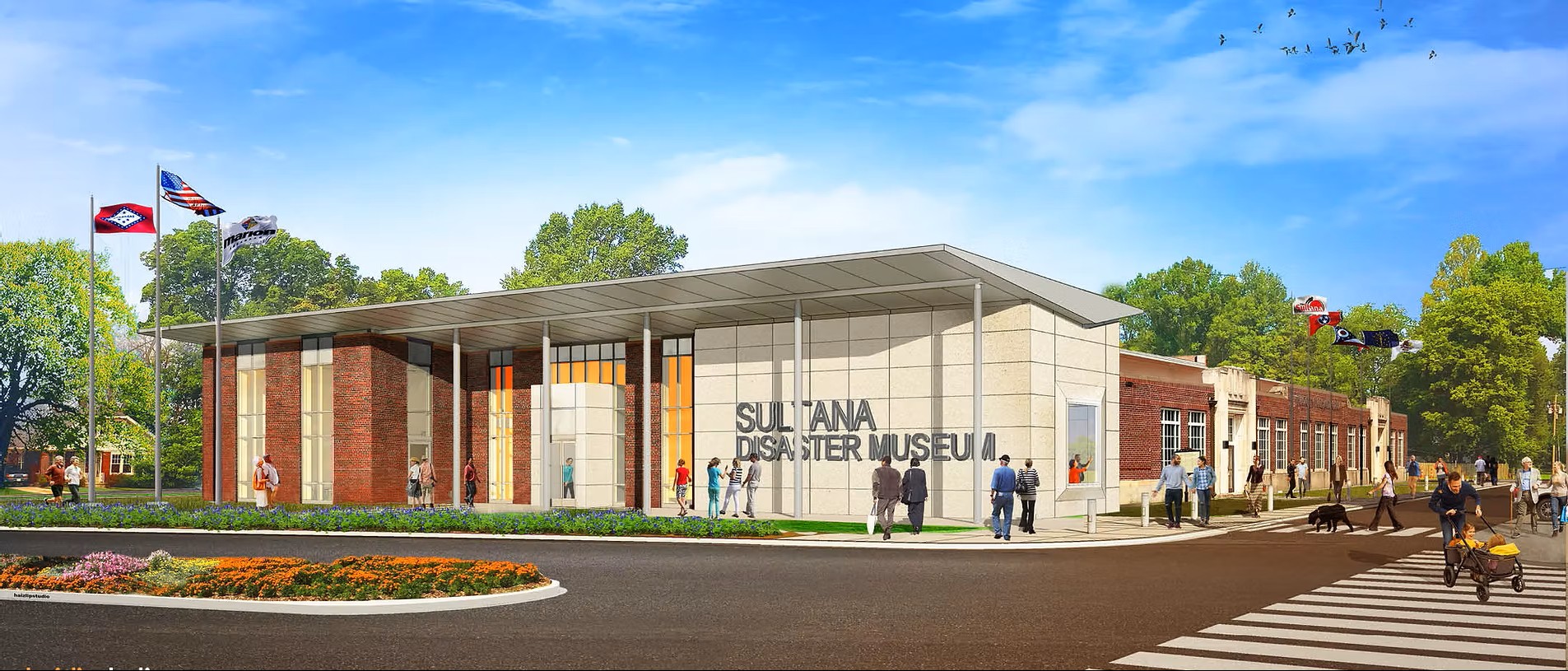
Yes. So it’s the worst in America, yes. And so in the museum are the folks that are they did a small Sultana, did a small exhibit at the State House in Little Rock several years ago that the folks who were doing did the architecture Haizlip Studio in Memphis, or designed the new museum, but then also designing the exhibits as well. And they did a really great sort of infographic comparing the Sultana and the Titanic in terms of the size of the boat. And obviously the Titanic is huge, and the Sultana in the grand scheme of things is pretty small compared to the Titanic, but also the closeness and the number of people that were on the boat and the number of casualties. You know, there’s more on the Titanic, but not that many more. You know, the casualty rates are, you know, little bit higher one side or the other. But it’s, it’s still pretty close. And so I think it’s a really helpful if you don’t know anything, and you know that this is the worst maritime disaster in US history, and then you see that it’s like, okay, everybody knows the Titanic. And so I think it’s, it’s, it’s a helpful teaching tool for us. To use it that way.
Dean Klinkenberg 1:00:02
So what happened? You kind of hinted at this a little bit, you know, the cold water and the so there are lots of reading like the conspiracy theories persisted for quite a while, until then, I found this from 1903 that was talking about in the other Confederate conspiracy. So what do we think actually happened?
Jeff Kollath 1:00:24
I mean, the boiler exploded for a couple of reasons. I mean, one was the the type of boilers. There’s the traditional style of boiler, and then there’s these tubular boilers, and the tubular boilers are thought to be a little bit more efficient. They were really successful on the Upper Mississippi River. But obviously, what makes the Upper Mississippi so much different is the fact there’s not full of silt and sand and dirt and various things. So there, whereas the Lower Mississippi is the boat is drawing in water to fill the boilers and and to boil the water and to make, to make things go, make the engines go, it’s what in the paddlewheel turn is that when you’re pulling up all this dirty water requires these boilers require constant care, and so it’s a lot of there’s soot and stuff that gets inside technical term. Stuff gets inside these boilers and requires constant cleaning and scraping and ensuring that they’re clean, because that start, that that stuff could start on fire as well, too. So that was one of the major issues, was that it’s pulling up not just super cold water, but also super dirty water too. So that was one of the issues. The type of iron that was used on these on these boilers, again, in the 1860s was things you don’t, you don’t, you don’t know it until you don’t know it, until you know it. And so this type of iron that was used was come to find out, prone to expansion and contraction when filled with cold water. Boiling water heats, expands. Cold water when it’s down, it contracts, can create these little microscopic fissures in the iron that, again, if you don’t see the hole, or if you don’t see a crack, you don’t know that they’re there. That was something that was a theory sort of put forth by Hartford Steam Boiler, who I’ll talk about in a second, and one of their engineers, and that that was actually the main cause, was that this idea of this heating and cooling and contraction, expansion and contraction is what caused those fissures, weakening the iron and then giving the steam, you know, space to go. Obviously, the flues, the boat not being balanced and being the superheated flues getting exposed, and then the ice cold water going back on top of the flue is really creating this sort of immediate evaporation or creation of steam in a sort of a violent way, contributed to that too. And so it was, what was determined, though, was that this type of boiler was really unsafe to use on the Lower Mississippi. And so you start to see this type of boiler outlawed on the lower Mississippi, return to the more traditional style boiler. But then you have a company like HSB Hartford Steam Boiler coming in and saying, there is no program for inspecting these boilers. You know, boiler explosions never just happening in maritime and industrial endeavors. They’re also happening in domestic endeavors and using boilers in houses and buildings for heating. And so boiler explosions were fairly common occurrence, and really wasn’t an understanding of how these things were happening, but how to prevent them, moreover. And so what HSB does is it, you know, establishes itself at this company, and establishes, really, the first boiler inspection program in the United States. And not only is inspecting them, but then also creating an insurance program for those as well. And so, which was really unprecedented, and and really it’s, it’s their, their company, which is one of our donors, still exists in Hartford, Connecticut. There’s there they are one of the entities that has kept this story alive, and is in his continued to tell it, and it is part of their corporate history, but it’s part of their culture there too, and so every new employee learns it the dining room, and their headquarters is called the Sultana Room, and they’re an active partner with us in this, in this endeavor, and it’s all because of, you know, again, a group of really intelligent people understanding, there’s a problem, let’s figure out how to solve this problem. And they did, and I think was it last time I heard one of their, their their corporate spiels. They inspected three. Million boilers in 2024, or something throughout the world. So it’s really pretty incredible. And so, yeah, I think that that you know, it was, it was an accident. It was not sabotage, but it certainly was. It something that could have been prevented with better care, perhaps could have been prevented with different type of material, perhaps, but I think also just comes back to would there have been loss of life had the boat not been overloaded, potentially, but certainly not to the scope and scale that we saw with the boat.
Dean Klinkenberg 1:05:38
So the survivors organized a group, and many of them got together for a while to offer mutual support, I assume, and check in on each other. But the story of this kind of largely got lost in the subsequent history. There’s so much. There was so much going on in that time. Lincoln was assassinated, then Booth was killed, the war was ending. I think there was probably so much war fatigue. People were ready to move on and get on with things. And this story, although it got some press, obviously it didn’t really have legs to it. And and there, you know, there’s some books out there now, every now and then a story. I see a story pop up here and there about the Sultana, but it still feels like to me, this is not a story that’s as well known as it should be, given the magnitude of what happened. So I was, you know, when I a few years back, when I saw there was a new museum in Marion that was going to pay homage to this whole experience, I was really happy to see that. So tell us a little bit about the museum and how you came to be. And I understand you’ve got some big plans.
Jeff Kollath 1:06:47
Real big. So, I mean, the museum has really been, it’s been a passion project for the, you know, the folks in Marion, Arkansas and Crittenden County, and again, with supporters all over the country. There is a Sultana descendants Association, which was formed in the 1980s kind of run out of by a lawyer in Knoxville. It’s guy by the name of Norman Shaw. There’s a memorial in Knoxville, East Tennessee, had the second highest number of casualties, after the state of Ohio, East Tennessee was Union country, and a lot of these guys were part of Tennessee Union, Tennessee federal regiments that were mustered in in East Tennessee. And so there’s this really widespread support. You know, of this dedicated, loosely, loosely organized group, but they have an annual they’ve had an annual meeting every year. Sometimes it’s in Marion and Memphis, sometimes it’s in Vicksburg or Knoxville or wherever. And it’s an incredible group of people that who are so passionate about this story, but have continued to research and seek and learn and so on. And one of the the most heartening things that I’ve been a part of was the reunion last year in in Knoxville. And it’s, you know, people come to this a lot of times through genealogy and but there’s also family lore. And so it’s, you know, great, great granddaddy, a great, great uncle or whoever survived this terrible explosion. And as you know, with family lore, stories get passed down. The details get lost. The truth may never have been true, or the truth may get changed, as for us, but verify, yes, exactly. And one of the greatest things that I experienced was the number of descendants that have continued to research and learn and seek and not just to reinforce what they think they know or but to seek the truth and and not be, be okay with to and I think it’s a really, it’s an act of courage in a lot of ways, when you find out that the story that your family member has told, that has been passed down isn’t exactly true. And, and, and get to the point where the sources say this, this is the source. And I saw that on multiple occasions, and I remember thinking like, again, the historian in me is very much like that right there. That is what you do. And I think it was really invigorating, I think for me, and I think for board members that were there to see that in action and to give us kind of the is just sort of the boost that you need every once in a while that because, again, these projects, it’s there’s a big group of people working on it, but it comes, when it gets down to the brass tax, there’s a small group that’s responsible for it, especially in terms of the fundraising. And to make everything’s go, and make everything go. And I think it’s been, you know, there’s, there’s a we got a lot of, we got a lot of people behind us, and to make this happen. And so museums been around for, you know, a little more than 10 years. It’s in, you know, we have a small space on the courthouse square. It’s about 800 square feet, relatively small artifact collection, a few photos, a few other primary sources, and we’re going from 800 square feet to 21,000 square feet in terms of the space, but 9,000 feet of square feet of permanent exhibition space. And you know, if all goes according to plan, will be open in eight months, in November of 2026 and so I think you know, because the artifact collection is relatively small, you know, and obviously the boat exploded and sank. So there’s not a lot, there’s not a ton of pieces out there. And there’s letters and very in diaries and things that exist out there too. But really, you know, there’s not a lot of three dimensional objects from wartime, certainly. So most of our artifacts, most of our collection, is post war. It’s from survivors associations. It’s from G.A.R. and that kind of thing, which is an interesting part of the story, certainly.
Jeff Kollath 1:11:22
So the, you know, the exhibits are going to be, you were going to rely a lot on technology, rely on a lot on storytelling, first person accounts, because we have hundreds of those. And really, you know, I think trying to create an experience that is, at times, somewhat traditional, in terms of, you know, museums and looking at stuff and reading some text and but then also something that’s very modern and very of the moment. So some immersive experiences, especially around that moment when the explosion happens, talking about river commerce and traffic and communication, and and obviously the boat itself and how it was constructed and used, and it’s role sort of up to the point of loading all the guys on it in Vicksburg. So it’s, it’s quite, quite an endeavor, to say the least. And I, but I think it’s, it’s a story that, again, virtually nobody knows. And but like with a lot of things that might be a little off the beaten path or somewhat esoteric or not as well known, the people that do know it are incredibly passionate about it. And so if you go on YouTube, and you know, there are multiple, there’s, you know, a couple of you know, full length, feature length documentaries that have been made. It’s been on History Detectives, the old PBS show, there’s a brand new, relatively new documentary, part of a documentary series about shipwrecks and maritime accidents that was put together last year that has some really incredible graphics and CGI work that was done to kind of recreate the boat from original drawings and that sort of thing. So there’s a lot of, there’s, there’s, there’s a lot of interest in it. And I think it’s, you know, it’s Civil War history in theory, but it’s also sort of Civil War adjacent. And I think that’s also been part of the struggle in getting the type of recognition that it deserves at a federal level. You know, the organization and congressional delegations from Tennessee and Ohio mostly fought diligently for, you know, 20, 30 years up to the 50th anniversary, essentially, and kind of couldn’t get any traction in the House of Representatives to get any kind of federal designation passed for the survivors or for the to even acknowledge the the event. And it kind of went silent until this descendants Association came along. So, you know, I think as we at once, we’re open, you know, my hope is that we catch the eye and the ear of people that have the ability to to make those sort of, suggest those sort of designations, and see what we can do. Because I think that there’s, there’s a lot of opportunity here. I think there’s a lot of there will be a lot of interest in what we’re doing. There isn’t a we’re the only museum in the world with the word disaster in the title, which are in its name, which is a kind of a unique thing, you know, to be in close to Memphis, just really, you know, 15 minutes from Downtown Memphis, but still in Crittenden County, Arkansas, being in the Arkansas Delta, which has such a rich history, cultural history, especially, you know, really music and art and literature and everything that has come out of there. Johnny Cash boyhood home up the street from us the Blytheville Air Base. And it’s rolling, the Cold War on down to Helena and King Biscuit and Delta Arts and in West Memphis and so on. So there’s, there’s a really amazing things that that have occurred in that part of Arkansas and eastern Arkansas and in the Delta, and we’re certainly part of it. And so we view ourselves kind of obviously telling the story in our permanent gallery all day, every day, but through our temporary exhibits and our programming and various other things, I think we have a lot, we have ton more stories that we can tell too.
Dean Klinkenberg 1:15:37
Well, fantastic. Do you have social media accounts for your posting very much for the museum. Or where can folks keep up with what you’re doing?
Jeff Kollath 1:15:46
Facebook’s probably the best place right now. Just search for Sultana Disaster Museum. You could sign up for our mailing list. We send out in we don’t sell it or anything. I don’t know if people still do that sell sell mailing lists.
Dean Klinkenberg 1:15:59
Unfortunately, I think they do. But anyway.
Jeff Kollath 1:16:03
But sign up for our email list, and we don’t bombard you with things you get, you know, a monthly newsletter, and then other interesting things that are going on. And there’s going to be a lot of interesting things going on, certainly over the next few months. You know, we’d love to see a good crowd at the grand opening and in November, and then come see us. You know, after that, I think right now, in the small museum, we’ll be open for sure through the end of April, which I guess when this, when this, when this runs, it’ll be just a few more days.
Dean Klinkenberg 1:16:30
You’ll be shutting down.
Jeff Kollath 1:16:31
Yes, to use the old adage from Widespread Panic, “Call before you Haul” and, you know, come see us, but be sure we’re there still, and then the hope will be to slow, kind of gradually, open the new space with some temporary exhibits and some programs later this spring, in the early summer, and then grand opening in November. So be a lot going on. But again, follow us on Facebook is really the best, and then our website is a great resource to find out about the history and start your journey if you want to learn more about individuals, and then go from there.
Dean Klinkenberg 1:17:07
Fantastic. Like you said, Marion’s an easy stop if you’re going south down I-55 toward Memphis. It’s very easy to jump off a little bit hop into Marion until the end of April, visit so or November, and free parking?
Jeff Kollath 1:17:25
That’s right.
Dean Klinkenberg 1:17:26
Well, Jeff, thank you so much. That was fantastic. That was a really great overview of the Sultana story. And I’m sure if people wanted to contribute a little bit to help you finish off the museum or get set up. I’m sure you wouldn’t object to some donations coming your way as well.
Jeff Kollath 1:17:46
Love donations. You can donate through our website. We’ll be launching a membership program probably around the time that this airs, so that’ll be a great way for people to get involved as well. And so again, I think, you know, construction projects always take a long time, so we’ve been a little bit behind schedule and opening a little later than than what we’d like. But I think we’re the timing. It’s going to the timing is going to work out. And I think the time, the little longer runway to get there, has benefited us. And I think people are going to be really excited about what they see when they come see us later in 2026 or 2027.
Dean Klinkenberg 1:18:32
Fantastic. I’m going to put it on my calendar. So great, Jeff. Thank you very much. I appreciate your time and thanks for sharing your expertise.
Jeff Kollath 1:18:32
Thanks for having me.
Dean Klinkenberg 1:18:36
Thanks for listening. If you enjoyed this episode, subscribe to the series on your favorite podcast app so you don’t miss out on future episodes. I offer the podcast for free, but when you support the show with a few bucks through Patreon to help keep the program going, just go to patreon.com/dean.klinkenberg. If you want to know more about the Mississippi River, check out my books. I write the Mississippi ValleyTtraveler guidebooks for people who want to get to know the Mississippi better. I also write the Frank Dodge mystery series that’s set in places along the river. Find them wherever books are sold. The Mississippi Valley Traveler podcast is written and produced by me, Dean Klinkenberg. Original Music by Noah Fence. See you next time.