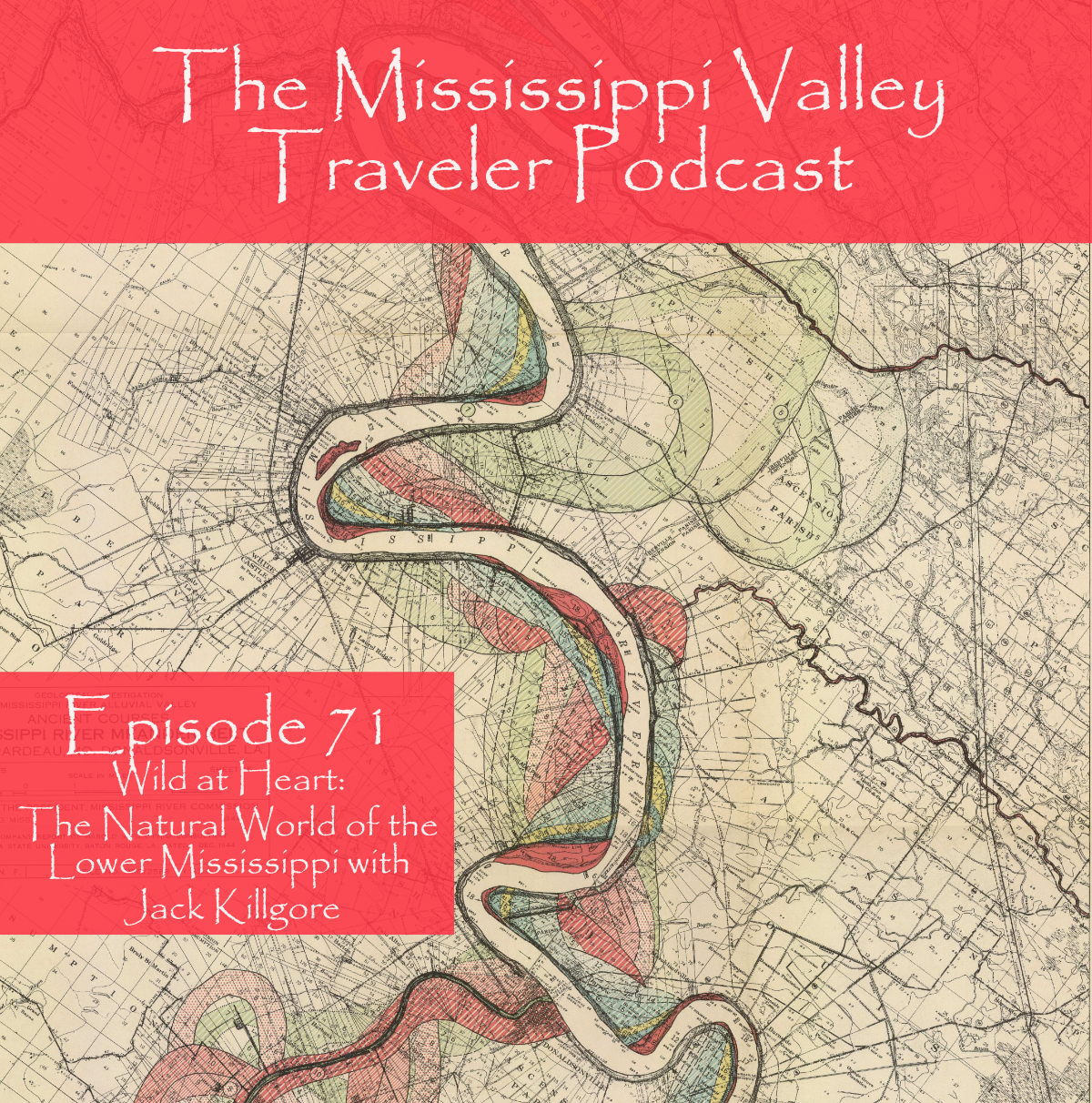
The lower half of the Mississippi grows to an immense scale that is hard to comprehend until you’re sitting on a small boat in the middle of it. In this season of the Mississippi Valley Traveler podcast, we’re going to go deeper into that world, of the lower Mississippi. We’re kicking off this new season with an episode where we dive into the ecology of the lower River. Long-time fisheries biologist Jack Killgore takes us through the past and present of the lower river’s world. We talk about the lower Mississippi before engineers began to remake it, then talk about how human engineering has altered the lower river’s ecology. He describes the significance of the 2,000 miles of uninterrupted channel that run down the Missouri and Mississippi Rivers, and describes work in progress to restore ecosystems harmed by river engineering. We finish with a description of the fish the river sustains, with an emphasis on the big ones, such as sturgeon, paddlefish, and alligator gar, as well as the problems posed by invasive carp.
Show Notes
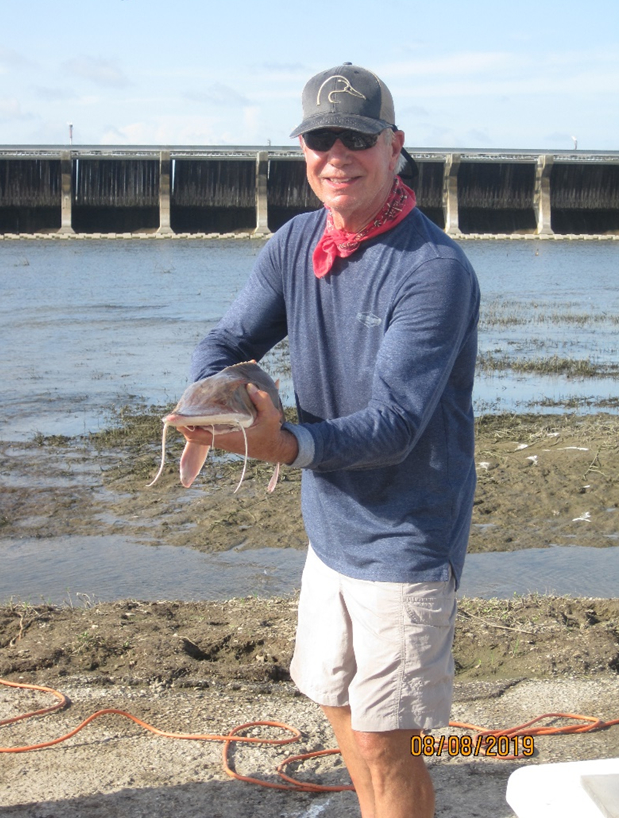
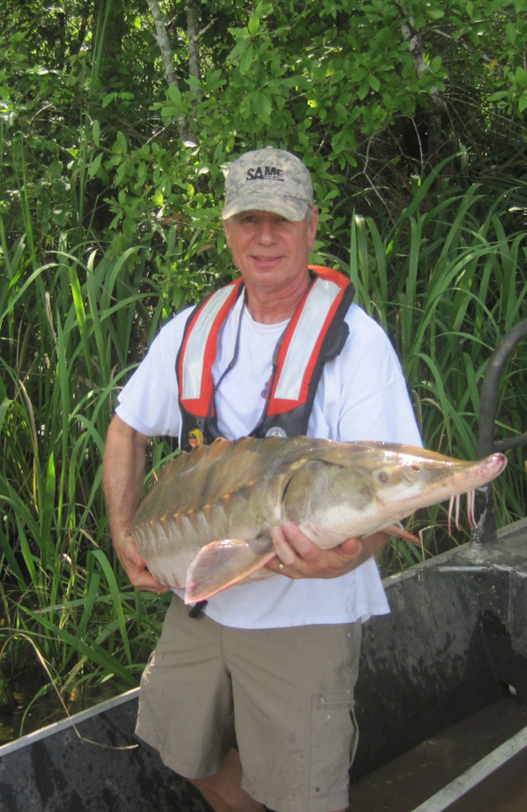
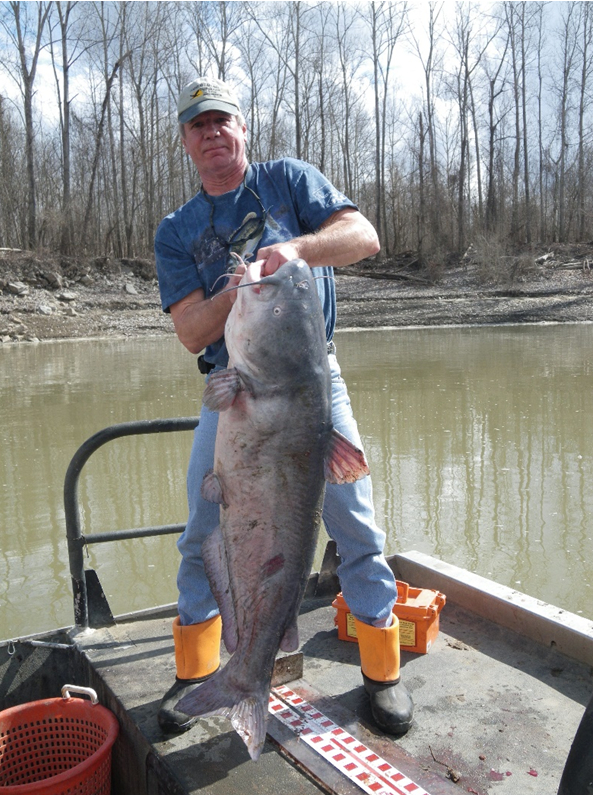
Below are photos of Dr. Jack Killgore holding (left to right): pallid sturgeon, gulf sturgeon, and blue catfish.
Support the Show
If you are enjoying the podcast, please consider showing your support by making a one-time contribution or by supporting as a regular contributor through Patreon. Every dollar you contribute makes it possible for me to continue sharing stories about America’s Greatest River.
Don’t want to deal with Patreon? No worries. You can show some love by buying me a coffee (which I drink a lot of!). Just click on the link below.
Transcript
71. Ecology of Lower Mississippi River
Thu, Feb 26, 2026 2:15PM • 1:04:50
SUMMARY KEYWORDS
Mississippi River, ecology, flora and fauna, aquatic environment, engineering projects, restoration projects, fish species, paddlefish, sturgeon, alligator gar, invasive species, gravel bars, floodplain, biodiversity, habitat assessment.
SPEAKERS
Dr. Jack Killgore, Dean Klinkenberg
Dr. Jack Killgore 00:00
A lot of the flora and fauna that existed before European settlement still exists today. And that’s what people don’t realize, is that we really had no extirpations or extinction of species in modern day. What we have had is a shrinkage, shrinkage of the aquatic environment, and that’s always been one of my goals, is what we have is in a lot it’s very natural. In a lot of ways, it’s still that wilderness value, and I don’t think people appreciate that, because when I talk to folks about the Mississippi today, they tend to think that it’s just a polluted stream that’s been channelized that feeds nutrients to the Gulf of Mexico, and it’s nothing like that.
Dean Klinkenberg 01:10
Welcome to the Mississippi Valley Traveler Podcast. I’m Dean Klinkenberg, and I’ve been exploring the deep history and rich culture of the people and places along America’s greatest river, the Mississippi, since 2007. Join me as I go deep into the characters and places along the river, and occasionally wander into other stories from the Midwest and other rivers. Read the episode show notes and get more information on the Mississippi at MississippiValleyTraveler.com. Let’s get going.
Dean Klinkenberg 01:42
Welcome to Episode 71 of the Mississippi Valley Traveler podcast. Well, welcome back for a new season, for a new year of episodes of the podcast. We’re kicking off this year with a look at the Lower Mississippi, and my first guest of 2026 is Dr Jack Killgore, who’s been a longtime fisheries biologist, mostly with the US Army Corps of Engineers based in the in the Vicksburg District. In this episode, we talk about the ecology of the Lower Mississippi specifically. We talk about what the lower river valley looked like before all of the engineering projects began. We cover some of the flora and fauna and the ecosystems that dominated during that period of time. And we also talk about the changes that we’ve made, the way we’ve re-engineered the river, and the impact it’s had on the flora, fauna and those ecosystems. We talk about the significance of having 2000 miles of free flowing river along the Missouri Mississippi River system, and we get into some of the restoration projects that are underway or planned for the Lower Mississippi to bring back some of the ecosystems and flora and fauna that have been harmed by the way we’ve engineered the river. Then we spend some time really going deep into different kinds of species of fish, especially the big fish that are common along the Lower Mississippi, including paddlefish, sturgeon and alligator gar. It’s a fun discussion. I learned a lot about the ecology of the Lower Mississippi. I think you will as well. So let me know what you think.
Dean Klinkenberg 03:20
I have one quick update I want to share with you. Last April, I was interviewed for Travel with Rick Steves. We recorded two segments about the Mississippi River. The first was a more general exploration of the river the culture places to visit. The second segment, which just aired in January, is about each of the 10 states. He kind of put me through the ringer and asked me to pick a highlight in each of the 10 states along the main stem of the Mississippi. That just aired on January 30, I think. So if you Google “Travel with Rick Steves” and along with my name with Dean Klinkenberg, you should be able to find both segments if you’re interested in listening to those. It was awfully fun, and I’m grateful for the opportunity to be on his national radio show.
Dean Klinkenberg 04:06
You can find the show notes for this episode and access to all the previous episodes at Mississippi Valley traveler.com/podcast for as little as $1 a month, you can join the Patreon community, and you get early access to the episodes by doing so. In addition, you are part of the group that makes this podcast possible. Without the financial support from my Patreon supporters, there would not be a current season of this podcast. So thank you to all of you who stepped up and provide some support. If Patreon is not your thing, you can buy me a coffee go to MississippiValleyTraveler.com/podcast, and at that link, you can find out how to buy me a cup of coffee to support my caffeine habit or to join the Patreon community. Well, let’s get on with the interview.
Dean Klinkenberg 05:07
Beginning in the 1980s Dr .Jack Killgore worked in Vicksburg, Mississippi as a research fisheries biologist at the Environmental Laboratory for the US Army Corps of Engineers, Engineer Research and Development Center, which was formerly known as the Waterways Experiment Station. His research interests include habitat assessment of large river fishes, conservation of endangered species, aquatic habitat restoration, invasive species management and environmental impact analysis for Corps of Engineers, flood control and navigation projects. Although Dr. Killgore has worked in many regions of the United States, his emphasis has always been the Mississippi River and its tributaries. He currently teaches several river science courses as an adjunct professor at Tulane University. He is an enrichment speaker for the Viking Mississippi river cruises, and continues to analyze and publish research results for the Corps as a contractor. Jack, welcome to the podcast.
Dr. Jack Killgore 06:02
Thank you, Dean. I’m very glad to be here.
Dean Klinkenberg 06:04
Well, I’m very excited to talk to you today. A lot of my work has been on the upper part of the river, and I have spent some time on the lower river as well, but I feel like I’ve kind of neglected it to some degree. So this season, one of my goals is to really do a few more episodes that really highlight aspects of life along the Lower Mississippi. And I think you’re a great one to start with. Maybe what we should start with is give me, like an overview of what we know about what the lower part of the Mississippi was like before we started really making changes to it.
Dr. Jack Killgore 06:40
It was a very meandering river. Huge, huge bendways. Many of those were cut off in the 1930s and 40s to shorten the river. But prior to that, you could get lost going into the secondary channels and the sloughs. There was a lot of woody debris in the river. Because, you know, of course, the river is part of a bottomland hardwood forest, so you had a lot of wood. Of course, that became a problem with navigation, and it the the floodplain would would go 100 plus miles, in some cases, when you had major floods. So, you know, it was kind of, I’ve always thought it was kind of like a mini Amazon river, in a way. We can’t compare any river in the world to the Amazon, but it had a lot of those characteristics. So it was, it was just a wilderness at that time.
Dean Klinkenberg 07:43
It’s sometimes hard for, I think for even me too, to think about the scale of the impact of this river. It’s It’s enormous today, and it had a huge impact in shaping the area around there. You mentioned the 100 mile wide floodplain in places it’s hard to imagine today, when you’re driving through the Mississippi Delta, that at one time that was basically swamps and bottomland forest, right?
Dr. Jack Killgore 08:09
Right. It’s, of course, today, it’s all about the dirt that that was deposited by that meandering river, you know, over the 1000s of years, and that’s why you have such a rich soil and some of the agricultural greater than, you know, many places in the world.
Dean Klinkenberg 08:29
And because of the the size and the the impact of the river, it supported a pretty diverse and abundant wildlife. So can you just get a give us a sense of what that flora and fauna would have been like, and those pre-engineered in the pre-engineered rivers world?
Dr. Jack Killgore 08:48
Well, maybe, with a few exceptions, on extinctions, a lot of the flora and fauna that existed before European settlement still exists today. And that’s what people don’t realize, is that we really had no extirpations or extinction of species in modern day. What we have had is a shrinkage, shrinkage of the aquatic environment. And that’s always been one of my goals, is what we have is in a lot it’s very natural in a lot of ways. It’s still that wilderness value, and I don’t think people appreciate that, because when I talk to folks about the Mississippi today, they tend to think that it’s just a polluted stream that’s been channelized, that feeds nutrients to the Gulf of Mexico, and it’s nothing like that. And so yes, there have been changes, but we still have an incredible amount of biodiversity in the river, both the flora and the fauna. I mean, I’m a fisheries biologist, so I’m more familiar with the aquatic life than I am with the plant. Community, but we still have Cypress Tupelo swamps out there. Cypress tupelos were very, very widespread at one time. They were the first that were cut down, but they still exist in some of the scatters and breaks so a variety of habitat types and a consistent flow, and usually you have a connection to the floodplain almost every year, and that’s an important part of the Lower Miss that you don’t find in regulated rivers. The Upper Miss, for example, they don’t really have a seasonal floodplain like you have in the Mississippi.
Dean Klinkenberg 10:39
Yeah, that’s really in some parts of the Upper Mississippi, the valley is so narrow anyway, there wouldn’t be that much floodplain like there would be on the lower Mississippi. What was the value of those seasonal flooding pulses to the life along the river?
Dr. Jack Killgore 10:54
Well, the flood pulse is a flood pulse concept. It’s been studied for years. We ignored it for for a while, but we realized that that annual flood pulse that moves laterally into the floodplain, the fish and other aquatic life follow that pulse. They utilize that aquatic, terrestrial zone that’s that’s being expanded as as the river increases in elevation, and sometimes those floods will stay for months, and then everything shrinks and it comes back into the main stem river, and that’s what feeds the river. The energy, the carbon the young of year begin to thrive and grow. So recruitment of fishes is very, very dependent upon that flood pulse, and that’s why it’s so in a way, it’s a unique because, like I mentioned, if you look at the Arkansas River and many of the other tribs that have lock and dams, you know we don’t have that flood pulse, but we do here in the lower mass. So I tell people, don’t forget that that flood pulse is what drives the biodiversity of the Lower Mississippi River.
Dean Klinkenberg 12:10
Excellent. So part of like, we’ve made a lot of changes to the river over time, and really for two primary reasons, one, to improve navigation. You mentioned the forests and the the wood and the river. And, you know, there are lots of very vivid accounts from riverboat pilots of log rafts and other dangers they encountered trying to drive steamboats on the Lower Miss. And so clearing that was one of the earlier engineering efforts, but also flood prevention for communities and people that lived along the river is another major engineering project. Is it the scale of the levees that line the Lower Mississippi has to be one of the largest engineering projects in the world, ever undertaken. I would imagine. Do you know where it fits in, in terms of human engineering projects?
Dr. Jack Killgore 13:00
Well, it certainly must be, because from Cape Girardeau down to really Baton Rouge, you have what we call the main line Mississippi River levees. But there’s a history of that as well. I mean, the levee, the French started be building levees back in the 1700s around New Orleans, and they would build them three or four foot feet high. And then here comes a flood. And they build them a little bit higher and higher every year, and they never could seem to build them high enough. Well, the Corps ended up having a levee only policy in the late 1800s thinking that if we build these levees, the federal government takes over and builds these levees from Baton Rouge up to Cape Girardeau, then we can contain the greatest flood of record. And of course, we had the 1927 flood, which proved that concept wrong. And that’s when the Corps began to look at other ways of controlling floods, through diversions backwaters and continuing to build the mainline Mississippi River levees higher and higher,
Dean Klinkenberg 14:06
And what has been sort of the general like ecological impact of the changes along the Lower Mississippi. You You’ve already hinted we haven’t lost species, and maybe the world has shrunk some, but tell us a little bit about how the world has changed along the Lower Mississippi with these engineering projects.
Dr. Jack Killgore 14:25
A lot of the what I call backwater or wetland fishes. They suffered the most, in other words, because we shrunk the floodplain down to reduced it by 80% a little bit more than 80% we lost a lot of those swampy backwater areas where you have a unique assemblage of wetland fishes that thrive there, like pirate perch and taillight shiners. I mean, just really small, diminutive fish, but they’re very characteristic of it. That’s what I’ve noticed., Well, when you get into the main channel of the Mississippi River, it really hadn’t changed. People may not realize that, but you still have bendways and straightways and crossings. You have huge sand bars. You have huge gravel bars. You know the although they’ve they’ve been impacted to a certain extent by the wing dams or the dikes, because the purpose of those is to constrict the channel in order to maintain a navigation channel year round, nine to 12 feet here in the lower Mississippi River, at least till you get down to Baton Rouge and and so that that has created what we would call sedimentation along the channel border and the shoreline, because the purpose of dikes is to trap sediment, shrink the channel, constrict it, so you’ll have that that low water channel. So that’s that’s something that we’re dealing with right now with a lot of the ecosystem restoration projects that are going on.
Dean Klinkenberg 16:06
I think one area where you can really see the impact of the the wing dikes is along the Missouri River. There’s some really great historic photos that show what the river’s channel looked like before there were many wing dikes, and then how sediment accumulated along those dikes and really narrowed the channel. We’ll get to the restoration projects in just a minute, but I think, like one of the things that I think I’ve never fully appreciated either until I really started spending time on the Lower Miss, is just understanding how unique it is to have this long uninterrupted channel like I live on, you know, I’ve spent most of my time on the upper mist, where we have locks and dams, you know, every 20 or 30 miles or whatever. But really, there are, what, 2000 or so miles of uninterrupted channel from what around Gavin’s Point Dam on the Missouri River to the Gulf of Mexico. Can you tell us a little bit about why that’s important, why that matters.
Dr. Jack Killgore 17:04
It’s it’s an aquatic highway. It’s a corridor where migratory fish such as sturgeon, paddlefish, buffalo, they they move sometimes over 1000 miles. And the reason we know that is through telemetry studies that we and other agencies have done. We’ll tag fish, put receivers out there, or we’ll put an external spaghetti tag on, and someone catches it and sees my 1-800 number, and they call me and say, We just caught a fish in the Missouri River, and I look it up, well, we tagged it in the Lower Mississippi River. And that’s when I began to realize that a fish can come into the Gulf and go 1200 miles up to St Louis on the Mississippi. Take a left up to Gavin’s point. Like you mentioned, another seven or 800 miles. So you have 2000 miles of free flowing Missouri, Mississippi River. And then I began to research that. I said there’s really no other river in the world except for the Amazon, again, because all the other great rivers that the Yangtze and the Congo and all of them, they have dams near the mouth of the river, and we don’t. Fortunately, they realized that you don’t need a lock and dam in the lower river, because once the Ohio River comes in, there’s usually enough water to float a barge. And so the way that they did it here is they did put dikes in, but we don’t have the the density of dikes in the Lower Miss, as you mentioned in the Missouri River. So you didn’t have those major changes in the channel form here, as you did in the Missouri although the dikes are still there was probably 800 plus dikes in this well, in about 800 miles of river. It’s two to three to four times that [per river mile] in the Middle Miss and in the Missouri River. So that’s, that’s, that’s the result of all the water that we normally get, although we’ve been in droughts here the last couple of years.
Dean Klinkenberg 19:17
Yeah, and we may be heading into another dry year. Who know that we don’t have a lot of snow to melt this year anyway? Let’s talk a little bit about that the world in the main channel itself. When I was working on the Wild Mississippi, I know there used to be kind of a belief among biologists and scientists that the main channel, especially on the river bottom just wasn’t that rich of an environment. There wasn’t a lot of life there. But it seems like we know a lot better now. And there’s, there’s a lot of variety of, I don’t know what the right word is, habitats, like within the main channel itself, slack water areas. Water temperature varies. I guess dissolved oxygen can vary. Different areas. Can you just tell us a little bit about that main channel environment and how much, even that much that can vary?
Dr. Jack Killgore 20:07
Well, the main channel really makes up about 70% of the water volume of the channel itself, from top bank down, I would say. So there’s there’s a lot of habitat, but the reason that we thought that it was somewhat of a barren area is that it’s so hard to sample, you just can’t go out there with the gill net or electroshock and bow, which is some of the traditional tools that fisheries biologists use in order to understand what lives in that main channel. We were able to sample the secondary channels. There’s about little over 100 different side channels, or secondary channels, which are very important to the ecology of the Lower Miss. They’re still functional. We’re still trying to keep them open and connected to the main channel. I mentioned the point bars, the huge, huge sand bars and gravel bars that can go miles and miles that if you you probably walked on them. It is like you’re on the Sahara Desert sometimes, they’re so big. And and you have the dikes, which also form some very interesting habitat types, especially the ones that are notched but almost all the dikes create these scour pools, which are highly used by a variety of fish. They want to get out of the really strong current. They move into the channel border or into the dike fields. And so we see a lot of fish utilizing those structures as habitat. So they’re kind of, in a way, they’re they do have their impacts, like I said, but they also have their benefits to habitat complexity.
Dean Klinkenberg 21:44
How much does the ecology of the of the channel, or the main channel change at the major confluences, like when the Missouri River meets the Mississippi, or the Ohio River merges with the Mississippi, does that change much of the ecology or the nature of what can survive in the river?
Dr. Jack Killgore 22:03
You have a lot of similar species composition all the way through the Missouri and the Mississippi and even the Ohio River. They’re all kind of a pan there. The species that we see here in the Lower Miss, we also find in the Ohio and the Middle Miss, the Upper Miss. There are some exceptions. As you get further north, you get more of your cool water fishes like your walleye, for example. We don’t really see very many walleye here, but we do see sauger, which is very similar to a walleye. So yeah, I it’s, it’s overall, you know, species composition is probably up to about 250 species in the Mississippi River Basin. We have at least over 100 in the Lower Miss that that reproduce in the river. They may be some of them may be transient, but a lot of them are reproducing either in the floodplain, because we do have that intact floodplain, or in the main channel itself.
Dean Klinkenberg 23:10
So tell me a little bit then about what some of the restoration projects are under and tell, what are you, what’s the focus of the restoration efforts? What are some of the larger goals?
Dr. Jack Killgore 23:22
Well, restoration has a long, storied history, and the Lower Miss for a long time was a stepchild in restoration for various reasons, ecosystem restoration in the basin really began in the Upper Mississippi River, which you’ve covered very well in your podcast, and that was due to the navigation expansion program primarily. That’s where the money came in. And the Upper Mess restoration in the Missouri River was a direct result of the Endangered Species Act on pallid sturgeon. So the Corps in that part of the country had to began looking at the population integrity and restoration of sturgeon habitats. Same thing in the Middle Miss. The Middle Miss has restoration program, but it was also a result of the Endangered Species Act on not only the navigation, but also what we call a biological opinion that the navigation prod project could harm the pallid sturgeon. So ecosystem restoration projects started there in earnest in the St Louis district, and they really were the forerunners of going in there and notching dikes and creating islands and opening up secondary channels, but that really hadn’t, the money hadn’t really come into the Lower Miss. But we had one organization that championed that, called the Lower Mississippi River, the LMRCC Lower Mississippi River Conservation Committee, and. And it was begun by Ron Nassar, and now it’s led by Angie Rodgers, but it’s the six states that border the Lower Mississippi River come together, and they develop plans every what they call the slogan, “Restoring America’s Greatest River.” I’ve always liked that slogan, because I because really the Mississippi is America’s greatest river, no doubt about it.
Dean Klinkenberg 25:25
No argument from me.
Dr. Jack Killgore 25:26
You may have some arguments from the Columbia River folks, or, who knows, and so over and they, they began to lobby Congress and and finally, in one of the water resource development acts, they began the the LMRRA. You know, everything in the government has an acronym, but the Lower Mississippi River Resource Assessment, which was our first opportunity to go into a certain stretch which and our first stretch reach a river was near Memphis and about 35 miles. And we and all the states and the federal agencies came together and came up with a list of ecosystem restoration projects, and that is now in Congress, and hopefully we’ll receive money in order to implement some of those restoration projects. So we finally have a federally funded restoration effort going on in the Lower Miss. It’s not anything compared to the Upper Miss, where you have the environmental management program, but it’s the beginning, I think, and people begin to recognize the importance and the quality of this lower river. So I was really excited about that.
Dean Klinkenberg 26:42
Yeah, that’s good when you think about a project like that, and maybe it’s a little bit of both of these. Are you thinking about projects targeting specific species, recovery of specific species? Is it more general about restoring certain habitats? How do you prioritize what kinds of restoration projects to do?
Dr. Jack Killgore 27:02
It’s a little bit of both. We still have to be concerned about the endangered species, which are sturgeon. So some of the main channel type projects are targeting sturgeon, but there are other species that co occur, that are riverine type species that would also also benefit. When we get into the floodplain, we try to look at at species diversity rather than individual species, because there’s so many different species with different lifestyles, different habitat requirements, but they all depend on, say, a connection to an oxbow lake or even the borrow pits that were dug along to build the levees up. They have become very important aquatic habitats for a variety of species as well. So overall, we try to look at a community level assessment rather than individual species. Nothing wrong with the Endangered Species Act. I’m not saying that, but we need to think outside the box to say, how can we benefit the maximum number of species with our restoration projects? And it’s worked pretty well.
Dean Klinkenberg 28:20
All right? Well, you’re a fisheries biologist, so it would be a shame if we didn’t have a chance to geek out a little bit on different kinds of fish species. So why don’t we run through some of the bigger ones first, and maybe, like as we go through these, just tell us a little bit about their habits. You know, what they’re like, what their lives are like, a little bit about them like, let’s just start with paddlefish, like an old species in Mississippi.
Dr. Jack Killgore 28:50
Yes. Well, when I was building our research team, I was able to hire a long term friend and colleague, Dr Jan Jeffrey Hoover, and he and I have worked together for over 30 years, and he has always taken a liking to paddlefish. He’s done a lot of work because they’re so unique. You know, for years, people thought, What in the world is that paddle used for? They thought it was used to maybe muck up the bottom and then they’d open their mouth, but, you know, finally, they realized that that they are eating microscopic zooplankton. And so the the paddle is is a sensor working essentially, and it can detect minute amount of electricity as plankton swim into the water. And that’s how they they live, and that’s why they can get over 100 150 pounds just on microscopic zooplankton. They also make long distance migrations for spawning. They spawn over gravel for the most part, like sturgeon do, so that’s why we’ve been trying to protect and restore gravel bars for those type of species. Unfortunately, they do have the black eggs for caviar. So even though they’re not on the endangered species list, a lot of states regulate their numbers, because if you don’t, then they would be over harvested, just like what we just about did with sturgeon for the caviar market. And, so they’re very primitive fish, and I know you’ve covered it in your book. I just finished reading that book by the way, I enjoyed that.
Dr. Jack Killgore 30:31
They. So they’ve been been around unchanged, more or less, is the time of the dinosaurs. That’s what a lot of people like to say. Kind of like sturgeon, too. So they’re very unique fish, and really the only species of its kind, other than the Chinese paddlefish and the Yangtze but that they think that species is now extinct. So the paddlefish is, is the only one left to that group of fishes.
Dean Klinkenberg 30:57
Thank you.
Dean Klinkenberg 30:59
So I imagine that that paddle with the the ability to sense those minute electrical changes in the water. That seems like something that was probably an adaptation to living in muddy water, maybe.
Dr. Jack Killgore 31:12
Yes, it is. I mean, Shark skates and rays, they, they’re all kind of similar. They still, they also have that capability as well, and yes, and people say, How can, how can anything live in this muddy water where they’re uniquely adapted to muddy water they don’t necessarily have to see. Paddlefish have their electro receptor cells, and catfish have all types of taste buds and can detect movement vibrations in the water, so they don’t necessarily have to see because they evolved in this type of muddy environment.
Dean Klinkenberg 31:50
Well, all right, so let’s move on to sturgeon now, and there’s more than one kind of sturgeon. Tell us first a little bit about what what species of sturgeon are most common in the Lower Mississippi.
Dr. Jack Killgore 31:59
Okay, well, based upon our trotlining, and we put out 1000s of trotlines, that’s how we sample the bottom of the Mississippi River. It was years ago. We were coming into a boat ramp on the Big Sunflower River, Mississippi, and commercial fisherman was taking his boat out, and it was full of buffalo. I never will forget that scene. So we started talking to him, because we’re fisheries biologist, and I asked him, I said, Have you ever caught sturgeon in the Mississippi? He said, I catch ’em all the time on trop lines. Well, the next thing you know, we contract with this commercial fisherman. His name is Bill Lancaster, and we worked with him for 15 years, and like I mentioned, put out 1000s of trotlines, and what we found is that blue catfish is a number one, large bodied fish on the on the bottom of the Mississippi River. But number two is shovel nose sturgeon, which kin to the pallid, but they’re much, much more abundant compared to the pallids. And then you have your pallid sturgeon, which is the second type of sturgeon that lives in the Mississippi. We get lake sturgeon coming out of the Great Lakes, moving south, and they have been stocked, and their populations have been recovering quite a bit, and we’re starting to pick them up here in the Lower Miss. And then you have the gulf sturgeon, which comes really, it prefers just to live in the Gulf Coastal tributaries like the Pearl and the Pascagoula, but sometimes they’ll come up the mouth of the Mississippi, you know, into that lower reach. So we have four species of sturgeon here in the Mississippi River.
Dean Klinkenberg 33:42
Was it the shovelnose that were the smaller, the smallest of the species, and then the lake sturgeon were the big ones?
Dr. Jack Killgore 33:50
Yes. Well, the lake sturgeon, can get up several 100 pounds. The pallids here in the Lower Miss, very rarely get up to 10 to 15, although they can get up to 50 pounds in the in the Upper Missouri and but the shovelnose are typically anywhere from five to six, seven pounds. That’s a big shovel nose.
Dean Klinkenberg 34:16
So you mentioned paddlefish need gravel bars to complete their life cycle, to reproduce. What are what kind of settings or characteristics to the sturgeon need for reproduction?
Dr. Jack Killgore 34:29
Well, it’s the gravel bars are usually located in the upstream reach of these bendways. You could look at right where the Ohio comes in. There’s a lot of gravel bars. The floodplains not as expansive as it is as you go further south, but there’s a lot more gravel but then as you go further south, the gravel bars diminish. Once you get below Natchez, you very rarely see gravel bars again, but the other but the other part of that is that the batture is, the land between the levees, increases as you go downstream, so you have a wider floodplain. The gravel is is a primary substrate for a variety of riverine fishes for spawning and even rearing. Unfortunately, with dikes, that’s where a lot of the dikes are in the upper part of a bendway to push that water towards the outside bendway and we cover the gravel bars. So we’ve been monitoring and surveying gravel bars, trying to maybe change the dimensions of dikes in order to scour sand off of gravel that used to be there, and that’s that’s something that’s ongoing. We want to preserve gravel bars. To me, gravel bars are not only important for spawning and rearing, but they are also part of the geomorphology of the river that are important and kind of keeping that channel in place maybe preventing head cuts from happening. There’s a lot of advantages, and also, there are windows of time you’ve probably walked on gravel bars, Dean, anytime we have a lunch break, we head for if there’s a gravel bar, that’s where we’re heading, and we look, and we’ll find artifacts of sunken steamships. We’ll find Indian beads. We’ll find paleo animal bones, not all the time, but you know, we’re all looking for them. They are windows of time for the for the Mississippi River.
Dean Klinkenberg 36:37
Hey, Dean Klinkenberg here, interrupting myself, just wanted to remind you that if you’d like to know more about the Mississippi River, check out my books. I write the Mississippi Valley Traveler guide books for people who want to get to know the Mississippi better. I also write the Frank Dodge mystery series that is set in places along the Mississippi. My newest book, The Wild Mississippi goes deep into the world of Old Man River. Learn about the varied and complex ecosystems supported by the Mississippi, the plant and animal life that depends on them. And where you can go to experience it all. Find any of these wherever books are sold.
Dean Klinkenberg 37:15
Oh, they’re fantastic to wander around. I learned a lot about geology and such, walking around the gravel bars with John Ruske from the Quapaw Canoe Company and some of the other folks, some of his other guides. They are they’re remarkable places. All right, so the gravel bars are important. Are there? So which species of sturgeon are struggling right now? Then you said shovel nose seem to be pretty abundant which ones are having a harder time?
Dr. Jack Killgore 37:43
It’s the pallid sturgeon, and there’s several reasons for that. One of them is that we do. We built dams in the historic migratory pathways. But I think more importantly, there was an unregulated caviar market. And since the pallids were the larger of the two, that’s a lot of times they would be targeting large gravid females. And recent time, with the advent of genetics, the geneticists are telling us that the shovelnose and the pallets are hybridizing with each other. So we don’t really have purebred pallets in the Lower Miss. They’re mostly confined to the Upper Missouri, but I’m telling you, you know we we catch a pallid and we can identify it based upon its outside characteristics, and it looks a lot different than a shovelnose. You have to have a trained eye, but they are very similar to each other, and there could be hybridization going on. It appears that there is.
Dean Klinkenberg 38:46
Yeah, I don’t know if you know this off the top of your head, but like, just how, how big is the caviar market? Like, how, how much caviar is, you know, produced or harvested from the fish in the Lower Mississippi?
Dr. Jack Killgore 39:01
Well, for sturgeon, now since pallids are federally endangered, they listed the shovelnose under the similarity of appearance rule, because a lot of people can’t tell them apart. So that really eliminated the caviar market. Almost through the entire Mississippi River Basin, there are caviar ranchers, I guess, where they’ll grow out sturgeon, and they’ll get the caviar from there. They also, like I mentioned, get caviar from paddlefish, that it’s regulated, it’s highly washed, but that’s another way they both in the I mean, they’ll they’ll find eggs almost any type of fish, and if they taste decently, I guess they become caviar. But the caviar market has really shrunk dramatically. It used to be a mainstay for commercial fishermen, and you just don’t see that like that today anymore.
Dean Klinkenberg 39:59
Yeah. Well, let’s move on to another big fish. Let’s talk a little bit about alligator gar. So tell us. I don’t think there may be as numerous in the main channel the Mississippi as they might be in some other rivers, but tell us a little bit about these beasts.
Dr. Jack Killgore 40:17
Well, surprisingly, we’re seeing more and more alligator gar pop up in our surveys, not only our surveys, but other state and federal agency because they they were really a misunderstood fish. They were considered a rough fish, and so they put a bounty on their head trying to eliminate the apex predator of the Mississippi River. But they didn’t think of it that way back in those days, they just thought that these alligator gar, because they get 300 plus pounds, are eating their precious sport fish, their bluegill, their bass, and so they put a price on their head, and they just about wiped them out. But now we appreciate alligator gar, plus they can be a predator on the invasive carp and and, and, like I said, they are one of the top predators, so they’re now stocking alligator gar back into the river, and we’re seeing their numbers increase in our trawling samples, we’re picking up occasionally alligator gar along the main channel the Mississippi River. Of course, we know they kind of prefer those backwaters, and they spawn in backwaters over vegetation. But the alligator gar, I think, has a more positive outcome than it did 20 years ago, for sure.
Dean Klinkenberg 41:34
They get, they can get enormous in size. I forget the exact stats, but like there were, the largest one ever caught was somewhere around Vicksburg, maybe five or six years ago, maybe a little bit more was what, 300 pounds.
Dr. Jack Killgore 41:49
That’s right, that’s right, it was, it was caught by a commercial fisherman in one of our lakes just north of Vicksburg, Mississippi here. And it just shows you that we still have very large alligator gar and they’re great. I mean, who wouldn’t want to catch a 300 pound fish? I tell well, you can catch them and you can eat them, just don’t eat the eggs, because the green eggs are poisonous to humans or to to mammals.
Dean Klinkenberg 42:17
And they look scary, but they’re not aggressive toward people at all, as I understand it, right?
Dr. Jack Killgore 42:22
That’s right. The there have been studies. The river monster series did a series down here to see if alligator gar actually attacking and killing people. There have been some reports of alligator gar attacking a person. But it’s probably, you know, not directly. It may, they just may have thought it was some other type of food. So no, there’s never been a report of alligator gar attacking or killing a human that I’m aware of.
Dean Klinkenberg 42:56
So, what are their main, what’s the main source of their diet? What do they prefer to eat?
Dr. Jack Killgore 43:00
That’s another thing is they’re not eating the sport fish. They’re eating shad, gizzard and thread fin shad, which is the primary forage base for a lot of your top predators in the Mississippi River. And there are millions and millions of shad. So it’s not, not like we’re not we’re going to lose shad. And that’s why they are successful, because there is plenty of habitat, there’s plenty of spawning area, and there is plenty of food for them.
Dean Klinkenberg 43:32
So I know that we’ve we’ve had folks who have talked about the impact of removing apex predators on land from land ecosystems like the removal of wolves and the impact that had particularly on things like deer populations. What was the impact in the fisheries in the Lower Mississippi of losing an apex predator like those alligator gar?
Dr. Jack Killgore 43:53
Well, it’s really hard to say. I and you know, but if you go back 40 years when the invasive carp began to appear in the river system, and it was about the same time that alligator gar were being eliminated, because they are considered rough fish, and an invasive carp can grow so quickly that they outgrow the mouth size of a lot of your other predators that could possibly eat them, whereas alligator gar, you know, they could chomp down a 10 pound silver carp, and no problem at all. So that may have been one reason that we saw the expansion of invasive fish. It’s hard to say. You know, when you take an apex predator out of a population of fish, it’s, you know, it’s still unknown. I guess is exactly how that came about. But most people say justify the the development of aquaculture facilities for alligator guard as one biological control for invasive carp.
Dean Klinkenberg 45:04
All right, go alligator gar, right,.
Dr. Jack Killgore 45:07
That’s right.
Dean Klinkenberg 45:07
I want to get to the invasive fish in just a minute. But we can’t talk about the Mississippi and not at least touch on catfish. And you mentioned briefly the blue catfish, which are the biggest of the species. Tell us a little bit about the variety of catfish in the Lower Mississippi, and one or two things that maybe people don’t know about, their habits, or their life, life cycle, or whatever.
Dr. Jack Killgore 45:29
Well, we have three species of large bodied catfish. The blue cat is by far the well, not by far, but it’s the largest, I think the record’s about 130 pounds. And then we have the flatheads. They get up about 100 pounds. And then we have the channel catfish. That may be maximum 50 pounds. We don’t see as many channel cats as we do blue cats. Blue cats are by far the number one catfish in the Mississippi River, and that’s why you have these catfish tournaments, and they’re all targeting mostly blue catfish, because they do get very large. One of our studies have shown, though, that as you get further, as you go further south, you tend to get more blue catfish, and they also get larger. And it could be because you get that estuarine species coming up from, you know, up to north towards New Orleans, and you have a bigger food base. But it’s still unknown exactly why that trend shows in this but, but there’s a lot of catfish. Everyone that fishes the Mississippi River usually either goes after the catfish or the white bass in the main channel the Mississippi sometimes you’ll even get a striped bass, but, but it’s mainly the the catfish that sustains, really a growing trend of catfish tournaments up and down this river.
Dean Klinkenberg 46:58
So how far north do the blue catfish range? Because I know we don’t have them on the Upper Mississippi like about how far north is the northern extent of their range?
Dr. Jack Killgore 47:08
Well, I don’t know we we did some studies in the Upper Miss probably up to Rock Island, if I remember, we were catching some blue cats up there. I’m not as familiar with the species composition in the Upper Miss as I am in the Lower Mess. But I know blue cats have also been transplanted into other regions that they aren’t native and and they create a problem. And flatheads too. They don’t they become, all all of a sudden, they become an apex predator on native fish that that are native to that area.
Dean Klinkenberg 47:46
So, so catfish, yeah, what’s their diet? What do they like to eat?
Dr. Jack Killgore 47:52
The the flatheads typically only eat live fish, or you, you can also get them on cut skipjack, herring and worms, night crawlers, but it’s primarily fish. Blue cats eat the shad almost anything that they encounter, because there is a lot of different minnows and darters. They’re small, but they drum, buffalo, they co-occur with the catfish. We see those in their diet. So they’re opportunistic, is really what they are. They’ll eat anything that gets close to them. And I guess that’s why they’re so successful and so numerous, is they do have a variety, a very diet that allows them to switch seasonally or even based upon the location they’re in.
Dean Klinkenberg 48:43
So other than those fish that we just touched on, what were some of the other most populous species in the Lower Mississippi?
Dr. Jack Killgore 48:51
Buffalo. There’s three species of buffalo. Buffalo, in many cases here in the south. If you go to the fish market, people are buying the buffalo fish rather than the catfish. They they consider buffalo a delicacy, especially buffalo ribs, which are very good. I’ve eaten them before. So you have the big mouth that are mainly in kind of the backwaters. The small mouth buffalo is the most common. But then you have the black buffalo, which are just super big and strong. They’re just an impressive fish when you catch them. But they’re they’re fairly common. They’re doing very well in the Mississippi River. Drum, freshwater drum. When you’re out fishing, for example, you’ll see your pole go boop, boop, boop. And that’s usually one of those bait stealers, those freshwater drum trying to nibble at the worm or whatever. But, but they can get to be 20 or 30 pounds themselves. So they are interesting fish. They’re the only freshwater drum that we have all the other drum or usually associated with the estuarine or coastal environment, like your redfish and spotted sea trout, they’re also in the drum family. What people don’t realize, though, is the smaller fish we have, these fish called the these little minnows and chubs, a shoal chub, shoal chub is what it’s called. There are probably millions of those, and they are eaten by pallid sturgeon, but, but there’s the different minnows and shiners, and there’s, we have a few darters here that are very impressive, the river darter, the crystal darter, which is one of the largest darters in North America. So there’s a variety of fish in that main channel. It is not a barren habitat, but the reason, like I said earlier, is that it’s so hard to sample, and it’s dangerous to sample in some cases.
Dean Klinkenberg 50:53
Right. I’m sure you’ve got some stories about, you know, putting yourself at risk. You probably didn’t need to, just to do a little bit of sampling. But do you have anything, any memories at the top of your head where you found yourself in a difficult spot when you were trying to do your research?
Dr. Jack Killgore 51:09
Well, yes, you know, we’ve we’ve been entrained by high currents before. I think, really though, I’ve worked with seasoned river people that you know, knock on wood. We’ve never had any major incidences over the 30 plus years I’ve worked on that river. We’ve had a lot of close calls. One case, I know, we lost a lower unit on a dike. We didn’t know it was there. And you know, if you’re out there, you have to watch out for those stone dikes, because they will take your lower unit off. Or, even worse, I so I’ve I just, you know, it’s a thrill to be out there, and that’s that’s one reason that it amazes me, is, is just the wilderness and the grandeur of it all. I tell people that you can look one way and see exactly what Mark Twain saw as a cub pilot, and then you look another way and you can see all the river engineering work. So it’s this dual kind of capacity that you that you deal with there. But so yeah, I don’t know. We’ve had a few other incidences that they’re kind of sad finding, you know, some some people there. But other than that, it’s we’ve been very fortunate that over the years, we’ve been able to get on and off that river without any major mishaps. And it’s the people that I’ve worked with that smart, and they know the river, they know how to operate boats, and that’s been an important part of it.
Dean Klinkenberg 52:45
Well, let’s wrap up the fish discussion by talking about some of the invasives then up in this part of the river, the big head and silver carp get a lot of play because they’re exciting to film as you’re taking a boat through those areas, I assume they must be present in the Lower Mississippi too. I don’t know that I hear as much about them being as problematic, but, you know, tell us a little bit about the status of of the invasive fish along the lower Mississippi.
Dr. Jack Killgore 53:12
Okay, well, they began and they were initially introduced into the Lower Mississippi River. Came out of Arkansas. They common carp were brought in in the late 1800s as a food fish, although no one likes to eat them, and that’s how carp got a bad name, I think, because common carps aren’t nearly as tasty as your big heads and silvers. But then in the in the ’50s, 1950s and ’60s, they started bringing in grass carp to eat the problem aquatic vegetation. Well, they escaped into the Mississippi River and began establishing reproductive populations. And we catch them, continue to catch them today. But then they brought in the big head carp and the silver carp to eat plankton, because they’re planktivores out of the aquaculture ponds, and they escaped, and they establish reproductive populations. So it all began in the Lower Mississippi River. And from that point, these fish, the silver the big head, the grass carp, and then later on, the black carp, that’s the most recent introduction. They were brought in to eat these snails out of catfish ponds, which were intermediate host for a parasite. Well, they escaped, and now they are reproducing in the Mississippi so, so they began to expand, because they need flowing water to reproduce. Well, there’s plenty of flowing water in the Mississippi River, and then they need backwater habitat for rearing. Well, there’s plenty of backwater habitat the oxbow lakes and and the meander scars and everything that that exist. So they found it like a buffet, and they just began to grow their numbers and go move north and move south. And of course, that’s why, eventually, the Chicago district put in the electric barriers to keep them out of the Great Lakes. But they we’ve also found their move south, and they do have a little bit of tolerance to salinity, so they can move in to slightly saline water, maybe up to 10 parts per 1000. So now they could move along the coastline and get into the coastal waters like the Pearl, Pascagoula, Mobile. Maybe someday they’re coming down the Tennessee River into the Tenn-Tom. They’re trying to keep them out of the Tenn-Tom, because then they do get into the Mobile. So it’s, it’s a pandemic, really, it’s, they’re fine. We’re finding them almost everywhere. And they do jump, as as everyone knows, the silvers will jump. They’re they get 25 to 30 pounds. And if you get hit by one of those fish, you know it, I’ve been hit so many times, I’ve got a black eye. But you know, it’s I tell people, unless Americans really develop a taste for carp, like they have in Europe now, people consider carp a delicacy, and not a lot of parts of Europe and in Asia, they’re the number one cultured fish in the world. If you don’t do that, then we’re just going to have to deal with them like we have to deal with fire ants down here. They’re, they’re not going anywhere, and just have to be careful and aware that when you’re in an area, they can jump and they can’t hit you and they can’t hurt you.
Dean Klinkenberg 56:33
Yeah, I’ve been struck a couple times in a canoe, of all things. So it’s, it’s unpleasant, but it is memorable. It does make for a good story after.
Dr. Jack Killgore 56:44
You know, Dean, it’s interesting though, that they, you know, they really haven’t altered, in my opinion, the community structure of main channel Mississippi River. Where they do have an impact is getting into the backwaters, where they become one of the dominant fish, and they disrupt nest building fish. Like sunfish, like your bass and your bluegill, they compete for food, and that’s where you’re seeing the impact to our native fishes, not necessarily in the main channel. Not to say that something may change over time, but that’s just been the recent trend that I’ve noticed.
Dean Klinkenberg 57:19
Right. So those are the those species in particular that you mentioned, the bluegill, they’re the ones that are most threatened by the presence of the the invasive carp.
Dr. Jack Killgore 57:29
Yes, any nest building fish. Because what happens is those carp get into these lakes where, you know the bass and the bluegill, that’s where they construct their nest. But then you get this hoard, this school of carp coming in there, and they’re they’re rooting around, and then they scare away the adults that are protecting the fish, and then other fish come in there and gobble the eggs. In other words, they disrupt the entire nest building and rearing process of your sunfishes and other other kind of fish that that that spawn along in shallower water.
Dean Klinkenberg 58:08
Have you noticed a decline in those kinds of fish, or those fish adapting and finding somewhere else to nest?
Dr. Jack Killgore 58:14
Oh no, we’ve noticed. And really it’s, it’s, it’s the public that’s noticed more. We’ve been called to several meetings, and people go, how come we’re not catching bluegill and bass and crappie in our lake anymore? And they say it’s because of those dadgum carp are in there, affecting their populations. And it’s probably true, you know, because it’s it could be other things, but you would think that that hordes of these carp moving in are going to disrupt any kind of native fish community, and that’s, apparently was what happening.
Dean Klinkenberg 58:51
I will put into play. I can’t say that I’ve eaten silver carp or big head I don’t remember. I’ve had smoked carp from a fish market up on the Upper Mississippi. So it was probably common carp. Probably common carp. I thought it was delicious, you know, smoked carp. It was almost as good as smoked salmon in my book.
Dr. Jack Killgore 59:09
Yes, it is. They renamed it down in New Orleans, called a copi for copious and there’s a chef down there that has renamed it and trying to get people to eat it. So they are good eating fish. They have a lot of inner muscular bones, so you have to really know how to deal with that. But as far as their their white sweet meat, it’s, it’s, it’s the best. I mean, it’s, I don’t want to go that far, maybe, but they are good to eat.
Dean Klinkenberg 59:44
Well, maybe we’ll continue to campaign for people to be more adventurous eaters and try more carp. There’s certainly plenty of that available for us to sample from. You know, I forgot to ask you at the very beginning, and maybe this is a good way to kind of wrap things up a little bit, but you’ve been working along the Mississippi for a long time. What? What is it about the Mississippi that got your attention and keeps you coming back so so many years?
Dr. Jack Killgore 1:00:13
Well, even as a boy, you know, reading Mark Twain’s books, I was always fascinated by the Mississippi. I I had no idea that once I joined this organization, this research organization with the Corps called the waterways Experiment Station. Next thing I know, I’m right on the banks of the Mississippi River, even even before that though, I mean, growing up in Northwest Arkansas, my buddies and I, we would on the weekends, we grab our battered aluminum canoes and head for the river. So I always have been fascinated with the rivers, and it was always my goal to try to get projects, research projects and monitoring on the Mississippi River. It took about 10 years once I joined what the Waterways Experiment Station, which is now called the Engineer Research and Development Center. I’m just recently retired from there, but it was a dream come true, Dean, and I have enjoyed every minute of it, and I miss it. In fact, I fish with my own boat out there, so I still get out on the Mississippi River. I plan on continuing to fish as long as I can, but a lot of times it’s not fishing. I’ll just take some one of these inlets and go into the backwaters, and it’s like a jungle back there and and that’s always amazed me, is just the isolation that you can feel. And then there’s just a tremendous diversity and abundance. We would put out trotlines with 60 hooks, and in the winter, we would bring those trotlines in, and there was a fish on every single hook. They filled the boat up. And that hasn’t changed. That still occurs today. So there’s a lot of reasons, and I’ve been very thankful that I’ve had the opportunity to work for such a wonderful organization like like the Corps, with the Engineer Research and Development Center.
Dean Klinkenberg 1:02:08
Do you have a favorite spot or two that you don’t mind giving away?
Dr. Jack Killgore 1:02:13
Oh well, I mean, locally here, I you know, there’s a place here, it goes back into the Civil War history where Grant was here he was trying to cut off the bendway of the Mississippi River. Well, that didn’t work. Well, mother nature did it right at the turn of the century, and left Vicksburg high and dry. So they moved the mouth of the Yazoo River, so it will flow in front of Vicksburg. And the reason I’m telling you that is where the former mouth is, you can enter that and go way back into the swampy areas. And it’s just, it’s, you know, you get a feeling of the way it was before all the alterations occurred. That’s one of my favorite areas. And then I also fish with a professional fishing guide, a blue cat fishing guide, Bob Crosby, and he takes me to places that he’s found. And I’m not sure if I should tell you what those places are, because it’s one of his favorite fishing holes. He catches these big catfish, but it’s around Vicksburg, so you can go almost anywhere, up and down this river and find adventure, isolation and wilderness. It’s just a wonderful time out there.
Dean Klinkenberg 1:03:26
Fantastic. Jack, thank you so much for taking the time to talk with me today and share your expertise, and I really appreciate you taking this time this morning.
Dr. Jack Killgore 1:03:38
I’ve thoroughly enjoyed it. Thank you, Dean, I really enjoy your podcast.
Dean Klinkenberg 1:03:43
Thanks. Keep up the good work out there, saving our fisheries.
Dr. Jack Killgore 1:03:47
I’m a cheerleader for ’em.
Dean Klinkenberg 1:03:50
Thanks for listening. If you enjoyed this episode, subscribe to the series on your favorite podcast app so you don’t miss out on future episodes. I offer the podcast for free, but when you support the show with a few bucks through Patreon to help keep the program going, just go to patreon.com/dean.klinkenberg, if you want to know more about the Mississippi River, check out my books. I write the Mississippi Valley Traveler guidebooks for people who want to get to know the Mississippi better. I also write the Frank Dodge mystery series that’s set in places along the river. Find them wherever books are sold. The Mississippi Valley Traveler podcast is written and produced by me, Dean Klinkenberg. Original Music by Noah Fence. See you next time.